
Quick answer
Can you put mascara on lash extensions? You can, because extensions are semi-permanent, but Alessia Simonetta, owner and master lash artist at Luxury Lash Lounge, highly recommends against it. In her experience, mascara and eyeliner contain oils that break down the adhesive bond and will most likely make your extensions shed prematurely.
If you still want it for an occasion, most lash techs suggest one thin coat of non-waterproof mascara on your lower lashes or the tips only, removed gently that night with an oil-free product.
Can you put mascara on lash extensions?
Yes, it is possible, but it is rarely worth it. A set already gives you dark, curled, longer lashes, so mascara adds little and makes your extensions harder to keep clean.
From our studio: Alessia tells clients they're free to wear mascara or eyeliner, because lash extensions are semi-permanent, but she highly recommends against both. In her experience, the oils in these products break down the adhesive bond, so the extensions will most likely shed prematurely.
Most lash techs give clients the same advice, for the reasons below.
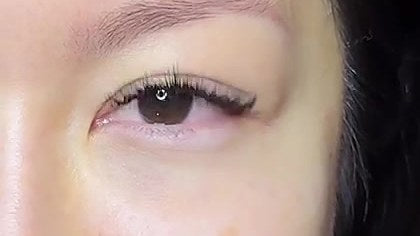
Why most lash techs say to skip mascara
- It clumps the set. A wand coats several extensions at once and can stick them together, so the soft, separated look of your set is lost.
- It builds up at the base. Residue collects next to the bond, where it is hard to wash out. The American Academy of Ophthalmology (AAO) notes that eye makeup can cause irritation if it is not removed properly.
- It takes more rubbing to remove. The AAO warns that rubbing, tugging or pulling can fracture your natural lashes and even cause permanent damage to the eyelash follicle.
- Removing it can loosen the bond too. Lash techs advise against oily removers near a set, and find waterproof mascara especially hard to remove without oil or a lot of rubbing.
- It has to come off before a refill. Natural lashes should be clean and fully dry before extensions go on, to help the glue hold. Any residue has to be washed out first.
What happens if you put mascara on lash extensions?
Lash techs commonly see these effects build up with regular use and rough removal:
- extensions that look clumped and spiky instead of soft and separate
- dark residue around the base of the set, close to the glue
- extensions shedding prematurely, which Alessia puts down to the oils in mascara breaking down the bond
- strained natural lashes from the extra rubbing
- irritated eyes if makeup is left on overnight or not fully removed
If you have already worn mascara on your set, don't scrub or pick at it; take it off with the gentle steps below.
Lash extensions vs mascara: do you still need it?
For most people with extensions, no. The point of a set is that you wake up with defined lashes, without applying and removing mascara every day.
| Lash extensions | Mascara | |
|---|---|---|
| What it is | Synthetic fibres attached to your natural lashes by a trained lash tech | A coloured coating you brush onto your own lashes |
| What it adds | Length, curl and fullness that stay between refills | Colour and definition for the day |
| Upkeep | Refills as your natural lashes shed | A new tube about every three months |
| Main risks named by the AAO | Eyelid or cornea injury or infection, allergic reaction to the glue, temporary or permanent lash loss | Bacteria growing in the product, irritation if it is not removed properly |
Read what lash extensions are and how they work for how a set is applied, and our lash extension aftercare guide for daily care.
EyeWiki, the AAO's online eye encyclopedia, says people with existing eye disease or a history of allergy should avoid extensions. It adds that they may consider mascara as a safer alternative if used properly. If that may be you, ask your eye doctor before you book.
If you still want mascara: how to wear it with the least risk
Keep it light, keep it away from the bond and take it off the same night. That is what most lash techs tell clients who want to use mascara on lash extensions for an event or photos.
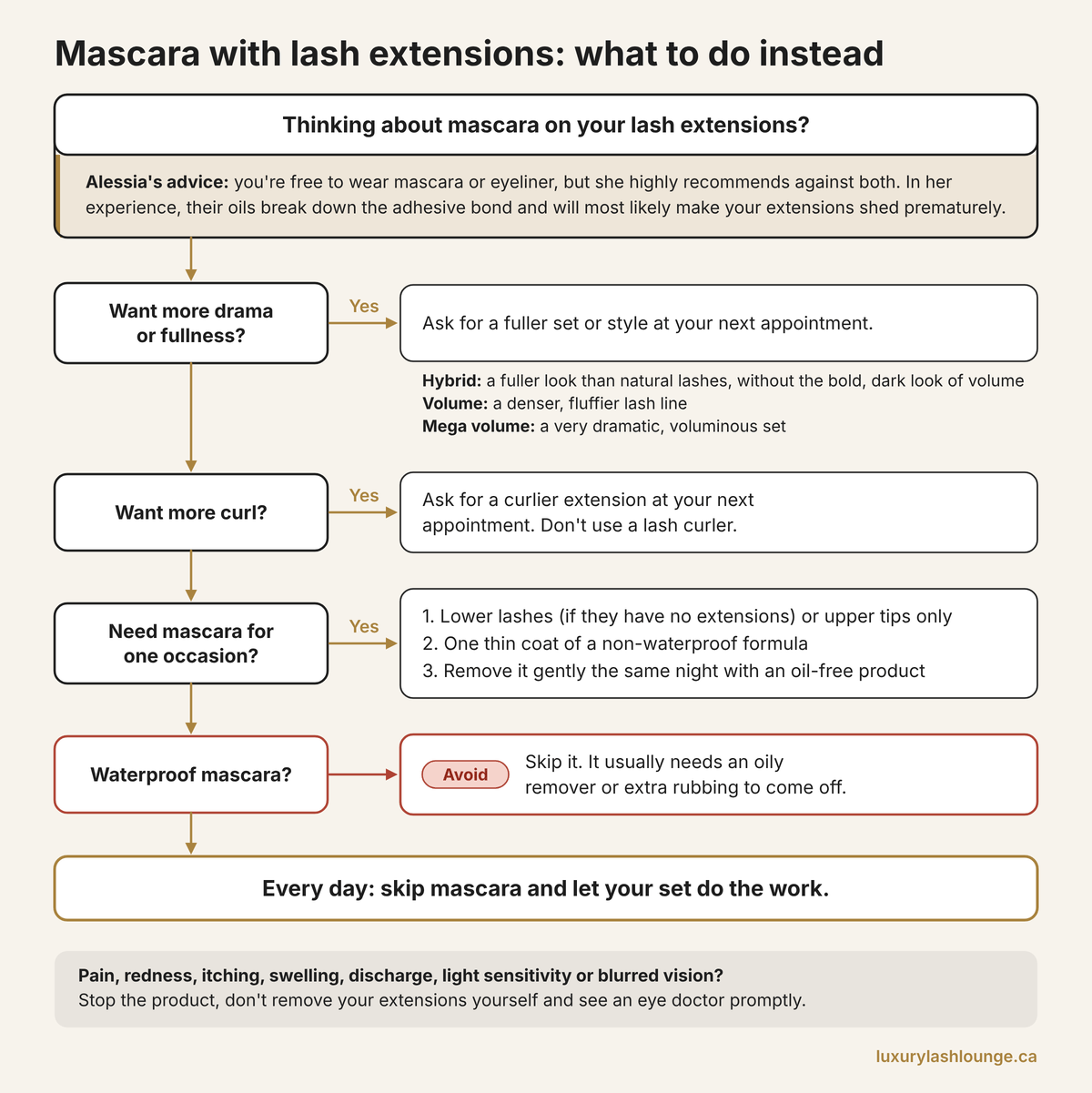
Where to put it
- Lower lashes first. If your lower lashes don't have extensions, a light coat there adds definition without touching your set.
- Upper tips only. If you want it on top, brush one thin coat onto the outer ends of the extensions, never at the base where the glue sits.
- One coat, no layering. Layering builds clumps and residue.
- Stay outside the lash line. The AAO advises keeping all makeup outside the lash line, away from the eye.
Choosing a mascara to wear with extensions
Read the label, not just the front of the tube, and look for:
- Non-waterproof. Most lash techs say to avoid waterproof formulas, because they are designed to resist water and usually take an oily remover or extra rubbing to come off.
- Easy removal. Choose a formula whose directions say it comes off with warm water or a gentle cleanser.
- Made for the eyes. The AAO says to use only cosmetics designed for use around the eyes. The US Food and Drug Administration (FDA) adds that some colour additives approved for cosmetics in general are not approved for the eye area.
Mascara hygiene rules that still apply
Extensions don't change the basic eye makeup rules from health bodies:
- Replace it. The AAO says to throw eye makeup away after three months, and the FDA notes that manufacturers usually recommend discarding mascara two to four months after purchase. In a small 2008 study of 40 women using non-waterproof mascara daily for three months, 36.4% of the returned tubes grew microbes.
- Never share it. Health Canada, the AAO and the FDA all say not to share eye makeup, and the AAO suggests avoiding store samples altogether.
- Keep it clean. Health Canada and the FDA advise washing your hands first and never moistening mascara with saliva. The FDA also says to throw dried-up mascara away.
- Stop during an infection. With an eye infection such as pink eye, the AAO says to throw out all your eye makeup.
How to remove makeup with lash extensions, step by step
Use an oil-free product, a soft brush and a light touch, then rinse and brush your lashes into place. The AAO's general advice still applies: remove all eye makeup before you sleep, keep remover out of your eyes and rinse it off your eyelids thoroughly.
You'll need an oil-free remover for the skin around your eyes, an oil-free foam lash cleanser with a soft brush, a clean spoolie and a lint-free swab. Our Lash Cleanser Kit pairs a 60 ml oil-free foam with a cleansing brush, and its product page lists every ingredient.
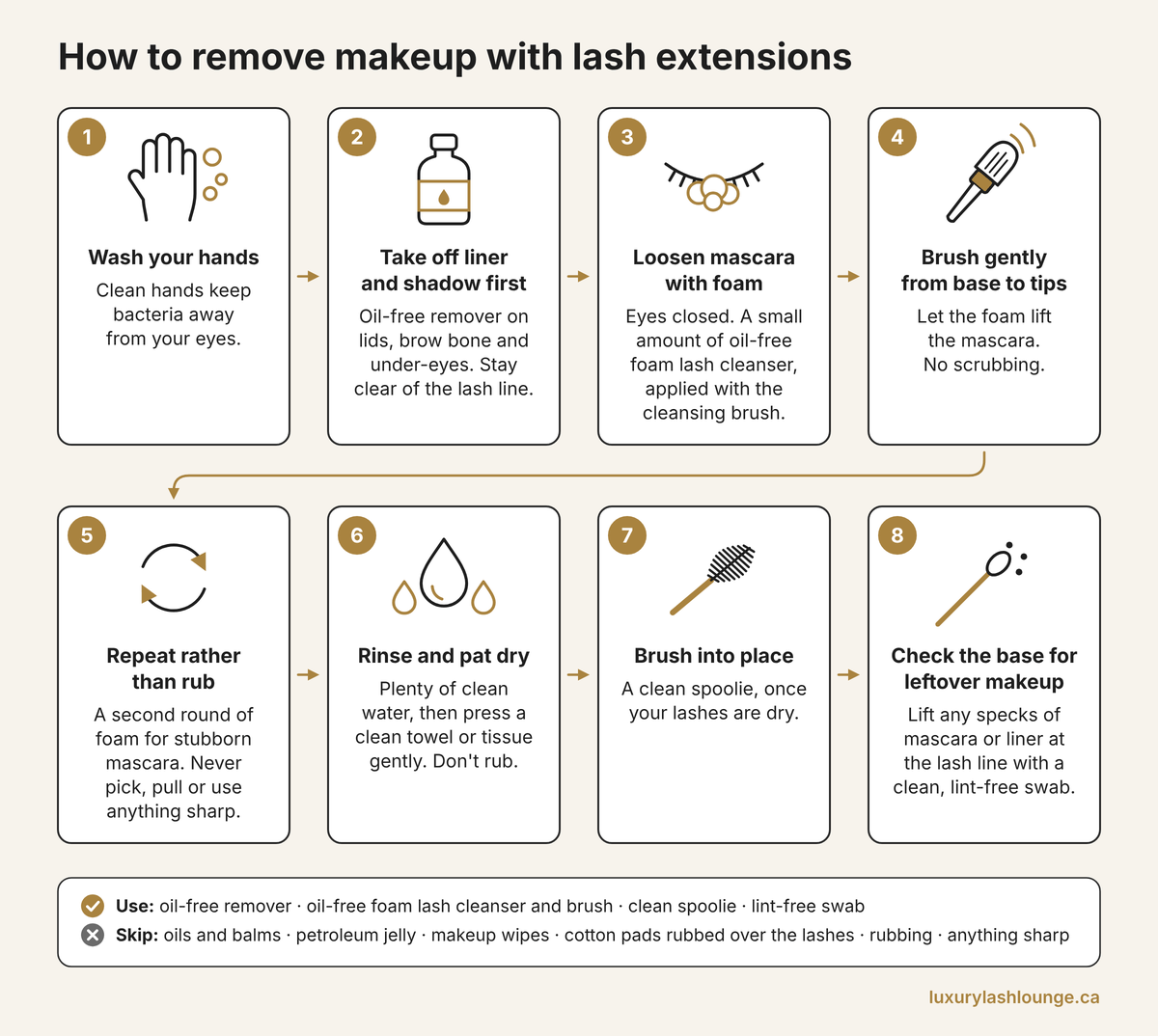
- Wash your hands. The FDA notes that bacteria on your hands can cause infections if they get into your eyes.
- Take off liner and shadow first. Remove eyeliner, eyeshadow and concealer from your lids, brow bone and under-eye area with an oil-free remover, staying clear of the lash line.
- Loosen mascara with foam. Close your eyes and apply a small amount of oil-free foam lash cleanser to the lashes with the cleansing brush.
- Brush gently from base to tips. Brush through the lashes and along the lash line, and let the foam lift the mascara instead of scrubbing.
- Repeat rather than rub. Use a second round of foam for stubborn mascara, and never pick or pull at clumps. The AAO also warns against using anything sharp to separate clumped lashes.
- Rinse and pat dry. Use plenty of clean water so no cleanser or makeup is left on your lids. Then press a clean towel or tissue gently against your face instead of rubbing.
- Brush into place. Once your lashes are dry, brush them with a clean lash spoolie.
- Check the base for leftover makeup. Look along the lash line and lift any specks of mascara or liner with a clean, lint-free swab.
The AAO suggests a clean cotton swab along the base of the lashes. With extensions, our Lint Free Micro Swabs are a better fit, because their 3 mm nylon tip leaves no fuzzy residue, unlike a cotton swab.

The foam is made for eyelash extensions and removes dirt and makeup from the lashes without breaking down the adhesive bond. The kit is $19.99 CAD, and like everything in our shop, it is used on our own clients in the studio.

The cleanser kit, spoolies and swabs are all in our lash extension tools.
Your daily lash wash, in brief
Taking makeup off and washing your lashes are two different jobs. Alessia recommends washing your lashes ideally every day with an oil-free cleanser, even on days you wear no makeup. Our lash extension aftercare guide covers the full routine, including the first days after a new set.
Can you wear eyeliner with lash extensions?
You can, but Alessia highly recommends against it, for the same reason as mascara. In her experience, eyeliner contains oils that break down the adhesive bond and will most likely make your extensions shed prematurely. If you still wear it, keep it on the skin outside the lash line, choose a formula you can remove without oil and stay off the waterline.
If you wear eyeliner, which type works best with extensions?
| Eyeliner type | If you wear it | What to watch |
|---|---|---|
| Liquid liner | Easiest to keep off the lashes | Stay on the skin above the lashes; pick one that removes with water or a gentle cleanser |
| Pencil liner | Careful | Use a soft pencil and light strokes so you don't tug the lid or catch the extensions |
| Gel or cream liner | Check the label | If the directions call for an oil-based remover, keep it away from your set |
| Waterproof or long-wear liner | Avoid near the lashes | Like waterproof mascara, it is hard to remove without oil or rubbing |
| Kohl or any liner on the waterline | Avoid | Can block the eyelid's oil glands and move into the tear film |
| Magnetic liner with magnetic lashes | Avoid | Puts a second lash product on top of your set |
These cautions follow standard professional advice: draw liner on the skin just above your lashes, never in between them, and keep oil and rubbing away from the bond.
The AAO notes that magnetic lashes attach to an eyeliner containing tiny magnetic particles. It adds that magnetic and glued false lashes can both irritate the skin around the eyes.
Keep eyeliner off the waterline
The waterline, the inner rim of the eyelid behind your lashes, is off limits for liner, with or without extensions. The AAO advises applying makeup outside the lash line, away from the eye, to avoid blocking the oil glands of the upper or lower eyelid.
Research supports this. In a small pilot study of three women, pencil eyeliner applied inside the lash line moved into the tear film more readily than liner applied outside it. With liner inside the lash line, contamination peaked 5 to 10 minutes after application, and the authors flagged this for contact lens wearers and people with dry or sensitive eyes.
Traditional kohl, also called kajal or surma, is a different product from modern eyeliner. Health Canada has found high levels of lead in some kohl products, says lead is especially harmful to children, and advises Canadians not to use unlabelled kohl.
What about eyeshadow and concealer?
Powder eyeshadow is generally fine with extensions. Tap off the excess so less powder falls into your lashes, and keep cream shadows, primers and concealer away from the lash line.
Be careful with glitter. The AAO says glitter flakes can fall into the eye and irritate it. It calls glitter eye makeup a common cause of corneal irritation or infection, especially for contact lens wearers.
Can you curl lash extensions?
No. Most lash techs advise against using a lash curler on extensions, because the curl is already set into each extension.
Lash techs warn that clamping a curler on a set can bend or kink the fibres and pull on your natural lashes. The AAO warns that tugging or pulling can fracture your natural lashes and even cause permanent damage to the eyelash follicle.
If an extension gets bent, don't try to reshape it. Brush the set with a clean spoolie and let your lash tech check it at your next refill. Our guide to whether lash extensions ruin your lashes explains what really harms natural lashes.
What about heated lash curlers?
Skip them too. The AAO warns that too much heat around the eye can cause lashes to fall out, damage the skin around the eye or damage the eye itself.
It notes that skin can sustain first-degree burns at 118°F (about 48°C) and that eyelid skin is especially thin. Heated curlers often range from 100°F to over 200°F (about 38°C to over 93°C).
With extensions there is a second reason: lash techs commonly warn that heat and pressure can change the curl of the extensions, so most keep heat away from a set.
Get the curl from your set instead
If you want more lift, ask for a different curl instead of curling at home. Extensions come in several curl shapes: our mixed length trays, for example, come in C, CC, D and L curls.
Alessia says C curl gives a more natural look, while D curl is the most popular curl with lash techs, a universal curl that looks good on everyone. Curl names and shapes vary between manufacturers, so describe the look you want and let your lash tech choose. Our lash curl chart explains each curl and who it suits.
Want curl without extensions? A lash lift curls your natural lashes instead. We don't offer lash lifts, but our guide to lash lift vs lash extensions compares the two fairly.
Lash serums and lash extensions
Check with your lash tech, and a doctor or pharmacist, before using any lash serum with extensions. No serum is safe for every set: it depends on what is in it, where you apply it and how your eyes react.
Prescription lash growth treatment
The AAO says the only lash growth product approved by the FDA needs a prescription, because of its possible side effects. Topical bimatoprost is a prescription treatment for hypotrichosis, meaning less than the normal amount of eyelash hair (MedlinePlus).
In Canada, a 0.03% bimatoprost topical solution is a prescription drug with a Health Canada product monograph for treating hypotrichosis of the eyelashes by increasing their growth, including length, thickness and darkness. According to MedlinePlus and the monograph:
- It goes on the upper lash line only, never on the lower eyelid.
- Side effects can include itchy, dry or red eyes, darker eyelid skin (which may be reversible) and a brown change in eye colour that is likely to be permanent.
- Hair can grow on other skin the solution often touches.
- People who use prostaglandin eye drops for eye pressure should talk to their doctor first.
- Lashes gradually return to how they were after you stop.
Because it goes on the base of the upper lashes, close to where extensions are attached, tell both your prescriber and your lash tech if you use it.
Cosmetic lash serums
Serums sold as cosmetics are a separate category. Health Canada's Cosmetic Ingredient Hotlist lists prostaglandins and their analogues, including bimatoprost, among the ingredients prohibited in cosmetics.
The AAO adds that non-prescription lash growth products have not been FDA tested, so their safety and effectiveness have not been officially proven. It advises talking to an ophthalmologist before using any lash growth product.
If you want to use a serum with your extensions
- Ask first. Tell your lash tech which serum you plan to use, and ask a doctor or pharmacist whether it suits your eyes.
- Read the ingredients. Standard professional advice is that oil weakens the bond. An oily serum, or a plain oil sold as a lash conditioner, raises the same concern as an oily remover.
- Stop if your eyes react. Follow the eye doctor advice below, and don't remove your extensions yourself.
Makeup removers and skincare around lash extensions
Use oil-free products on and near your lashes, and keep oils, balms and rich creams for the rest of your face. Look for "oil-free" on the label, and if the ingredients name oils or the product feels greasy, keep it off the lash line.
Oil-based vs oil-free removers
Standard professional advice is that oil weakens the adhesive bond, so lash techs recommend oil-free removers and cleansers around a set. It is the same concern Alessia has with mascara and eyeliner, which in her experience contain oils that break down the bond. Our Lash Cleanser Kit, for example, is oil-free and made to remove makeup without breaking down the adhesive bond.
General eye makeup advice can differ. The AAO, for example, calls petroleum jelly a very effective makeup remover, but its makeup removal tips don't mention extensions. With extensions, most lash techs ask you to keep greasy products like this away from the bond.
| Product | Near your extensions? | Notes |
|---|---|---|
| Cleansing oil or balm | Avoid | Puts oil right at the bond |
| Two-layer, shake-before-use remover | Avoid unless the label says oil-free | Treat it as oil-based until you have checked |
| Oil-free makeup remover | Yes, around the eyes | Use gently, then rinse |
| Oil-free foam lash cleanser | Yes, on the lashes | Made to wash makeup off lashes |
| Micellar water | Careful | Oil-free only; see below |
| Makeup wipes | Avoid on the lashes | They make it easy to rub and drag |
Is micellar water safe for lash extensions?
It can be, if it is oil-free and you use it gently. Micellar waters are water-based cleansers containing surfactant molecules that form micelles: tiny clusters that attach to oil and makeup and lift them away (Journal of Cosmetic Science, 2024).
Many lash techs are comfortable with an oil-free micellar water on the skin around your eyes. For the lashes themselves, most prefer a foam cleanser made for extensions.
Lash techs commonly suggest pressing micellar water on with a lint-free applicator rather than rubbing a cotton pad over your set, which can leave fibres behind. Then rinse, as the AAO advises for any remover.
Eye creams, sunscreen and face oils
- Eye cream. Apply it along the orbital bone, the bony rim around your eye, rather than up to the lash line. Most lash techs suggest lightweight, oil-free formulas near a set.
- Sunscreen. If you apply sunscreen around your eyes, keep it off the lash line and out of your eyes.
- Face oils and overnight masks. Keep them away from the eye area while you wear extensions.
- Scrubs. The AAO says not to use exfoliating scrubs around your eyes.
When to stop and see an eye doctor
Stop using any eye product that causes irritation or inflammation, as Health Canada advises, and see a doctor if irritation persists, as the FDA advises. With pain, redness, itching, swelling, discharge, light sensitivity or blurred vision, don't try to remove your extensions yourself; see an eye doctor (an optometrist or ophthalmologist) promptly.
The AAO gives the same advice for reactions to extensions: don't remove them yourself, and see an ophthalmologist immediately. If symptoms start soon after a lash appointment, our lash glue allergy guide explains possible causes and next steps. If you have had a reaction or sensitivity to extensions before, ask about our $20 patch test before your next set.
Special occasions: what to do instead of mascara
For a wedding, a trip or photos, build the extra drama into your set instead of adding mascara on the day.
- Choose a fuller set or style. At our studio, hybrid gives a fuller look than natural lashes without the bold, dark look of volume. Volume gives a denser, fluffier lash line, and mega volume a very dramatic, voluminous set. Compare types of lash extensions, or see our lash extensions in Woodbridge.
- Book a refill before the event. Extensions fall off as your natural lashes shed, so a refill fills the gaps. At our studio, a visit counts as a refill if at least 40% of your extensions remain, and appointments take around 1 hour, 1.5 hours at most. Our guide to how long lash extensions last explains timing.
- Don't patch gaps yourself. Most lash techs advise against strip lashes or glue on top of your set. Health Canada's Cosmetic Ingredient Hotlist says cyanoacrylate eyelash extension adhesives must be sold for professional use only.
- Test new makeup early, and remove it that night. The AAO advises introducing one new eye product at a time, and removing all eye makeup before you sleep.
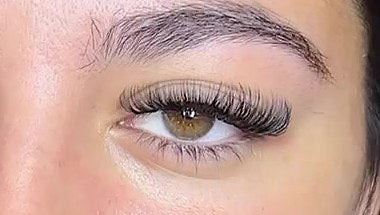
To book a set or refill at our private studio in Woodbridge, Vaughan, contact us.
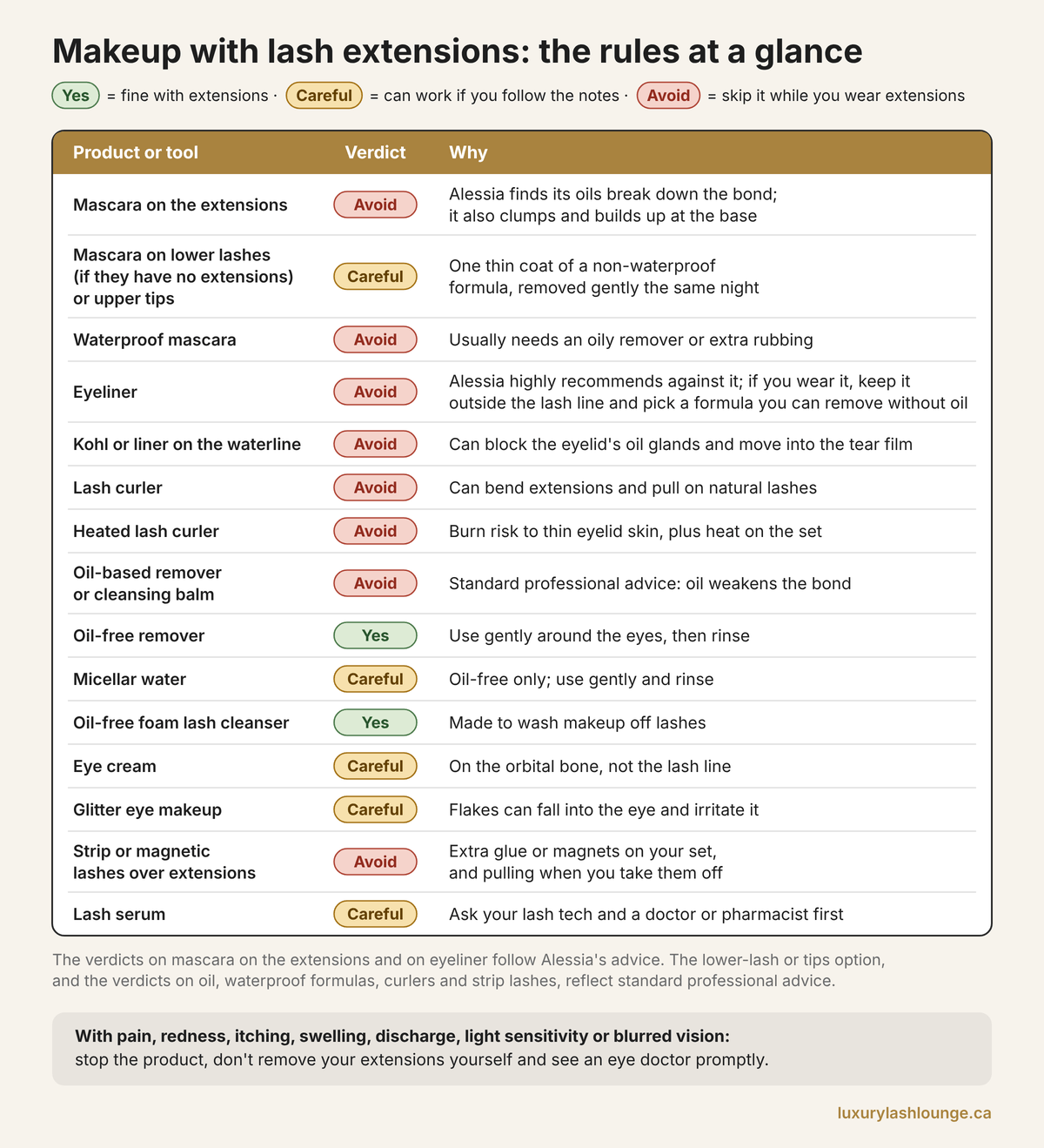
Makeup with lash extensions: the rules at a glance
Most makeup is fine with lash extensions if you keep oil, rubbing and heat away from the lashes. Use this table as a quick check: "careful" means it can work if you follow the notes.
The verdicts on mascara on the extensions and on eyeliner follow Alessia's advice. The lower-lash or tips option, and the verdicts on oil, waterproof formulas, curlers and strip lashes, reflect standard professional advice.
| Product or tool | Verdict | Why |
|---|---|---|
| Mascara on the extensions | Avoid | Alessia finds its oils break down the bond; it also clumps and builds up at the base |
| Mascara on lower lashes (if they have no extensions) or upper tips | Careful | One thin coat of a non-waterproof formula, removed gently the same night |
| Waterproof mascara | Avoid | Usually needs an oily remover or extra rubbing |
| Eyeliner | Avoid | Alessia highly recommends against it; if you wear it, keep it outside the lash line and pick a formula you can remove without oil |
| Kohl or liner on the waterline | Avoid | Can block the eyelid's oil glands and move into the tear film |
| Lash curler | Avoid | Can bend extensions and pull on natural lashes |
| Heated lash curler | Avoid | Burn risk to thin eyelid skin, plus heat on the set |
| Oil-based remover or cleansing balm | Avoid | Standard professional advice: oil weakens the bond |
| Oil-free remover | Yes | Use gently around the eyes, then rinse |
| Micellar water | Careful | Oil-free only; use gently and rinse |
| Oil-free foam lash cleanser | Yes | Made to wash makeup off lashes |
| Eye cream | Careful | On the orbital bone, not the lash line |
| Glitter eye makeup | Careful | Flakes can fall into the eye and irritate it |
| Strip or magnetic lashes over extensions | Avoid | Extra glue or magnets on your set, and pulling when you take them off |
| Lash serum | Careful | Ask your lash tech and a doctor or pharmacist first |
For lash techs: what to tell clients about makeup
Explain the makeup rules and the reasons at the consultation, then repeat them in your aftercare:
- Give the mascara and eyeliner advice with the reasons. Alessia tells clients they're free to wear both, but highly recommends against them, because in her experience their oils break down the bond. Clumping, residue and rubbing during removal add to the case.
- Send every client home with a spoolie. We recommend a fresh lash spoolie for each client's aftercare routine.
- Recommend an oil-free foam cleanser. Our Lash Cleanser Kit works for prep before a set and for clients' washing at home.
- Start on clean lashes. Wash the natural lashes and let them dry fully before you apply extensions, to help adhesive retention.
- Solve the reason behind the mascara. Offer more curl or drama at the next set instead. Our lash extension trays include mixed length trays in C, CC and L curl at 0.05 mm, and D curl at 0.03, 0.05 or 0.15 mm.
- Keep glue in the studio. Health Canada allows cyanoacrylate eyelash extension adhesives to be sold for professional use only, so never send lash extension glue home with a client.
- Refer, don't treat. Send any client with pain, swelling, discharge or vision changes to an eye doctor promptly.
Client consultations and allergy and infection knowledge are part of our 1-on-1 Eyelash Extension Masterclass.
FAQ
What happens if I put mascara on my eyelash extensions?
Mascara coats several extensions at once, so your set can turn clumped and spiky, and residue builds up near the glue. In Alessia's experience, its oils also break down the adhesive bond, so your extensions will most likely shed prematurely.
Removing it often takes rubbing or an oily remover, and the AAO warns that rubbing or pulling can fracture natural lashes. If you have worn it, take it off gently with an oil-free foam cleanser and a soft brush.
Can I wear mascara on my bottom lashes with extensions?
You can. Alessia highly recommends against mascara with extensions, but if your lower lashes don't have extensions, a light coat of non-waterproof mascara there is the lower-risk option most lash techs suggest.
Keep the wand well away from your upper set, and remove the mascara gently the same night with an oil-free product. The AAO advises taking off all eye makeup before you sleep, especially mascara.
Can I put mascara on fake lashes?
It depends which fake lashes you mean. On lash extensions, Alessia and most lash techs advise skipping mascara, for the reasons in this guide.
Strip lashes are a separate product, so follow the directions that come with them. Most lash techs advise against wearing them on top of extensions, because their glue and removal put extra stress on your set.
Is waterproof mascara bad for lash extensions?
Most lash techs say to avoid it. Waterproof mascara is designed to resist water, so it usually takes an oily remover or extra rubbing to come off.
Standard professional advice is that oil weakens the bond, and the AAO warns that rubbing, tugging or pulling can fracture natural lashes. If you need mascara for an event, choose a non-waterproof formula and keep it to the tips or lower lashes.
What not to use on lash extensions?
Alessia highly recommends against mascara and eyeliner, because in her experience their oils break down the adhesive bond. Also keep these away from your set: oil-based removers, cleansing balms and petroleum jelly; waterproof formulas; lash curlers, especially heated ones; strip or magnetic lashes on top; makeup wipes or cotton pads dragged across the lashes; and anything sharp.
Never use lash glue or professional removers at home. In Canada, cyanoacrylate lash adhesives must be sold for professional use only.
What are the dos and don'ts of lash extensions with makeup?
Alessia highly recommends skipping mascara and eyeliner. Do use oil-free removers and an oil-free foam lash cleanser, brush with a clean spoolie and remove all eye makeup before bed.
Don't use waterproof or oily products, curl your lashes, layer strip lashes on top or rub. For washing, water, sleep and the first days after a set, see our lash extension aftercare guide.
Can I use micellar water with lash extensions?
Yes, if it is oil-free and you use it gently. Micellar waters are water-based cleansers whose surfactants form micelles that trap oil and makeup.
Check the label for oils, and treat any two-layer, shake-before-use remover as oil-based unless it says otherwise. Use it on the skin around your eyes, rinse afterwards as the AAO advises, and clean the lashes themselves with a foam cleanser made for extensions.
Can I wear eyeliner with lash extensions?
You can, but Alessia highly recommends against it: in her experience, eyeliner contains oils that break down the adhesive bond and will most likely make your extensions shed prematurely.
If you still wear it, draw it on the skin outside the lash line, pick a formula you can remove without oil and skip waterproof liners. Never line the waterline: the AAO advises applying makeup outside the lash line to avoid blocking the oil glands of the eyelids.
Can I wear strip lashes over my extensions?
It's best not to. Most lash techs advise against layering strip or magnetic lashes over extensions, because the extra adhesive or magnets sit on your set and taking them off pulls on it.
If you want more fullness for an event, ask for a fuller style or book a refill instead. Lash extension glue is for trained professionals only, so never use it to attach strip lashes.
Can I use a lash serum with extensions?
Ask your lash tech and a doctor or pharmacist first. Prescription bimatoprost for sparse lashes can cause side effects such as itchy or red eyes, darker eyelid skin and a brown change in eye colour that is likely permanent.
It is also applied at the upper lash line, close to your extensions. In Canada, prostaglandins and their analogues are prohibited in cosmetics, and with any serum, avoid oily formulas and stop if your eyes react.
About the author
Alessia Simonetta is the owner, master lash artist and certified lash trainer at Luxury Lash Lounge in Woodbridge (Vaughan), Ontario. She has been lashing since 2018 and holds five certifications: Classic Lash Artist, Hybrid Lash Artist, Volume Lash Artist, Mega Volume Artist and Certified Lash Trainer. She has worked with thousands of lash clients and trained hundreds of students.
Book lash extensions at our Woodbridge studio, or learn from Alessia in a 1-on-1 lash course.
Sources
- American Academy of Ophthalmology. "How To Use Cosmetics Safely Around Your Eyes" (published 27 October 2026). https://www.aao.org/eye-health/glasses-contacts/eye-makeup
- American Academy of Ophthalmology. "Eyelash Extension Facts and Safety" (23 February 2018). https://www.aao.org/eye-health/tips-prevention/eyelash-extension-facts-safety
- EyeWiki, American Academy of Ophthalmology. "Eyelash Extensions" (last edited 21 July 2026). https://eyewiki.aao.org/Eyelash_Extensions
- Health Canada. "Eye cosmetics" (modified 5 December 2016). https://www.canada.ca/en/health-canada/services/cosmetics/eye-cosmetics.html
- Health Canada. "Cosmetic Ingredient Hotlist: Prohibited and restricted ingredients" (modified 13 August 2025). https://www.canada.ca/en/health-canada/services/consumer-product-safety/cosmetics/cosmetic-ingredient-hotlist-prohibited-restricted-ingredients/hotlist.html
- Health Canada. "Health concerns about lead in traditional kohl" (modified 6 December 2016). https://www.canada.ca/en/health-canada/services/cosmetics/health-concerns-about-lead-traditional-kohl.html
- US Food and Drug Administration. "Eye Cosmetic Safety" (content current as of 28 June 2022). https://www.fda.gov/cosmetics/cosmetic-products/eye-cosmetic-safety
- Ng A, Evans K, North RV, Purslow C. "Migration of cosmetic products into the tear film." Eye & Contact Lens. 2015;41(5):304-309. PubMed 25738987. https://pubmed.ncbi.nlm.nih.gov/25738987/
- Pack LD, Wickham MG, Enloe RA, Hill DN. "Microbial contamination associated with mascara use." Optometry. 2008;79(10):587-593. PubMed 18922495. https://pubmed.ncbi.nlm.nih.gov/18922495/
- Mussi L, Magalhães WV, Camargo FB Jr, Padovani G. "Effects of Prebiotic Micellar Solution on Makeup Removal and Skin Microbiome Balance." Journal of Cosmetic Science. 2024;75(6):553-564. https://library.scconline.org/v075n06/26
- MedlinePlus, US National Library of Medicine. "Bimatoprost Topical" (last revised 15 October 2016). https://medlineplus.gov/druginfo/meds/a609009.html
- Health Canada Drug Product Database. Product monograph for a bimatoprost 0.03% topical solution for hypotrichosis of the eyelashes (revised 13 October 2022). https://pdf.hres.ca/dpd_pm/00067890.PDF