
Quick answer
Good lash extension aftercare starts with keeping your lashes dry, steam-free and away from oil-based products for the first 24 to 48 hours. After that, wash them ideally every day with an oil-free cleanser, brush them with a clean spoolie and book refills every few weeks. Never rub or pull them, and if you notice pain, swelling, discharge or vision changes, don't remove the extensions yourself: see an eye doctor right away.
Lash extension aftercare for the first 24 to 48 hours
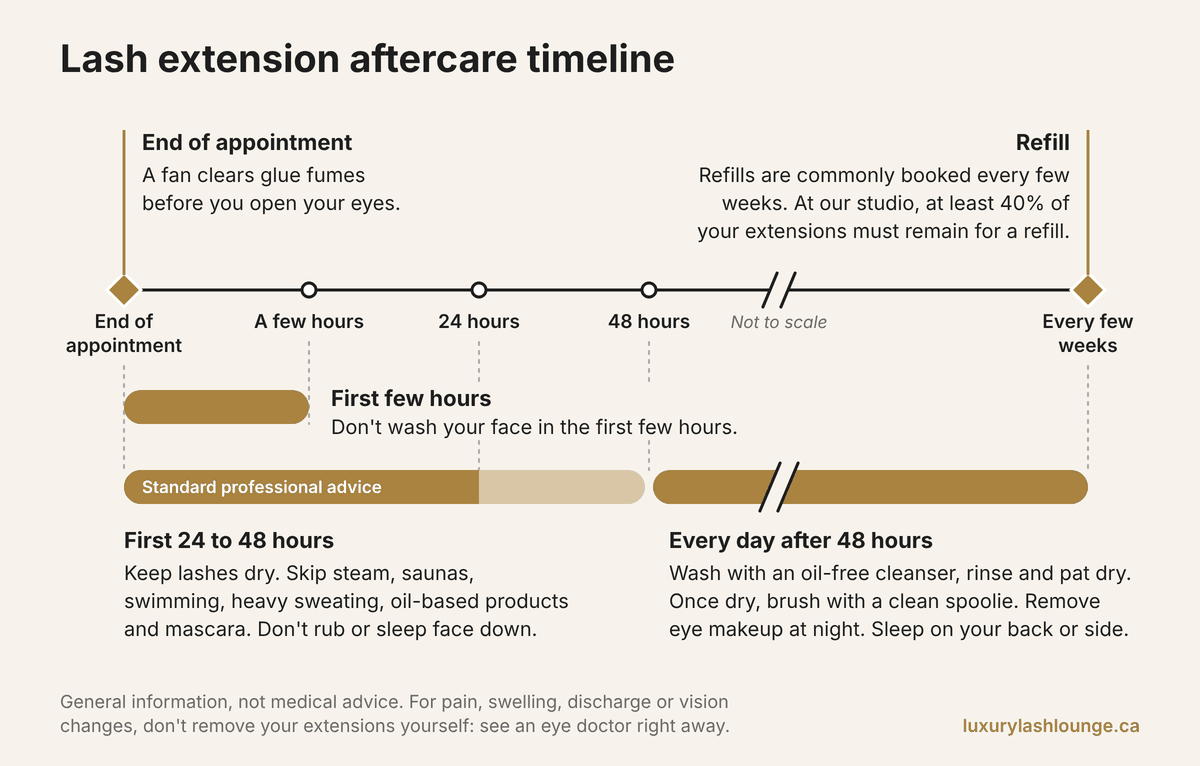
For the first 24 to 48 hours, keep your lashes dry, skip steam and oil-based products, and keep your hands off them. This is standard professional advice, not a measured curing time. It protects the bond while the glue finishes setting, with a safety margin on top, so it is where eyelash extension aftercare starts.
Why the first 48 hours matter
Most lash extension glues are based on cyanoacrylate compounds, as the Canadian Association of Optometrists notes. A 2018 review in the journal Molecules explains that cyanoacrylates set through rapid polymerization when they meet surface moisture. That is why lash glue grabs almost instantly.
Grabbing is not the same as fully set. The EyeWiki article on eyelash extensions, from the American Academy of Ophthalmology (AAO), advises against washing your face in the first few hours. Most lash techs add a generous safety margin and ask you to keep your lashes dry for 24 to 48 hours, before they face soaking, steam, heat and rubbing.
At our studio, we use the Pink USB Lash Fan at the end of an appointment to clear glue fumes before you open your eyes. From that moment, your job is to protect the bond.
What to avoid in the first 48 hours
- Water on your lashes, including splashing your face
- Steam from long hot showers, saunas, steam rooms and hot tubs
- Swimming, hot yoga and workouts that make you sweat heavily
- Oil-based cleansers, removers, creams and serums near your eyes
- Mascara and other eye makeup on the lashes
- Rubbing, touching or tugging your lashes
- Sleeping face down
What if your lashes get wet too soon?
A quick splash is not a reason to panic. Pat your lashes dry without rubbing, and brush them through once they are fully dry. If lashes start clumping, twisting or falling out over the next few days, ask your lash tech to check the set.
Watch how your eyes feel in these first days, too. EyeWiki notes that symptoms of an allergic reaction may not appear until hours or days after extensions are applied. The warning signs, and what to do about them, are covered further down this guide.
How to clean lash extensions, step by step
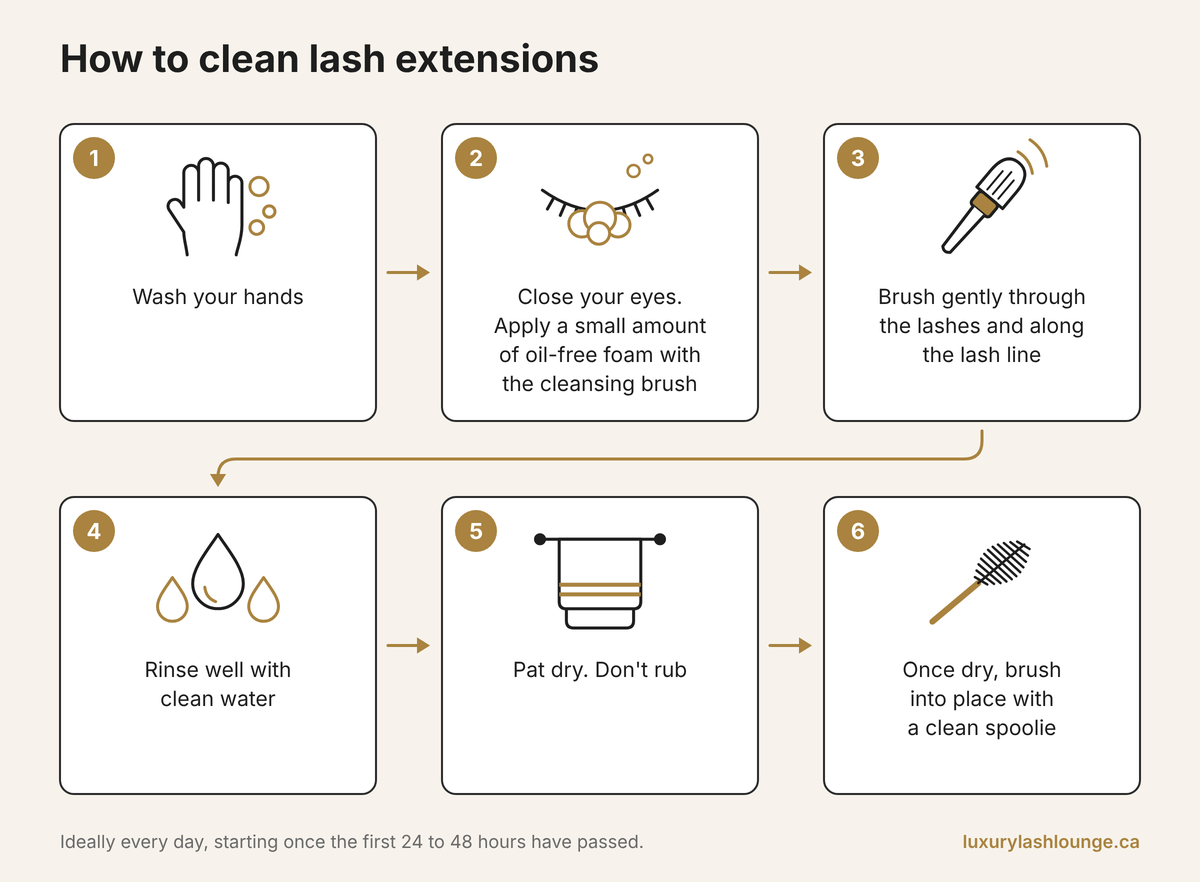
To clean lash extensions, close your eyes and work a little oil-free foam cleanser through them with a soft brush. Rinse with clean water, pat dry and brush them into place with a clean spoolie once dry.
Alessia recommends washing your lashes ideally every day with an oil-free cleanser. Start once the first 24 to 48 hours have passed.
Why daily cleaning matters
Washing your lashes is about eye health as much as looks. In a small 2024 study in the Journal of Clinical Medicine, researchers examined 31 women with dry eye symptoms who wore extensions.
During the eye exams, the clinicians noted a lot of uncleaned debris at the roots of the women's natural lashes, and they also observed Demodex infestations. These were observations, not counted or measured results: the study measured dry eye symptoms and signs. Demodex are microscopic mites that live in lash follicles.
The authors also note that extensions are very often the reason people neglect lid hygiene.
A 2019 review of eyelid cosmetic procedures makes a similar point. It lists bacteria collecting under the lash bed, and limits on cleansing the lids, as ways extensions can lead to infection.
Extra bacteria at the base of the lashes and an over-population of Demodex mites are among the causes of blepharitis, according to the AAO. Blepharitis is an inflammation of the eyelids. A gentle daily wash with a cleanser made for extensions keeps that area clean.
How to wash lash extensions
- Wash your hands. The US Food and Drug Administration (FDA) advises washing your hands before applying eye cosmetics. Anything you use near your eyes should be clean, too.
- Apply the foam. Close your eyes and apply a small amount of foam to the lashes with the cleansing brush.
- Brush gently. Work the brush through the lashes and along the lash line, where makeup and oil collect.
- Rinse. Rinse well with clean water, letting it run over your closed eyes.
- Pat dry. Press a clean towel gently against your lashes. Don't rub.
- Brush into place. Once your lashes are dry, brush them through with a clean spoolie.
Our Lash Cleanser Kit ($19.99 CAD) pairs a 60 ml gentle, oil-free foam lash cleanser with a cleansing brush. It is made for extensions and removes dirt and makeup without breaking down the adhesive bond. If you have sensitive skin, check the full ingredient list on the product page before you buy.

For step 6, our lash spoolies come in packs of 50, from $4.99. That makes it easy to switch to a fresh wand often, rather than reusing one that has been sitting on the bathroom counter.
What to use and what to skip
| Use | Skip |
|---|---|
| An oil-free foam cleanser made for extensions | Cleansing oils, balms and oil-based removers |
| A soft cleansing brush | Cotton pads and cotton swabs, which can leave fibres behind |
| Clean water | Two-phase removers you shake before use, which usually have an oily layer |
| A clean towel, pressed gently | Makeup wipes or towels dragged across the lashes |
| A clean spoolie, once lashes are dry | An old wand on wet lashes |
More aftercare and prep tools are in our lash extension tools collection.
What to avoid with lash extensions
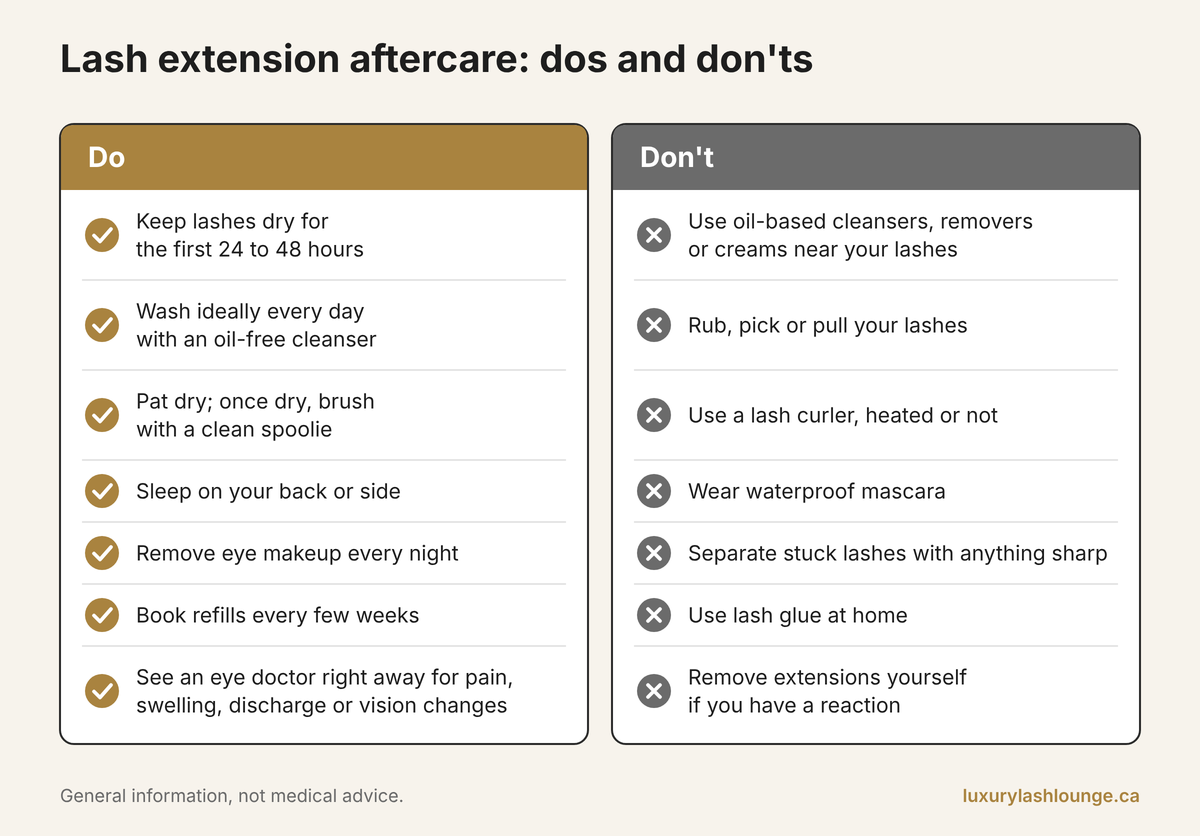
Avoid oil-based products near your lash line, rubbing or pulling, lash curlers, waterproof mascara and direct heat. Most lash techs warn against these because they can loosen or bend extensions, and some can harm your natural lashes or your eyes.
- Oil-based products. Keeping cleansing oils, oil-based removers and rich creams away from extensions is standard aftercare advice. Choose oil-free products for anything that touches your lashes, like our oil-free foam lash cleanser.
- Rubbing, picking and pulling. The AAO's extension safety guide warns that "rubbing, tugging or pulling can fracture your natural lashes, and even cause permanent damage to the eyelash follicle." Never pick or pull extensions off: professional removal ($20 at our studio) is the safest option. If you are set on doing it yourself, first read how to remove lash extensions at home safely.
- Lash curlers. Extensions come with a set curl, such as C, CC, D or L (see our lash curl chart). Most lash techs advise against curlers, which can bend extensions out of shape. The AAO's guide to using cosmetics safely warns that heated curlers can make lashes fall out and damage the eye or the skin around it.
- Waterproof mascara. Lash techs commonly advise skipping it. It is made to resist water, so it often takes more rubbing or a stronger, oil-based remover to take off.
- Direct heat. Keep hot air from hair dryers and curling irons, and the blast from an open oven, away from your lashes. This is a common precaution with synthetic extensions.
- Sharp tools. The AAO advises against using anything sharp to separate clumped lashes. Ask your lash tech to fix them instead.
- Lash glue at home. Cyanoacrylate lash adhesives "must be sold for professional use only," according to Health Canada's Cosmetic Ingredient Hotlist. Don't glue lashes back on, or stick strip lashes over your extensions.
Mascara and eye makeup
Alessia tells clients they are free to wear mascara or eyeliner, since extensions are semi-permanent, but she highly recommends against it: in her experience, these products contain oils that break down the adhesive bond and will most likely make the extensions shed prematurely. Extensions are designed to give you darker, fuller lashes on their own, so you may not need mascara at all.
Our guide to mascara on lash extensions explains how to wear it with the least risk if you still want to, and how to take it off without rubbing. If you reach for mascara every day, a fuller style could suit you better, so compare the types of lash extensions before your next refill.
Can you get lash extensions wet? Showers, swimming, saunas and workouts
Yes. After the first 24 to 48 hours you can get lash extensions wet, and washing them is part of good aftercare. What to avoid is soaking or steaming them early, rubbing them dry, and leaving chlorine, salt or sweat on them.
| Activity | First 24 to 48 hours | After 48 hours |
|---|---|---|
| Shower | Keep your face out of the spray; skip long, steamy showers | Fine; pat dry and brush once dry |
| Washing your face | Wash around the eyes, not the lashes | Wash your lashes with an oil-free foam cleanser |
| Swimming in a pool, lake or ocean | Avoid | Fine; rinse with clean water and wash your lashes afterwards |
| Sauna, steam room or hot tub | Avoid | Many lash techs suggest short sessions, then a rinse and gentle drying |
| Hot yoga or hard workouts | Avoid heavy sweating | Fine; wash your face and lashes afterwards |
| Rain or tears | Pat dry gently | Pat dry gently, then brush |
For the wet look lash style, see our guide to wet set lashes.
Can you shower with lash extensions?
Yes. For the first 24 to 48 hours, keep your face out of the spray and skip steamy showers. Washing your hair with your head tilted back helps.
After that, shower as usual. Wash your lashes as part of your routine, pat them dry and brush them once dry.
Can you swim with lash extensions?
Yes, once the first 48 hours have passed. Pool water can leave chlorine on your lashes, and seawater leaves salt.
Rinse your eyes with clean water after a swim, then wash your lashes with your oil-free cleanser. Choose goggles that don't press on your lashes, and don't rub your eyes with a towel.
Saunas, steam rooms and hot tubs
Skip them for the first 48 hours. After that, many lash techs suggest keeping heat and steam sessions short. Rinse your face afterwards, pat your lashes dry and brush them once dry.
Workouts and sweat
Avoid workouts that make you sweat heavily for the first 24 to 48 hours. After that, train as usual, then wash your face and lashes instead of letting sweat dry on them. Dab your face with a clean towel rather than wiping across your eyes.
How to sleep with lash extensions
Sleep on your back, or on your side, so your lashes are not pressed into the pillow. Most lash techs advise against sleeping face down, because it presses the lashes into the fabric night after night and can bend or twist them.
- Back sleeping keeps the lashes clear of the pillow altogether.
- Silk or satin pillowcases are a common suggestion from lash techs because of their smoother surface.
- A contoured sleep mask with raised eye cups keeps fabric off your lashes. Avoid flat masks that press on them.
- Clean lashes at bedtime. Remove all eye makeup before you sleep.
- A morning brush. Brush your lashes through with a clean spoolie, and resist rubbing your eyes when you wake up.

If your eyes often feel dry when you wake up, mention your extensions to your eye doctor. The 2019 review lists incomplete eyelid closure during sleep, which increases dryness, among the possible mechanical effects of extensions.
Skincare, facials and makeup removal
Keep oils, heavy creams and rubbing away from the lash line, and take off any eye makeup gently each night with oil-free products before you wash your lashes.
- Removing eye makeup. Use an oil-free remover, or the foam from our Lash Cleanser Kit, then follow the cleaning steps above. Skip cleansing oils, balms and two-phase removers.
- Facials and other treatments. Tell your esthetician you are wearing extensions, so they can keep steam, oils and pads away from your lashes.
For eyeliner, lash curlers, lash serums and choosing a makeup remover, see our guide to mascara and makeup with lash extensions.
If a product stings or makes your eyelids red or itchy, stop using it, as Health Canada advises for any cosmetic you think has caused a reaction. Don't remove your extensions yourself, and see an eye doctor right away; the warning signs are covered below.
Refills: how to keep your set full
Refills are commonly booked every few weeks. Your natural lashes shed on their own schedule, and each extension falls out with the lash it is attached to. In the small 2024 Journal of Clinical Medicine study mentioned above, 28 of the 31 women had their extensions refilled every 2 to 3 weeks.
The Canadian Association of Optometrists also notes that extensions fall out with your natural lashes. For the full picture of lash growth cycles, read how long lash extensions last.
At Luxury Lash Lounge, at least 40% of your lash extensions must remain for the visit to count as a refill. Less than that is charged as a full set, so daily care and on-time refills keep your costs down.
| Set | Full set | Refill |
|---|---|---|
| Hybrid | $120 | $65 |
| Volume | $135 | $70 |
| Mega volume | $150 | $80 |
Prices are before HST. We don't refill another lash technician's work, but outside removals are welcome for $20. If you book a full set while wearing another technician's lashes, you need to book a removal with it.
We need 24 hours' notice to cancel an appointment, as set out in our booking policies. To book, text or call 647-533-7202, send a DM to @luxurylashlounge on Instagram, email us or use our contact form. See all lash extension services and prices.
A refill is also a good moment to talk through style changes. Our lash map guide shows how lash styles are planned. For yearly budgeting, see how much lash extensions cost in Ontario.
Signs of irritation, allergy or infection, and what to do
If your eyes become itchy, red, swollen, sore or watery, or you notice discharge or blurry vision, don't rub them and don't remove the extensions yourself. See an eye doctor right away.
The AAO is clear: "If you have an allergic reaction to extensions, do not try to remove them yourself, as this could damage your eyes." It advises seeing an ophthalmologist (a medical eye doctor) immediately instead.
This section is general information, not medical advice. The AAO lists three risks: eyelid or corneal trauma or infection, allergic reaction to the glue, and temporary or permanent lash loss.
| What you notice | What it can be a sign of | What to do |
|---|---|---|
| Itchy, red or swollen eyelids, sometimes with tearing, hours or days after your appointment | An allergic reaction or sensitivity | See an eye doctor right away; don't remove the extensions yourself |
| Red, itchy, watery eyes | Irritation or pink eye (conjunctivitis) | See an eye doctor right away |
| Thick, sticky discharge, or lashes stuck together | Possible infection, such as bacterial pink eye | See an eye doctor right away |
| Flakes or crusts at the base of your lashes, red or sore lid edges | Possible blepharitis | See an eye doctor; keep your lashes clean |
| Moderate to severe pain, blurred vision, more sensitivity to light, or symptoms getting worse | Possibly something more serious | Contact an eye doctor (ophthalmologist) right away |
The symptoms in this table are drawn from EyeWiki and the AAO's guides to pink eye and blepharitis. The Canadian Association of Optometrists warns that damage to the eyelid or cornea makes infection more likely. Infection can lead to scarring and even permanent vision loss, so don't wait to get checked.
In Ontario, you can also call Health811 at 811, or chat online, for free advice from a registered nurse, 24/7. If an eye doctor advises removal, book a professional lash extension removal ($20). Let your lash tech know too, and you can report a bad reaction to a cosmetic to Health Canada online.
If you've had a reaction or sensitivity to lash extensions before, we recommend a patch test ($20, about 15 minutes) before your next set. Our lash glue allergy guide explains allergy symptoms and how patch tests work. For lash loss and damage, see our guide to whether lash extensions ruin your lashes.
Lash extension aftercare instructions: printable checklist
Save or print these lash extension aftercare instructions and keep them by your bathroom mirror.
| When | Do | Avoid |
|---|---|---|
| First 24 to 48 hours | Keep lashes dry; brush gently with a clean spoolie | Water on the lashes, steam, saunas, swimming, heavy sweating, oil-based products, mascara |
| Every day after that | Wash with an oil-free foam cleanser, rinse, pat dry, then brush once dry | Rubbing, pulling, picking, cotton pads |
| Every night | Remove all eye makeup; sleep on your back or side | Sleeping face down or in mascara |
| After swimming, saunas or workouts | Rinse, wash, pat dry and brush | Wiping your eyes with a towel |
| Every few weeks | Book a refill | Waiting until less than 40% of your set is left |
| Any time | See an eye doctor right away for pain, swelling, discharge or vision changes | Removing extensions yourself during a reaction, or using lash glue at home |
For lash techs: what to tell your clients
Send every client home with clear, written aftercare instructions and the tools to follow them. Good aftercare protects your client's eyes and your work.
- Go over the first 24 to 48 hours in person before the client leaves, then give it to them in writing.
- Send them home with a spoolie. We recommend sending every client home with one, and our lash spoolies come in packs of 50.
- Recommend an oil-free foam cleanser. The Lash Cleanser Kit works for your prep before a set and for your client's routine at home.
- Explain refill timing and your refill policy, such as the minimum share of extensions that must remain (ours is 40%).
- Explain the warning signs and tell clients to see an eye doctor right away, rather than remove the extensions or treat a reaction themselves.
- Offer patch tests to clients who have reacted before.
Never sell or give lash glue to clients. Health Canada requires cyanoacrylate lash adhesives to be sold for professional use only, labelled "For application by trained professionals only." For removals, use a professional product such as our Eyelash Extension Cream Remover, and keep it out of the eyes and off the skin.
Prep tools like Lint Free Micro Swabs are in our lash extension tools collection. Allergy and infection knowledge, client consultations and client retention are all covered in our 1-on-1 Eyelash Extension Masterclass. If you are starting out, read how to become a lash tech in Ontario.
Eyelash extension aftercare FAQ
How soon after eyelash extensions can I shower?
Most lash techs say you can shower the same day if you keep your face out of the spray and avoid a steamy bathroom. Standard professional advice is to keep the lashes themselves dry for the first 24 to 48 hours.
EyeWiki advises against washing your face in the first few hours, and lash techs add a margin on top. After that, shower as usual, then pat your lashes dry and brush them.
What happens if you get your lashes wet before 24 hours?
A quick splash is not a reason to panic. Pat your lashes dry gently, don't rub, and brush them through once they are fully dry.
Lash techs ask you to wait because the glue keeps hardening for some hours after your appointment. The bond should set fully before it faces soaking, steam or rubbing. If lashes clump, twist or fall out over the next few days, ask your lash tech to check the set.
Do eyelash extensions look better after a few days?
Some people find their set looks softer after a few days of washing and brushing, once they are used to the new look. A well-applied set should still look neat and feel comfortable from the start.
If lashes are stuck together or twisted after 48 hours, contact your lash tech instead of fixing them yourself. If an extension pokes your eye or causes any discomfort, the AAO advises seeing an ophthalmologist right away.
How long does it take for lashes to recover after extensions?
There's no set recovery time. Your natural lashes keep growing and shedding on their normal cycle, during and after extensions, as our guide to how long lash extensions last explains.
Rubbing, pulling and heavy extensions can cause lash loss, which the AAO and the Canadian Association of Optometrists say can be temporary or permanent. If your lashes don't grow back as expected, see an eye doctor, and read our guide to whether lash extensions ruin your lashes.
Can I wash my face with lash extensions?
Yes. For the first 24 to 48 hours, wash around your eyes and keep the lashes themselves dry. After that, wash your face as usual with an oil-free cleanser and clean your lashes as part of the same routine.
Work gently around your eyes rather than scrubbing, then pat your lashes dry with a clean towel and brush them once they are dry. Keep cleansing oils, balms and rich cleansers away from the lash line.
Can I swim with lash extensions?
Yes, once the first 48 hours have passed. After swimming in a pool, lake or ocean, rinse your eyes with clean water.
Then wash your lashes with an oil-free cleanser, pat them dry and brush them. Choose goggles that don't press on your lashes, and don't rub your eyes with a towel.
How often should I wash my lash extensions?
Ideally every day, with an oil-free cleanser: that's what Alessia recommends. Start once the first 24 to 48 hours have passed.
Daily washing helps remove makeup, oil and debris from the base of your lashes, where clinicians in one small study observed debris and even mites in women who wore extensions. All you need is a foam cleanser made for extensions, a soft brush and a clean spoolie.
Should I brush my lash extensions every day?
Yes. A gentle brush with a clean spoolie keeps your lashes neat, free of tangles and in place.
Brush them once they are fully dry after washing, and again in the morning if they have shifted overnight. Brush lightly, without tugging, and switch to a fresh spoolie often.
Can I glue a fallen lash back on myself?
No. Health Canada's Cosmetic Ingredient Hotlist says cyanoacrylate eyelash extension adhesives must be sold for professional use only, labelled "For application by trained professionals only."
The Canadian Association of Optometrists warns that glue on the eyelid skin or eye can cause an allergic reaction or a chemical burn. Leave small gaps alone and book a refill instead.
What should I do if my eyes are itchy or swollen after lash extensions?
Don't rub your eyes, and don't try to remove the extensions yourself. Itching, redness and swollen eyelids can be signs of an allergic reaction, which may start hours or days after your appointment.
See an eye doctor right away. In Ontario, you can also call Health811 at 811 for free advice from a registered nurse, and our lash glue allergy guide explains the signs in more detail.
About the author
Alessia Simonetta is the owner, master lash artist and certified lash trainer at Luxury Lash Lounge in Woodbridge (Vaughan), Ontario. She has been lashing since 2018 and holds 5 certifications: Classic Lash Artist, Hybrid Lash Artist, Volume Lash Artist, Mega Volume Artist and Certified Lash Trainer.
She has worked with thousands of lash clients and trained hundreds of students. Book lash extensions in Woodbridge, or learn from Alessia in a 1-on-1 lash course.
Sources
- American Academy of Ophthalmology, "Eyelash Extension Facts and Safety" (Reena Mukamal, reviewed by Rebecca J. Taylor, MD, 2018): https://www.aao.org/eye-health/tips-prevention/eyelash-extension-facts-safety
- American Academy of Ophthalmology, "How To Use Cosmetics Safely Around Your Eyes" (Dan Gudgel, reviewed by Rebecca J. Taylor, MD, October 2026): https://www.aao.org/eye-health/news/eye-makeup-safety-tips
- American Academy of Ophthalmology, EyeWiki, "Eyelash Extensions" (last edited July 2026): https://eyewiki.aao.org/Eyelash_Extensions
- American Academy of Ophthalmology, "What Is Blepharitis?" (reviewed by Brenda Pagan-Duran, MD, October 2026): https://www.aao.org/eye-health/diseases/what-is-blepharitis
- American Academy of Ophthalmology, "Conjunctivitis: What Is Pink Eye?" (reviewed by Brenda Pagan-Duran, MD, June 2026): https://www.aao.org/eye-health/diseases/pink-eye-conjunctivitis
- Canadian Association of Optometrists, "Eyelash Extensions" (last updated March 12, 2023): https://opto.ca/eye-health-library/eyelash-extensions
- Health Canada, "Cosmetic Ingredient Hotlist" (entry: cyanoacrylate-based adhesives; modified 2025-08-13): https://www.canada.ca/en/health-canada/services/consumer-product-safety/cosmetics/cosmetic-ingredient-hotlist-prohibited-restricted-ingredients/hotlist.html
- Health Canada, "Use cosmetics safely" (modified 2019-02-28): https://www.canada.ca/en/health-canada/services/cosmetics/cosmetics-safety.html
- Health Canada, "Report an incident involving a consumer product or cosmetic: Consumers" (modified 2026-05-01): https://www.canada.ca/en/health-canada/services/consumer-product-safety/report-incident/consumers.html
- Government of Ontario, "Your health: Connect to care 24/7 with Health811" (accessed November 1, 2026): https://www.ontario.ca/health
- US Food and Drug Administration, "Eye Cosmetic Safety" (updated June 28, 2022): https://www.fda.gov/cosmetics/cosmetic-products/eye-cosmetic-safety
- Duffy C, Zetterlund PB, Aldabbagh F. "Radical Polymerization of Alkyl 2-Cyanoacrylates." Molecules. 2018;23(2):465. doi:10.3390/molecules23020465: https://www.mdpi.com/1420-3049/23/2/465
- Grupcheva CN, Grupchev DI, Usheva N, Grupcheva LO. "Beauty versus Health: How Eyelash Extensions May Affect Dry Eye Disease?" Journal of Clinical Medicine. 2024;13(11):3101. doi:10.3390/jcm13113101: https://www.mdpi.com/2077-0383/13/11/3101
- Masud M, Moshirfar M, Shah TJ, Gomez AT, Avila MR, Ronquillo YC. "Eyelid Cosmetic Enhancements and Their Associated Ocular Adverse Effects." Medical Hypothesis, Discovery and Innovation in Ophthalmology. 2019;8(2):96-103: https://www.mehdijournal.com/index.php/mehdiophthalmol/article/view/705