
Quick answer
The safest options are to let your lash extensions shed with your natural lashes, or to book a professional lash extension removal. If you still want to know how to remove eyelash extensions at home, the gentlest way is an oil-based eye makeup remover over closed lashes, then a slow, gentle wipe.
Never pull, and never use acetone, nail polish remover, lash glue or a professional remover at home. With any pain, redness, itching, swelling, discharge or blurred vision, leave the extensions on and see an eye doctor promptly.
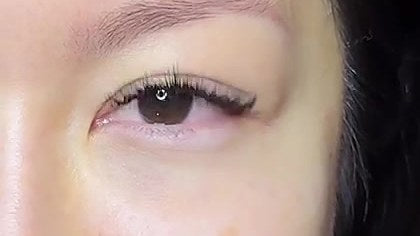
Can you remove lash extensions at home safely?
You can, if your eyes feel completely normal and you are patient. But it carries more risk than letting your extensions shed or having a lash tech take them off. The risk comes from two places: pulling on your natural lashes, and getting product into your eyes.
Each extension or lash fan is glued to one natural lash with what the American Academy of Ophthalmology (AAO) calls a "specially formulated, semi-permanent glue." Our guide to how lash extensions are applied explains the process. So when you tug an extension, you tug the natural lash underneath it.
The AAO's eyelash extension safety guide puts it plainly: "Rubbing, tugging or pulling can fracture your natural lashes, and even cause permanent damage to the eyelash follicle."
Eye doctors have documented other problems too. EyeWiki, the AAO's eye encyclopedia, describes traction alopecia as natural lashes being "lost due to the traction of synthetic lashes." It also describes subconjunctival hemorrhage (bleeding under the surface of the eye), which often shows up as a sudden red eye and "may be caused by mechanical compression when the lash extensions are removed."
The second risk is product in your eyes. The AAO's advice for any eye makeup remover is: "Whatever eye makeup remover you use, avoid getting it in your eyes." At home you work on your own eye in a mirror, which is harder than a lash tech working over your closed eyes.
The rest of this guide shows how to remove lash extensions at home with the least risk, and when not to try at all.
Stop signs: when not to remove lash extensions yourself
Do not try it at home if any of these apply. See an eye doctor first, and let them decide how the extensions should come off.
- You have symptoms. Pain, redness, itching, swelling, discharge, sensitivity to light, stinging or burning, a feeling that something is in your eye, or blurred or changed vision. For an allergic reaction, the AAO says "do not try to remove them yourself" and to see an ophthalmologist immediately.
- You have an eye infection, or the skin around your eye is inflamed. The US Food and Drug Administration (FDA) advises avoiding eye cosmetics altogether when that is the case.
- You have an eye condition or have had recent eye surgery. EyeWiki says clients with existing eye disease or a history of allergy should avoid extensions in the first place. Ask your eye doctor how yours should come off.
- Glue got into your eye, or your eyelids are stuck together. Health Canada warns that lash extension glue "may bond your eyelids instantly." Its Cosmetic Ingredient Hotlist requires these glues to carry the caution "Eyelid bonding: consult a physician."
- You cannot keep your eye closed and the product out of it. If you blink, flinch or tear up easily, a professional removal is the better choice.
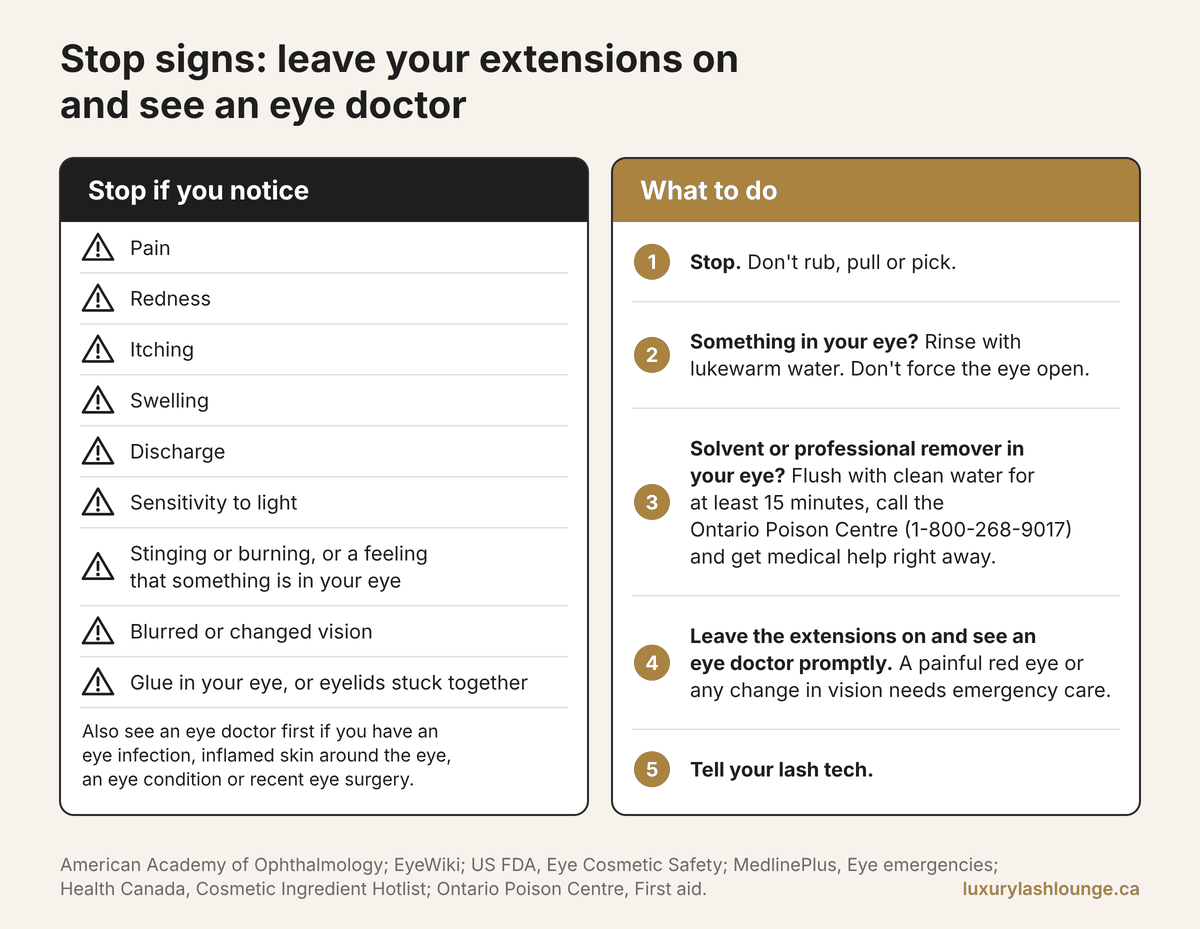
If you already have symptoms, here is what to do:
- Stop. Don't rub, pull or pick.
- Something in your eye? Rinse with lukewarm water. The Ontario Poison Centre says to rinse the eyes with lukewarm water and not to force the eye open.
- Solvent or professional remover in your eye? Treat it as an emergency. MedlinePlus advises flushing a chemical out of the eye with clean water for at least 15 minutes and getting medical help right away. You can call the Ontario Poison Centre at 1-800-268-9017.
- Leave the extensions on and see an eye doctor promptly. MedlinePlus lists eye pain, redness, sensitivity to light, discharge and vision loss among the symptoms of an eye emergency. It says a painful red eye or any change in vision needs emergency care.
- Tell your lash tech, so they know what happened. Our lash glue allergy guide explains reactions in more detail.
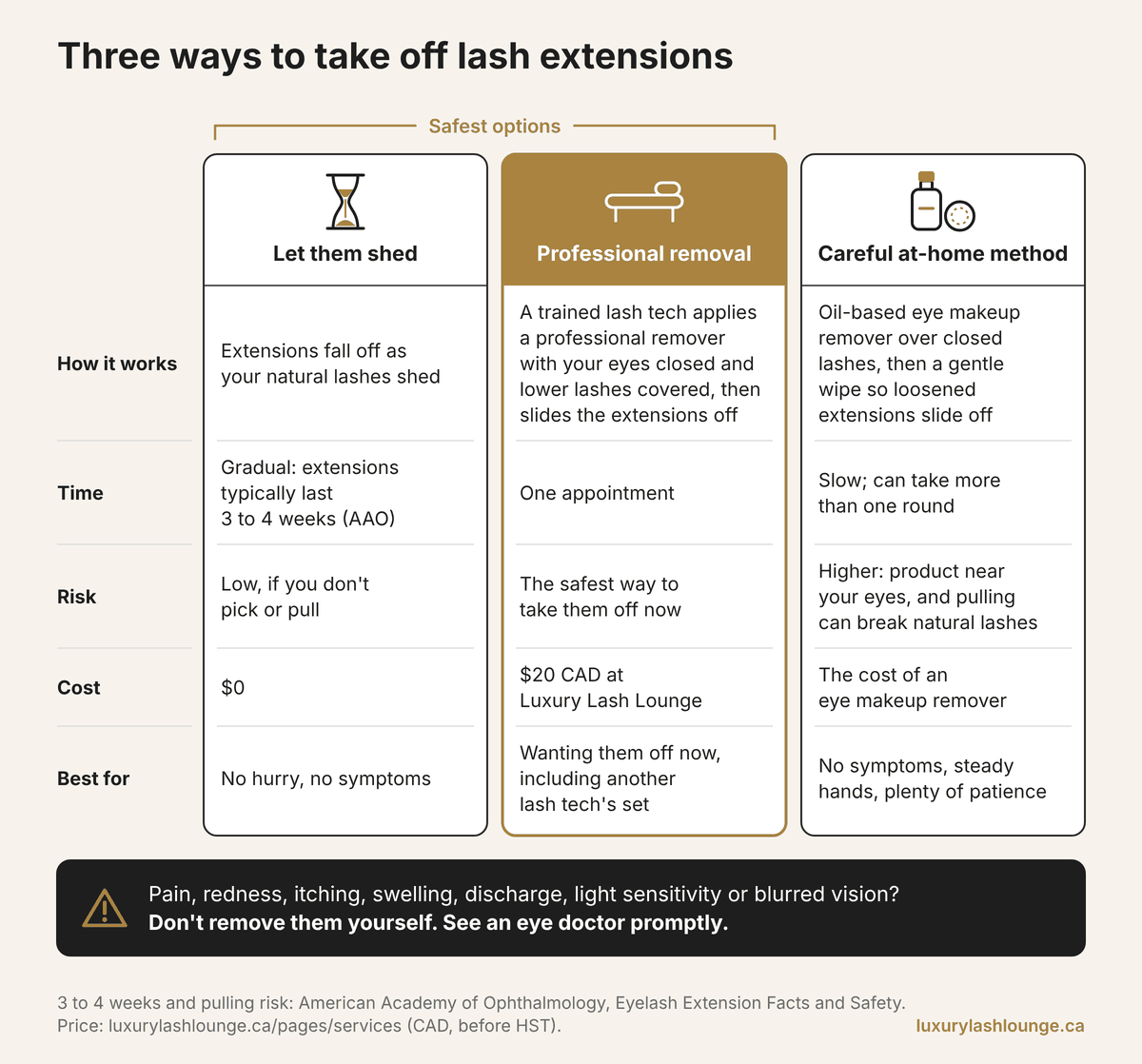
Three ways to take off lash extensions, compared
You have three choices: let them shed, book a professional removal, or remove them carefully at home. The first two are the safest options.
| Let them shed | Professional removal | Careful at-home method | |
|---|---|---|---|
| How it works | Extensions fall off as your natural lashes shed | A trained lash tech applies a professional remover with your eyes closed and lower lashes covered, then slides the extensions off | Oil-based eye makeup remover over closed lashes, then a gentle wipe so loosened extensions slide off |
| Time | Gradual: extensions typically last 3 to 4 weeks (AAO) | One appointment | Slow; can take more than one round |
| Risk | Low, if you don't pick or pull | The safest way to take them off now | Higher: product near your eyes, and pulling can break natural lashes |
| Cost | $0 | $20 CAD at Luxury Lash Lounge | The cost of an eye makeup remover |
| Best for | No hurry, no symptoms | Wanting them off now, including another lash tech's set | No symptoms, steady hands, plenty of patience |
Option 1: let them shed naturally
If you are in no hurry, the gentlest option is to do nothing at all. The AAO says extensions "typically last three to four weeks, falling off as your natural lashes shed."
Because each extension leaves with its own natural lash, nothing gets pulled and no remover goes near your eyes. The trade-off is a grow-out phase that can look patchy.
While you wait, keep your lashes clean and brush them gently. In our studio, we tell clients to wash their lashes ideally every day with an oil-free cleanser, such as our Lash Cleanser Kit. Our lash extension aftercare guide covers the routine, and our guide to how long lash extensions last explains the lash growth cycle behind the timing.
Option 2: book a professional removal
If you want your extensions off now, book a professional removal. A trained lash tech applies a remover made for the job while your eyes are closed and your lower lashes are covered, so nothing has to be pulled.
As our services page puts it, professional removal "is the safest way to take off eyelash extensions without damaging your natural lashes."
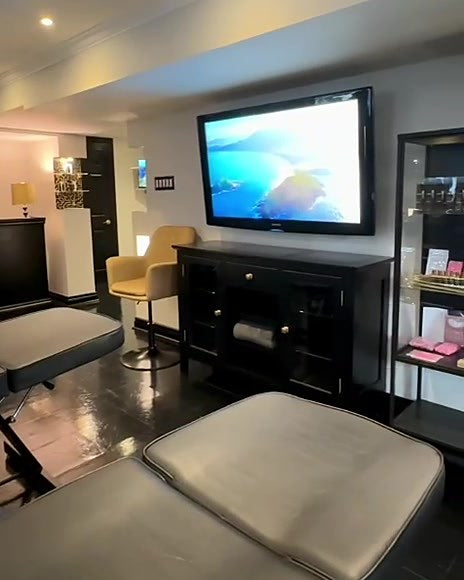
At Luxury Lash Lounge, a lash extension removal at our Woodbridge studio is $20 before HST, by appointment. Outside removals are welcome, so it doesn't matter who applied your set. If you book a new full set with us while wearing another technician's lashes, you must book a removal with it.
To book an appointment, text or call 647-533-7202, send a DM to @luxurylashlounge on Instagram, email luxurylashloungevaughan@gmail.com, or use the request form on our website. We need 24 hours' notice to cancel; see our booking policies. For what removals cost at other studios, see our guide to lash extension prices in Ontario.
One exception: if you have any of the stop signs above, see an eye doctor before you book anything. Follow their advice on how and when the extensions should come off.
How to remove eyelash extensions at home: the gentlest method, step by step
The gentlest way to take lash extensions off at home is slow and oil-based. You apply an oil-based eye makeup remover along the lash line, then wipe gently so any loosened extensions slide off on their own. Anything that doesn't slide off stays put until it sheds.
This is how to remove lash extensions at home as safely as possible, without a professional remover, which is never for home use. Oil-based removers are commonly used for this and may help loosen some extensions. We found no published research on how well they work on lash glue, though, so expect it to be slow and possibly incomplete.
What you need
- An oil-based eye makeup remover made for use around the eyes. If you don't have one, people commonly use a plain oil or petroleum jelly instead (compared in the table further down).
- Clean, lint-free pads, so no fibres are left on your lashes.
- A clean spoolie for brushing through. Our Lash Spoolies come in packs of 50, so you can use a fresh one each time.
- A mirror, good light and a clean towel.
- An oil-free cleanser for afterwards, such as our Lash Cleanser Kit.
The steps
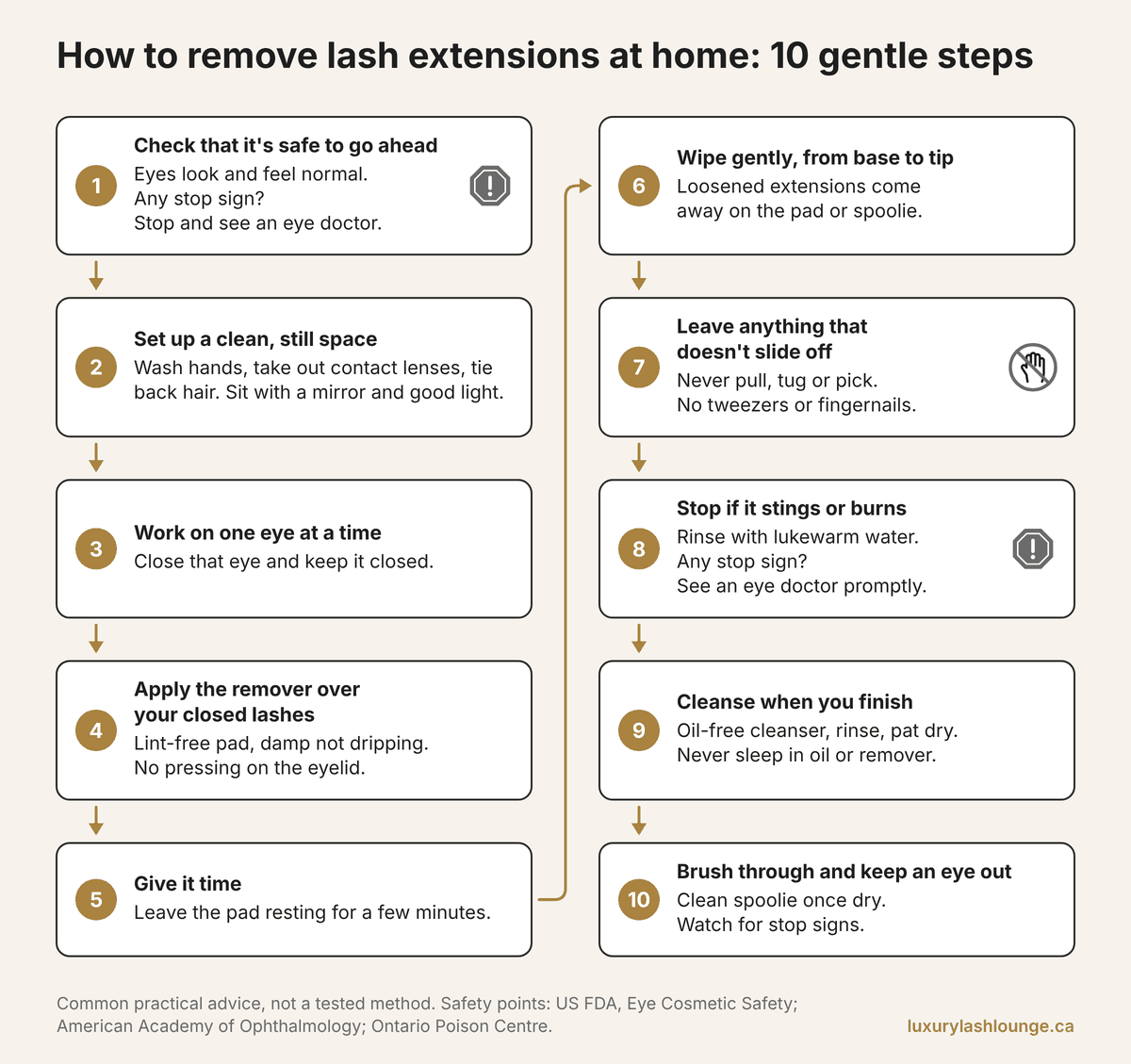
Here is how to take off eyelash extensions at home, one eye at a time. Where a step comes from a health body, we name it; the rest is common practical advice, not a tested method.
- Check that it's safe to go ahead. Your eyes should look and feel completely normal. If you have any of the stop signs above, stop here and see an eye doctor.
- Set up a clean, still space. Wash your hands, take out contact lenses and tie back your hair, then sit at a table with a mirror and good light. The FDA's eye cosmetic safety tips include washing your hands and making sure "any instrument you place in the eye area is clean." The FDA also warns never to apply or remove eye cosmetics in a moving vehicle.
- Work on one eye at a time. Close the eye you are working on and keep it closed. Watch in the mirror with your other eye.
- Apply the remover over your closed lashes. Wet a lint-free pad with a small amount of remover, so it is damp but not dripping. Rest it gently on the closed upper lashes, without pressing on your eyelid.
- Give it time. Leave the pad resting there for a few minutes so the remover can soak in around the bases of the extensions. Keep your eye closed the whole time.
- Wipe gently, from base to tip. Slide the pad, or a clean spoolie, along your lashes in the direction they grow. Extensions that have loosened will come away on the pad or the spoolie.
- Leave anything that doesn't slide off. Never pull, tug or pick, and never use tweezers or your fingernails. Add a little more remover and wait again, or leave stubborn extensions to shed with your natural lashes.
- Stop if it stings or burns. If anything gets into your eye, rinse it with lukewarm water and leave the rest of the extensions on. The FDA says to stop using any eye cosmetic that causes irritation, and "if irritation persists, see a doctor." With pain, redness or any other stop sign, see an eye doctor promptly.
- Cleanse when you finish. Wash your lashes and lids with an oil-free cleanser, rinse well with clean water and pat dry. Never go to bed with oil or remover on your lashes.
- Brush through and keep an eye out. Once your lashes are dry, brush them gently with a clean spoolie. Over the next few days, watch for any of the stop signs.
How to take off lash extensions without damage
There is no guarantee when you take lash extensions off at home, but three habits help protect your natural lashes:
- No pulling or rubbing. These are exactly what the AAO warns can fracture lashes and damage the follicle.
- No harsh solvents. Stick to an oil-based eye makeup remover or a plain oil, and keep it out of your eyes.
- Patience over force. If some extensions won't budge, stop. They will shed with your natural lashes, or a lash tech can finish the job with a professional remover.
A stubborn extension is still firmly glued to a living lash, so leaving it is always safer than forcing it.
What dissolves lash extension glue?
Lash extension glue is a cyanoacrylate, and once it has set, lash techs loosen it with a professional remover made for the job. At home, oil-based removers may help loosen it slowly, and nothing stronger should go near your eyes.
Cyanoacrylates "are well-known fast-setting adhesives," the family behind instant "super glues" and medical skin adhesives, according to a 2018 review in Molecules. They are sold as liquids with stabilizers, and "rapid anionic polymerization on exposure to surface moisture is responsible for instant adhesion." In plain terms, moisture turns the liquid glue into a solid plastic almost instantly.
Our own EXTREME BOND lash glue, for example, lists ethyl cyanoacrylate as its first ingredient. Like every cyanoacrylate lash extension glue sold in Canada, it is for trained professionals, not for home use. Health Canada's Cosmetic Ingredient Hotlist says these adhesives "must be sold for professional use only (i.e., not for direct sale to consumers)."
Why professional removers stay in the studio
Professional removers, such as gels and creams, are solvent-based products used with the client's eyes closed and protected. A 2018 case report in the American Journal of Ophthalmology Case Reports calls one an "eyelash extension removal solvent." In that report, a misapplied removal gel left a 46-year-old woman, who had previously had LASIK surgery, with chemical conjunctivitis and corneal inflammation in both eyes.
The report describes significant dry eyes, corneal haze and fluctuating vision afterwards. A 2024 study on eyelash extensions and dry eye notes that the eye's surface barrier "might be broken" by mechanical effects and by "the chemical glue or removal solvents." EyeWiki says the ingredients of glues and removers "should also be strictly regulated and monitored."
That is why we never suggest a professional remover for home use, including ours. Lash techs use them with the lower lashes covered and the eyes kept closed until every trace is cleaned away.
Why acetone and nail polish remover never belong near your eyes
You may see acetone or nail polish remover suggested online. Don't use either anywhere near your eyes. MedlinePlus lists nail polish remover among the products that contain acetone, and the Canadian Centre for Occupational Health and Safety (CCOHS) classifies acetone as causing serious eye irritation.
CCOHS also lists acetone as a highly flammable liquid that can ignite at room temperature. The same caution applies to any other household solvent: if it isn't made for the eye area, keep it away from your eyes.
Coconut oil, olive oil, petroleum jelly, micellar water and steam: what people try
Oil-based products are commonly used for at-home removal and may help loosen extensions. Micellar water and steam aren't designed to break down lash glue, and solvents never belong near your eyes.
| What people try | What it is | Does it help loosen extensions? | Risks and cautions |
|---|---|---|---|
| Oil-based eye makeup remover | A makeup remover with oils, made for the eye area | Commonly used; may help loosen extensions slowly | Keep it out of your eyes, as the AAO advises for any eye makeup remover; stop if it stings |
| Coconut oil | A plant oil | Commonly suggested; we found no research on lash glue | Not made for the eye area; use a little, keep it out of your eyes and cleanse it off afterwards |
| Olive oil | A kitchen oil | Commonly suggested; we found no research on lash glue | Same as coconut oil |
| Petroleum jelly | A thick, greasy jelly | We found no research on lash glue | Use a thin layer on the outside of closed lashes only; keep it out of your eyes; cleanse it off afterwards |
| Micellar water | Water mixed with surfactants that lift oil, makeup and dirt | We found no evidence that it loosens lash glue | Gentle, but don't expect it to take extensions off |
| Steam or a warm compress | Warm moisture on the face or closed eyes | We found no evidence that it loosens lash glue | Steam and hot liquids can scald; keep it warm, never hot, and skip facial steamers |
| Acetone or nail polish remover | A solvent | Not safe to use near the eyes | Acetone causes serious eye irritation and is highly flammable (CCOHS) |
| Professional gel or cream remover | A solvent-based remover for lash techs | Made to loosen lash glue | Professional use only; in one reported case, a misapplied removal gel caused chemical injury to both eyes |
If you are still wearing a set you want to keep, note that lash techs commonly advise keeping oil-based and greasy products, including petroleum jelly, away from extensions. Oil is widely believed to weaken the bond, which is the same effect at-home removal relies on. Our guide to mascara and makeup with lash extensions covers which removers suit a set you are keeping.
Can I use olive oil to remove lash extensions?
You can try, with the same care as any oil. Olive oil is a kitchen product rather than a cosmetic made for the eye area, and we found no research on how well it loosens lash glue.
If you use it, put a small amount on a lint-free pad, rest it on your closed lashes and follow the steps above. Keep it out of your eye, never pull, and wash it off afterwards with an oil-free cleanser.
Will micellar water remove lash extensions?
It isn't designed to. Micellar water "typically consists of water mixed with surfactants (surface-active agents)," according to a 2024 paper in the journal Dermato. Its micelles trap oils and fats, so makeup, sunscreen and dirt lift away without harsh rubbing.
That makes it a cleanser, not a remover for set lash glue. We found no reliable evidence that it loosens lash extensions, so don't expect it to take them off.
Does steam or a warm compress help?
We found no reliable evidence that steam or warmth loosens lash glue, and heat near your face has real risks. MedlinePlus lists scalds from hot liquids and steam among the most common causes of burns, so skip facial steamers and bowls of hot water.
If you still want to try a warm compress, the AAO describes one for blepharitis, an eyelid condition, not for lash removal. You wet a clean washcloth with warm water, wring it out until somewhat dry and place it over closed eyes. Keep it warm, never hot.
What never to do when taking off lash extensions
When you take off lash extensions at home, never pull, pick, rub or cut them, and never dissolve them with anything not made for the eye area. Each of these puts your natural lashes or your eyes at risk.
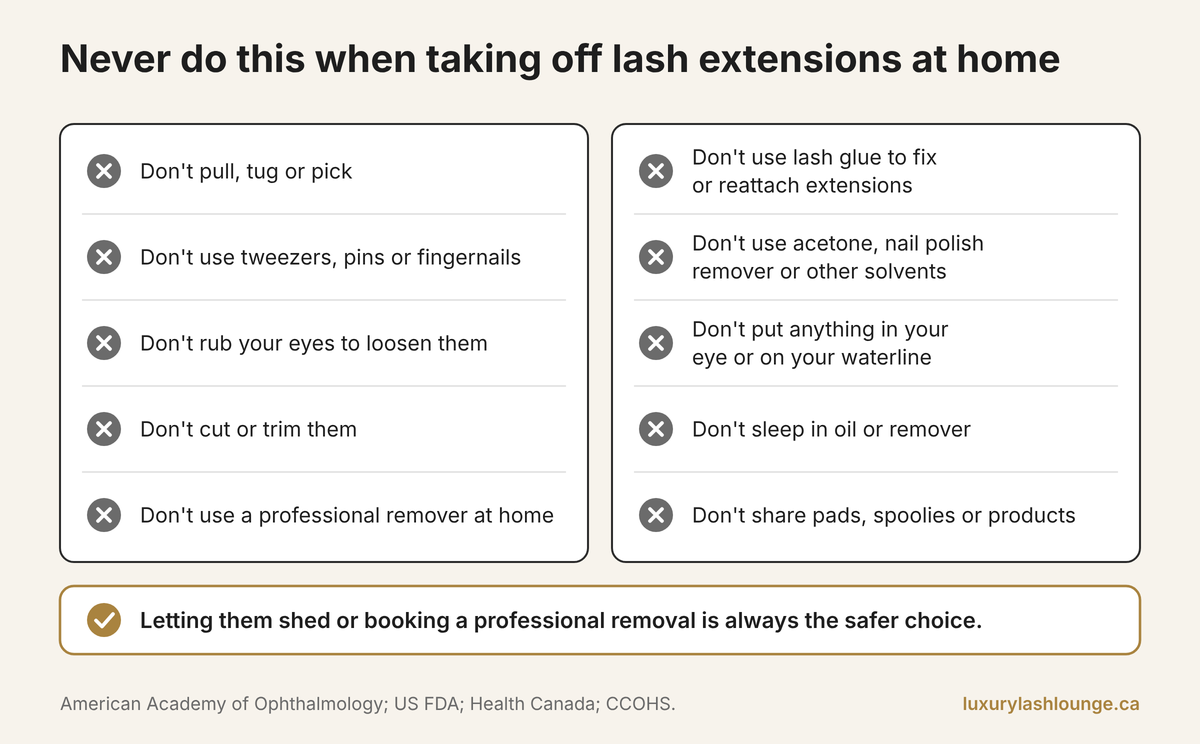
- Don't pull, tug or pick. Pulling an extension pulls the natural lash it is glued to, and the AAO warns this can fracture lashes and permanently damage the follicle.
- Don't use tweezers, pins or fingernails. The FDA warns to be careful "not to scratch the eyeball or other sensitive area" when applying or removing eye cosmetics.
- Don't rub your eyes to loosen them. Rubbing is on the AAO's list of what damages lashes, alongside tugging and pulling.
- Don't cut or trim them. Scissors near your eye can injure you, and the glued base stays on your lash anyway.
- Don't use a professional remover at home, including our cream remover. It is made for trained lash techs and "is not for clients to use at home."
- Don't use lash glue to fix or reattach extensions. Health Canada restricts cyanoacrylate lash adhesives to professional use and warns they "may bond your eyelids instantly."
- Don't use acetone, nail polish remover or other solvents. CCOHS classifies acetone as causing serious eye irritation.
- Don't put anything in your eye or on your waterline. Keep every product on the outside of your closed lashes.
- Don't sleep in oil or remover. The AAO advises you to "remove all eye makeup at night before sleeping," so treat oil and remover the same way.
- Don't share pads, spoolies or products. Health Canada says never to borrow or share eye make-up, and the FDA warns that "another person's bacteria may be hazardous to you."
After removal: caring for your natural lashes
Once the extensions are off, cleanse away every trace of oil or remover, then treat your natural lashes gently. That means no rubbing, no pulling and a clean spoolie for brushing.
- Cleanse. Our Lash Cleanser Kit pairs a 60 ml oil-free foam cleanser with a cleansing brush, and it is for washing natural lashes as well as extensions. With your eyes closed, apply a little foam with the brush, then brush gently through the lashes and along the lash line.
- Rinse and dry. Rinse well with clean water and pat dry with a clean towel. Don't rub.
- Brush. Once your lashes are dry, brush them into place with a clean spoolie.
- Watch. Keep an eye out for the stop signs over the next few days. If you notice any of them, see an eye doctor promptly.

If your lashes look thinner or patchier than you expected, don't pick at them. Our guide to what lash extensions can do to natural lashes explains lash damage, regrowth and the signs of a bad set.
Planning a new set? If you have had a reaction or sensitivity to lash extensions before, we recommend a $20 patch test first. If you had symptoms this time, check with your eye doctor before you book.
What a professional removal looks like at a lash studio
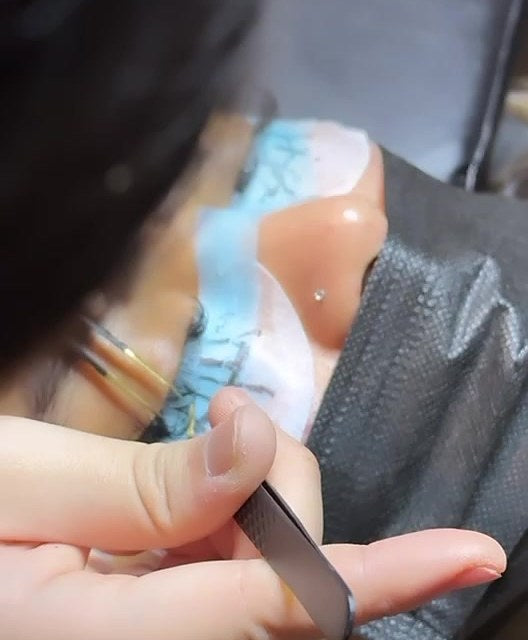
A professional removal is done with your eyes closed from start to finish. Your lash tech protects your lower lashes, applies a remover made for the job and lets it work, then slides the extensions off without pulling.
Here is what to expect:
- A quick check-in. Tell your lash tech about any sensitivity, eye condition or recent eye surgery, and take out contact lenses.
- Eyes closed. You lie back on a lash bed and close your eyes.
- Lower lashes covered. A gel eye pad goes under each eye to cover and protect the lower lashes.
- Remover on. The lash tech applies the remover to the extensions with a fine, lint-free swab, keeping it out of your eye and off your skin.
- A short wait. The remover stays on until the extensions come away easily. Our cream remover's instructions say 3 to 5 minutes.
- Extensions off. They are slid off your natural lashes with a clean swab or tweezer.
- Clean-up. Any remover left on your lashes is cleaned away before you open your eyes.
Nothing should be pulled. If anything stings, tell your lash tech straight away.
In our studio, we use our own Eyelash Extension Cream Remover, which is for professional use only, and our Gel Eye Pads. Like everything in our shop, they are what we use on our own clients.
For lash techs: how a professional removal is done
This section is for trained lash technicians.
Work with the client's eyes closed, protect the lower lashes, and let a professional remover do the work so nothing is pulled. These steps follow the instructions for our Eyelash Extension Cream Remover.
- Check first. Ask about symptoms before you start. If a client has signs of a reaction or infection, refer them to an eye doctor before doing anything. The AAO tells clients with a reaction not to remove extensions themselves, and EyeWiki advises "prompt professional medical advice" for symptoms.
- Close and protect. Have the client close their eyes and place a Gel Eye Pad under each eye, covering the lower lashes, close to the lash line but off the waterline. Check that no lower lashes sit above the pad, and tape down strays if needed.
- Apply. Apply a small amount of cream to the extensions with a Lint Free Micro Swab, keeping it out of the eye and off the skin.
- Wait. Leave it on for 3 to 5 minutes, or until the extensions come away easily.
- Slide, don't pull. Gently slide the extensions off the natural lashes with a clean micro swab or tweezer.
- Clean up. Clean away any cream left on the natural lashes before the client opens their eyes. Use a fresh pair of pads and clean swabs for every client.

The cream remover is a thick 5 g cream ($15) that sits on the lashes instead of running into the eyes or onto the skin. Even so, keep it out of the eyes and off the skin. Its ingredients are propylene carbonate, bentonite, methyl methacrylate/acrylonitrile copolymer and fragrance (parfum).
Our Gel Eye Pads ($20 for 50 pairs) are hypoallergenic and lint free, and they are the same pads we use in our own appointments. Our micro swabs ($8 for 50) have a 3 mm nylon tip that leaves no fuzzy residue, unlike a cotton swab. You will find the rest in our lash extension tools.
Remember the case report above: a misapplied removal gel injured both of a woman's eyes. Take your time, keep the remover out of the eye and off the skin, and clean away every trace before the client opens their eyes. For the public health side of lashing professionally, see our guide on how to become a lash tech in Ontario. We teach removals, along with refills and patch tests, in our 1-on-1 Eyelash Extension Masterclass.
FAQ
What is the easiest way to remove eyelash extensions at home?
The easiest way is not to remove them at all. The AAO says extensions typically last three to four weeks, falling off as your natural lashes shed.
If you want them off sooner, the gentlest home method is an oil-based eye makeup remover on a lint-free pad over closed lashes, then a gentle wipe. Never pull. A professional removal is safer still.
Will Vaseline remove eyelash extensions?
The AAO calls it "a very effective makeup remover," but that is about removing eye makeup, not lash glue. It may loosen some extensions, though we found no research on how well petroleum jelly works on lash glue.
Because it is greasy, lash techs commonly advise keeping it away from a set you want to keep. To try it for removal, use a thin layer on the outside of closed lashes, keep it out of your eyes, wipe gently, never pull and cleanse it off afterwards.
What dissolves eyelash extension glue?
Lash glue is a cyanoacrylate that hardens on contact with moisture. Lash techs loosen it with professional removers, which are solvent-based and kept out of the eye.
At home, oil-based removers may help loosen it slowly. Never use acetone or nail polish remover: CCOHS classifies acetone as causing serious eye irritation, and it is highly flammable.
What can I use if I don't have a lash remover?
An oil-based eye makeup remover made for the eye area is the gentlest choice. If you don't have one, people commonly use a plain oil or a thin layer of petroleum jelly instead.
Whatever you use, keep it out of your eyes, follow the steps above and never pull. Don't improvise with solvents, and don't buy a professional remover for home use.
How long does it take for extensions to fall out on their own?
The AAO says lash extensions "typically last three to four weeks, falling off as your natural lashes shed." Because they come off with your own lashes rather than all at once, a set thins out gradually. Our guide to how long lash extensions last explains the lash growth cycle and refills in detail.
Can I remove lash extensions with coconut oil?
Coconut oil is commonly suggested and may help loosen some extensions. We found no research on how well it works on lash glue, though, and it isn't made for the eye area.
If you use it, apply a little on a lint-free pad over closed lashes, keep it out of your eyes, wipe gently and never pull. Cleanse afterwards with an oil-free cleanser.
Will removing extensions pull out my lashes?
Done properly, it shouldn't, because nothing is pulled. A professional remover loosens the bond so the extensions slide off the natural lashes.
At home, anything that doesn't slide off should be left to shed. Pulling is the real problem: the AAO says rubbing, tugging or pulling can fracture natural lashes and even permanently damage the follicle.
Can I buy the cream remover or lash glue to use at home?
No. Our Eyelash Extension Cream Remover is for professional use only and "is not for clients to use at home." Lash glue is professional only too: Health Canada says cyanoacrylate eyelash extension adhesives "must be sold for professional use only."
To have your extensions taken off, book a removal. To learn the skill, take a lash course.
My eyes are itchy, red or swollen. Should I take my extensions off?
No, don't remove them yourself. For an allergic reaction, the AAO says "do not try to remove them yourself" and to see an ophthalmologist immediately.
Stop rubbing and leave the extensions on. See an eye doctor promptly, and tell your lash tech what happened so they know before your next appointment.
How much does it cost to have lash extensions removed?
At Luxury Lash Lounge, a removal costs $20 before HST, by appointment at our Woodbridge studio, and that includes another lash tech's work. Prices at other studios vary. For removal and refill prices across the province, see our guide to lash extension prices in Ontario.
Can I get new lash extensions after a removal?
Yes. At our studio, if you are wearing another lash tech's extensions, you must book a removal with your new full set. We also don't refill another technician's work.
If you have reacted to extensions before, we recommend a $20 patch test first. If you had symptoms this time, check with your eye doctor before you book.
About the author
Alessia Simonetta is the owner, master lash artist and certified lash trainer at Luxury Lash Lounge in Woodbridge (Vaughan), Ontario. She has been lashing since 2018 and holds five certifications: Classic Lash Artist, Hybrid Lash Artist, Volume Lash Artist, Mega Volume Artist and Certified Lash Trainer. She has worked with thousands of lash clients and trained hundreds of students.
Book a removal or a new set through our lash extension services, or learn removals, refills and patch tests in our 1-on-1 lash training.
Sources
- American Academy of Ophthalmology, "Eyelash Extension Facts and Safety" (Reena Mukamal, reviewed by Rebecca J Taylor, MD, February 23, 2018): https://www.aao.org/eye-health/tips-prevention/eyelash-extension-facts-safety
- American Academy of Ophthalmology, "How To Use Cosmetics Safely Around Your Eyes" (Dan Gudgel, reviewed by Rebecca J Taylor, MD, October 27, 2026): https://www.aao.org/eye-health/glasses-contacts/eye-makeup
- American Academy of Ophthalmology, "What Is Blepharitis?" (Kierstan Boyd, reviewed by Brenda Pagan-Duran, MD, October 20, 2026): https://www.aao.org/eye-health/diseases/what-is-blepharitis
- EyeWiki (American Academy of Ophthalmology), "Eyelash Extensions" (last reviewed May 10, 2026): https://eyewiki.aao.org/Eyelash_Extensions
- Health Canada, "Eye cosmetics": https://www.canada.ca/en/health-canada/services/cosmetics/eye-cosmetics.html
- Health Canada, "Cosmetic Ingredient Hotlist" (entry for cyanoacrylate-based adhesives; modified August 13, 2025): https://www.canada.ca/en/health-canada/services/consumer-product-safety/cosmetics/cosmetic-ingredient-hotlist-prohibited-restricted-ingredients/hotlist.html
- US Food and Drug Administration, "Eye Cosmetic Safety" (content current as of June 28, 2022): https://www.fda.gov/cosmetics/cosmetic-products/eye-cosmetic-safety
- MedlinePlus Medical Encyclopedia (US National Library of Medicine), "Eye emergencies" (reviewed April 29, 2025): https://medlineplus.gov/ency/article/000054.htm
- MedlinePlus Medical Encyclopedia, "Acetone poisoning" (reviewed April 8, 2025): https://medlineplus.gov/ency/article/002480.htm
- MedlinePlus, "Burns" (last updated October 10, 2024): https://medlineplus.gov/burns.html
- Canadian Centre for Occupational Health and Safety, OSH Answers chemical profile, "Acetone": https://www.ccohs.ca/oshanswers/chemicals/chem_profiles/acetone.html
- Ontario Poison Centre, "First aid": https://www.ontariopoisoncentre.ca/for-families/first-aid/
- Duffy C, Zetterlund PB, Aldabbagh F. "Radical Polymerization of Alkyl 2-Cyanoacrylates." Molecules 2018;23(2):465 (DOI 10.3390/molecules23020465): https://www.mdpi.com/1420-3049/23/2/465
- Moshirfar M, Masud M, Shah TJ, Avila MR, Hoopes PC Sr. "Chemical conjunctivitis and diffuse lamellar keratitis after removal of eyelash extensions." American Journal of Ophthalmology Case Reports 2018;12:21-23 (DOI 10.1016/j.ajoc.2018.07.007); abstract read on the Directory of Open Access Journals: https://doaj.org/article/8993269faa424875bbded0b64480282a
- Grupcheva CN, Grupchev DI, Usheva N, Grupcheva LO. "Beauty versus Health—How Eyelash Extensions May Affect Dry Eye Disease?" Journal of Clinical Medicine 2024;13(11):3101 (DOI 10.3390/jcm13113101): https://www.mdpi.com/2077-0383/13/11/3101
- Skadiņa D, Nokalna I, Balcere A. "Assessment of Micellar Water pH and Product Claims." Dermato 2024;4(3):79-85 (DOI 10.3390/dermato4030009): https://www.mdpi.com/2673-6179/4/3/9