
Quick answer
Do lash extensions ruin your lashes? They shouldn't, when the extensions suit your natural lashes, a trained lash tech applies them and a professional removes them.
Eye doctors and researchers do document real harm, though: lash loss from pulling (traction alopecia), broken lashes, damaged follicles, eye irritation, infection and glue allergies. Most of these risks have known causes you can avoid or reduce, and this guide walks through each one.
This guide is general information, not medical advice. If your eyes hurt, look red or swollen, or your vision changes, don't remove your extensions yourself. See an eye doctor.
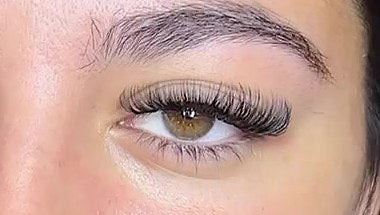
Do lash extensions ruin your lashes? What eye doctors and research say
Do lash extensions damage eyelashes? They can, but not by default.
According to the American Academy of Ophthalmology (AAO), ophthalmologists say extensions can be safe as long as you take precautions. The AAO also lists both temporary and permanent lash loss among the risks.
Here is what the main sources say, and what each one means for you.
| Source | What it found | What it means for you |
|---|---|---|
| American Academy of Ophthalmology (2018) | Risks include injury to or infection of the eyelid or cornea, allergic reactions to the glue, and temporary or permanent lash loss. Rubbing, tugging or pulling can break lashes and permanently damage the follicle. | Damage is possible, and much of it comes from handling. |
| EyeWiki, the AAO's eye encyclopedia (reviewed 2026) | Lists inflammation of the eye's surface, allergic eyelid reactions, damage to the eye's surface, broken blood vessels on the white of the eye, and traction alopecia as complications. | The problems on record come from pulling, glue, tape and removal. |
| Masud et al., 2019 review | Millions of cosmetic eyelid procedures, including extensions, are done every year without any adverse effects, but reports of complications keep increasing. | Many procedures go without problems, but complications are real and reports of them are growing. |
| Amano and Nishiwaki, 2013 national web survey in Japan (self-reported) | Of 205 women who had worn extensions, 55 (26.8%) reported health problems such as eye redness, pain, and itchy, swollen eyelids; about 73% did not report any. Short intervals between extensions were linked to reported problems. | Most of these women reported no problems, but about 1 in 4 did: common enough to take seriously. |
| Grupcheva et al., 2024 study | In 31 women with dry eye complaints, dry eye symptoms and test results improved 4 weeks after their extensions were removed. | If you have dry eyes, talk to your eye doctor first. |
Two patterns stand out. Damage has clear causes: weight and pull on each lash, glue and tape near the eye, rubbing, poor hygiene and rough removal. And most of those causes are in your hands, or your lash tech's.
Keep the limits in mind, too. The Japanese survey relied on women's own reports, and the 2024 study was small (31 women, all with dry eye complaints) and short (4 weeks), so neither shows exactly how often extensions cause harm.
Normal shedding vs lash damage
Losing some lashes is normal. Each natural lash goes through a three-phase life cycle and then falls out, and a new lash starts growing in its place (Aumond and Bitton, 2018). The AAO notes that extensions fall off as your natural lashes shed, so an extension with a natural lash attached is usually just that cycle at work.
| Normal shedding | Possible damage | |
|---|---|---|
| What you see | Single lashes falling out, each with its extension attached | Gaps, bare patches, or lashes that look broken off short |
| What causes it | A lash reaching the end of its life cycle | Weight, lashes glued together, rubbing, picking or rough removal |
| Regrowth | A new lash grows in its place | Slow or absent if the follicle is damaged |
| What to do | Nothing | Remove the cause, have the extensions taken off professionally, and see an eye doctor if gaps don't fill in |
How lash extensions damage lashes: the 6 main causes
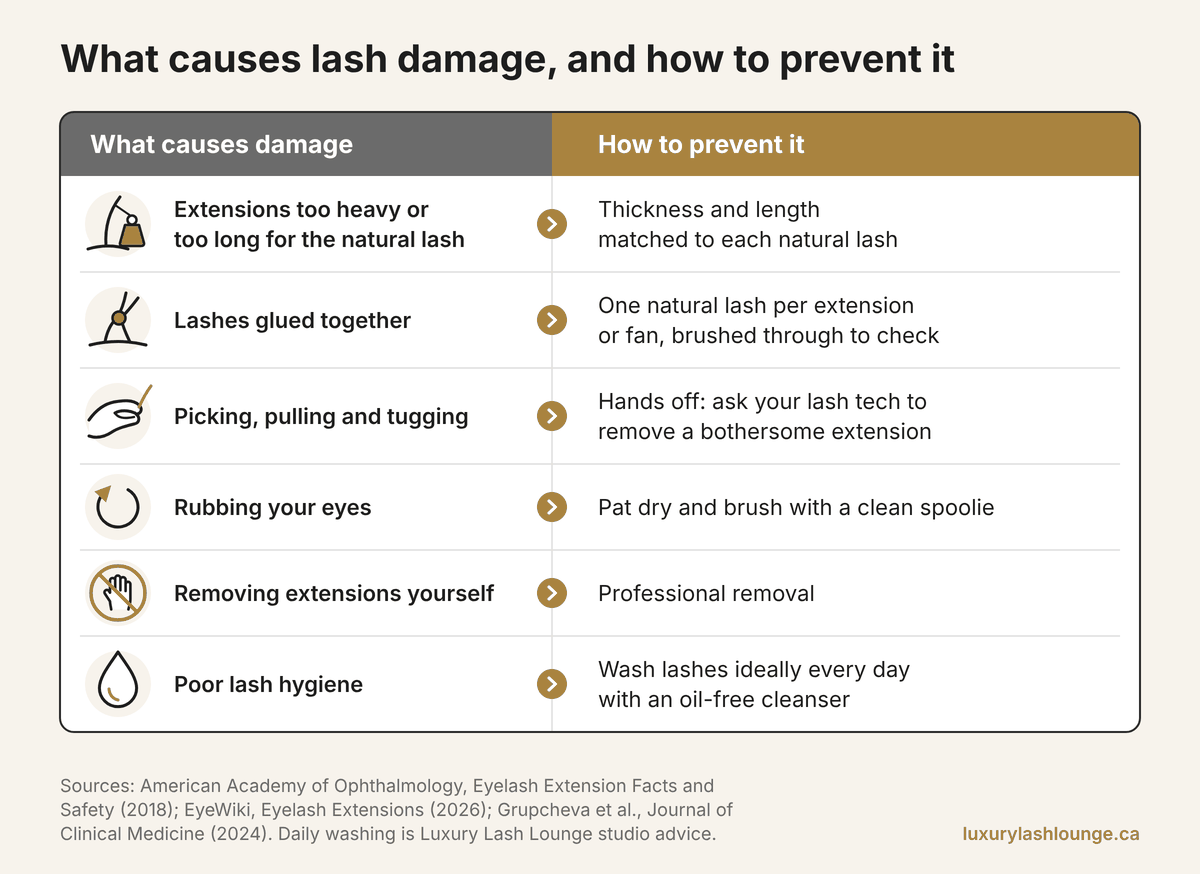
Eyelash extensions damage natural lashes mainly through pulling: too much weight on each lash, lashes glued together, and fingers that pick, tug or rub. Removing extensions yourself and poor hygiene add to the risk.
What is traction alopecia?
With lash extensions, traction alopecia means losing natural lashes to the steady pull of the extensions. EyeWiki defines it as natural lashes lost to the traction of synthetic lashes, and warns that it may damage the follicles further and stunt lash growth. In clinics, lash loss is often called madarosis, though a Journal of Optometry review says milphosis is the more precise term.
The term is better known from scalp hair. The American Academy of Dermatology warns that traction alopecia from hairstyles that pull can become permanent the longer it goes untreated. Its page covers scalp hair only and doesn't mention lashes.
For lashes, the evidence comes from EyeWiki and the other eye sources in this guide, not from the AAD. Because EyeWiki warns that the pull may damage lash follicles further, the safest move is to stop the pulling as soon as you notice it.
1. Extensions that are too heavy or too long
Each extension, or each fan of fine extensions, is glued to a single natural lash. That lash carries the extra weight, day and night, until it sheds. If the extension is too thick or too long for it, it keeps pulling on the follicle.
The authors of the 2024 study suggest that the added weight of synthetic extensions is "probably the most rational explanation" for the lash loss they noted, though they didn't measure it. Most lash techs choose finer, shorter extensions for fine or short natural lashes to keep that weight down.
2. Lashes glued together
When glue joins two or more natural lashes, they can no longer grow and shed separately. Lash techs call these "stickies" and treat them as a fault, because one lash ends up dragging on its neighbour. You might see a clump that won't separate when you brush it, or feel a tug at the lash line.
3. Picking, pulling and tugging
Picking at a loose extension pulls on the natural lash it's bonded to. The AAO warns that rubbing, tugging or pulling can break natural lashes and even permanently damage the follicle. If an extension bothers you, leave it alone and ask your lash tech to take it off.
4. Rubbing your eyes
Rubbing is the same pull, repeated many times. A review in the Journal of Optometry notes that long-term mascara use has been linked to lash loss, possibly from rubbing it off with fingers and water. With extensions, pat your lashes dry and brush them with a clean spoolie instead of rubbing.
Try not to rub even when your eyes itch. Itching that doesn't settle can be a sign of a reaction, so see an eye doctor.
5. Removing extensions yourself
Pulling extensions off, or picking at the glue, can take natural lashes with them. Professional removal is the safest way to take extensions off without damaging your natural lashes. Our studio removes lash extensions, including other lash techs' work, for $20 CAD.
Lash extension glue and professional removers are for trained professionals only, so they're not an at-home option. If your eyes are red, sore, itchy or swollen, don't remove anything yourself.
The AAO says trying to remove extensions during a reaction could damage your eyes, and advises seeing an ophthalmologist. Our guide on how to remove lash extensions at home explains why a professional removal is the safer choice.
6. Poor lash hygiene
Extensions can make lash hygiene slip. The authors of the 2024 study write that extensions are "very often" the reason for neglected eye hygiene, though that is their clinical view, not something the study measured. In the 31 women they examined, they noted a lot of uncleaned debris at the roots of the women's own lashes and, in some, significant Demodex mite infestation (Grupcheva et al.).
In our studio, we recommend washing your lashes ideally every day with an oil-free cleanser. Our Lash Cleanser Kit pairs a 60 ml oil-free foam with a cleansing brush, and it removes dirt and makeup without breaking down the adhesive bond.
Can lash extensions damage your eyes? Other risks to know
They can. Beyond lash loss, eye doctors document irritation of the eye's surface, infection, allergic reactions to the glue, and injuries during application or removal.
Problems aren't a given, though. In the 2013 national survey in Japan, about 73% of the women who had worn extensions did not report any health problems. Those answers were self-reported and came from one country, so they don't show how often problems happen elsewhere.
Eye irritation and dry eye
Keratoconjunctivitis, an inflammation of the eye's surface, causes itching, irritation and redness. EyeWiki links it to glue chemicals reaching the eye's surface during the procedure or in the hours afterwards. In our studio, we use a fan at the end of an appointment to clear glue fumes before you open your eyes.
Dry eye is less clear-cut. In the 2024 study of 31 women with dry eye complaints, symptoms and test results improved 4 weeks after their extensions came off. It was a small, short study, but if you already have dry eyes, talk to your eye doctor before booking.
Infection
The AAO lists infection of the eyelid or cornea among the risks. In a 2013 case report in the Canadian Journal of Ophthalmology, a 29-year-old woman developed a bacterial infection of the cornea after getting extensions. When she blinked, the bonding glue of one extension touched her cornea at the site of the ulcer; the infection cleared fully with antibiotic eye drops.
Health Canada notes that eye infections can be very serious and may cause blindness (Eye cosmetics). Keep your lashes clean, never share eye makeup, and choose a lash tech who keeps their hands and tools clean.
Allergic reactions
Allergic reactions are the complication reported most often: in the 2019 review, allergic blepharitis, an allergic reaction of the eyelids, made up 79% of the eyelash extension complications reported in the literature it reviewed, not 79% of wearers.
The AAO lists pain, itching, redness and swelling as signs of an allergic reaction to the glue, sometimes with temporary vision changes. If that happens, see an eye doctor right away and don't remove the extensions yourself. Our lash glue allergy guide explains how to tell an allergy from irritation and how patch tests work.
Injuries during application or removal
Health Canada warns that lash extension glue "may bond your eyelids instantly," and says the eyes must be protected and kept still during application. Its Cosmetic Ingredient Hotlist allows these glues to be sold for professional use only, with a required label warning to consult a physician if eyelids bond.
Tape and removal carry risks too. EyeWiki notes that eyelid tapes can rub and erode the eye's surface. It adds that pressure on the eye during removal can cause a subconjunctival hemorrhage, a burst blood vessel on the white of the eye.
The AAO also notes that, in rare cases, extension fibres get stuck under the eye tissue and may need surgical removal.
When to see an eye doctor
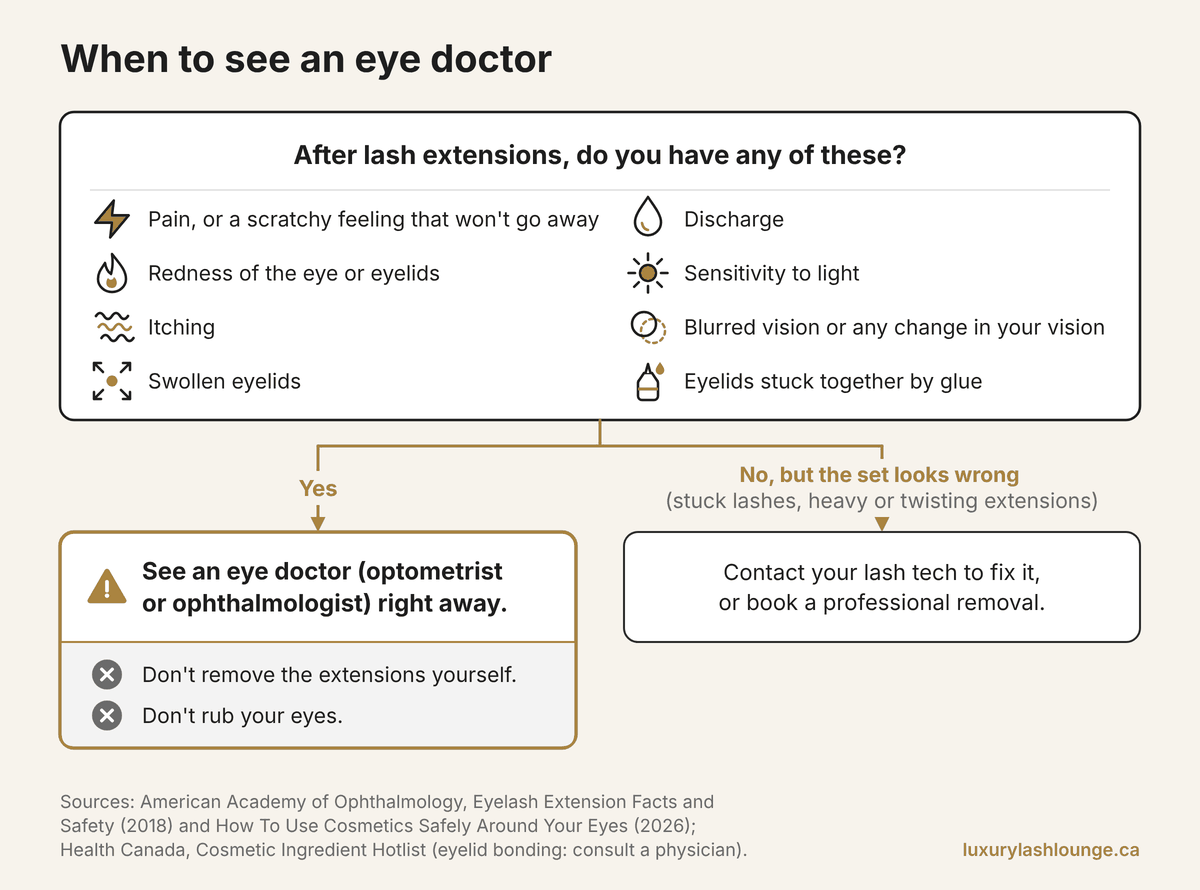
See an eye doctor, either an optometrist or an ophthalmologist, right away if you notice any of these after getting lash extensions:
- Pain, or a scratchy feeling that won't go away
- Redness of the eye or eyelids
- Itching
- Swollen eyelids
- Discharge
- Sensitivity to light
- Blurred vision or any change in your vision
- Eyelids stuck together by glue
Don't remove the extensions yourself, and don't rub your eyes. The AAO's advice is to see an ophthalmologist right away if you have any discomfort (AAO).
Signs of a bad lash set
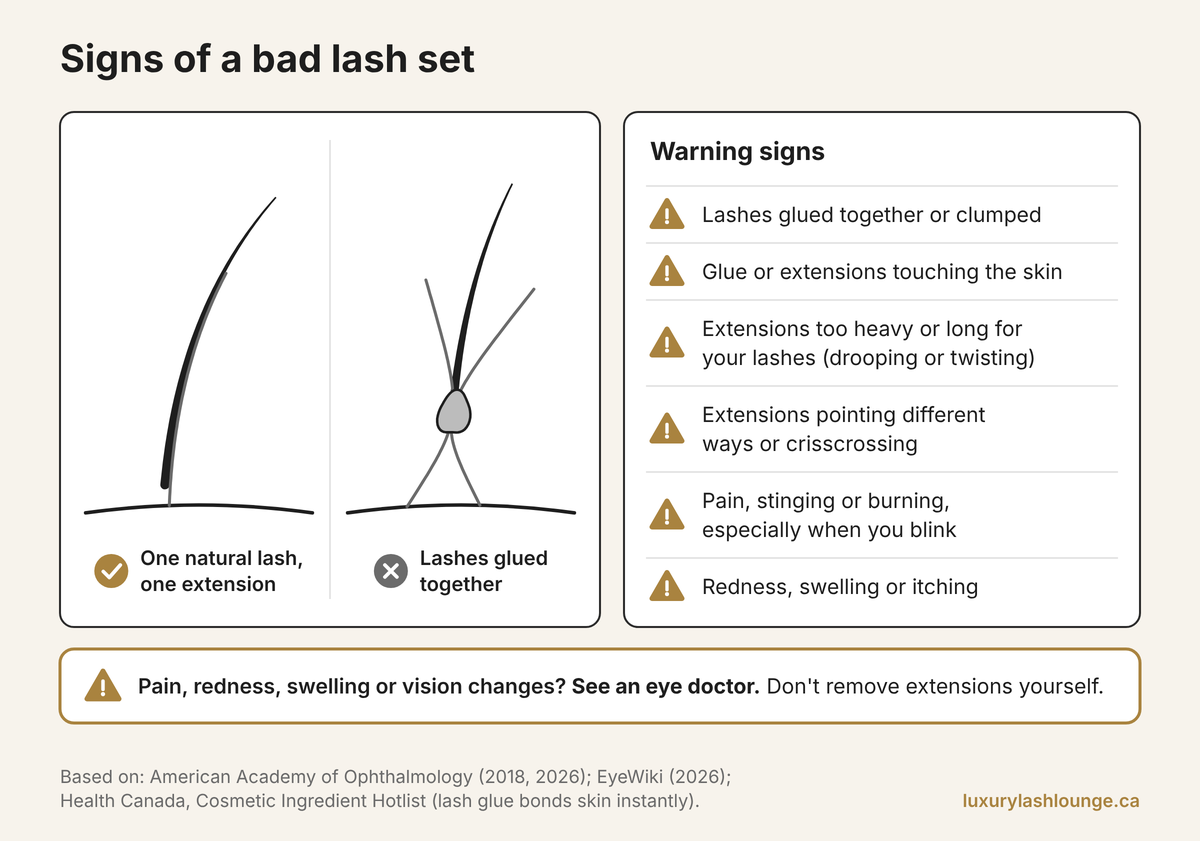
A bad lash set puts the look ahead of your natural lashes. The clearest signs are lashes glued together, glue or extensions touching your skin, extensions too heavy or long for your lashes, and any pain, redness or swelling.
| Sign | What you might notice | Why it matters |
|---|---|---|
| Lashes glued together | Clumps that won't separate when you brush them | Stuck lashes can't shed separately, so they tug on each other |
| Glue or extensions touching your skin | A stiff, scratchy or "stuck" feeling at the lash line | Lash glue bonds skin instantly and should stay off it |
| Extensions too heavy or long | Extensions that droop, twist or feel heavy | Extra weight pulls on each follicle |
| Uneven direction or crisscrossing | Extensions pointing different ways or crossing over | Often a sign the set wasn't checked carefully |
| Pain, stinging or burning | Discomfort when you blink or open your eyes | Not normal: see an eye doctor |
| Redness, swelling or itching | Red or puffy lids, or an itchy lash line | Possible irritation, allergy or infection: see an eye doctor |
If nothing hurts but you can see stuck lashes or extensions that look too heavy, contact your lash tech soon. A good lash tech will want to fix it.
If you'd rather start fresh somewhere else, note that our studio doesn't refill another lash tech's work, but we do remove it. You can book a removal through our contact page. Any pain, redness or swelling is a reason to see an eye doctor first.
Why do my eyelash extensions hurt when I blink?
Lash extensions shouldn't hurt when you blink. Pain on blinking can mean something is touching or rubbing your eye or eyelid, such as an extension tip, an extension bonded too close to the lid, or lashes glued together. It can also mean a scratch, an infection or a reaction on the eye's surface.
Some of these causes are documented. The AAO notes that glued lashes can dip into the eye and scratch the cornea if they aren't applied well. In the 2013 case report above, the glue of one extension touched the patient's cornea when she blinked.
| What you feel | Possible cause |
|---|---|
| Poking or scratching with each blink | An extension tip or base touching your eye or lid, or an extension placed too close to the lid |
| A tug at the lash line | Lashes glued together, or an extension too heavy for its natural lash |
| Stinging, burning or watering | Glue fumes or glue chemicals reaching the eye's surface |
| Pain with redness, light sensitivity, blurred vision or discharge | A possible scratch on the eye, an infection or a reaction |
See an eye doctor if you feel any pain or discomfort, especially with redness, swelling, discharge, light sensitivity or blurred vision. Don't pull out or trim the extensions yourself.
Go back to your lash tech if nothing hurts but you can see stuck lashes, extensions that twist or point the wrong way, or a set that looks too heavy.
Wondering whether the appointment itself hurts? Our guide to what lash extensions are and how they're applied covers that.
Will my lashes grow back after extensions?
In most cases, yes, as long as the follicle wasn't damaged. When a natural lash falls out, a new one grows in its place, so lashes you lose through normal shedding while wearing extensions are replaced over time. Our guide to how long lash extensions last explains the growth cycle in detail.
Lashes lost to damage are a different story, because regrowth depends on the follicle. The AAO lists both temporary and permanent lash loss as risks, and EyeWiki warns that traction from extensions may damage follicles and stunt lash growth. A Journal of Optometry review sums it up: when follicle damage is reversible, lashes can regrow, and when it is irreversible, they don't.
That's why stopping the cause early matters. If your lashes look thin or patchy, have the extensions removed professionally, give your lashes a rest and keep your hands off them. Right after a removal, your lashes may also look sparse simply because you're used to a full set.
See an eye doctor if gaps or bare patches don't fill in, if lashes keep falling out after the extensions are off, or if your lid margins look red or sore. Lash loss can have other causes, and a doctor can check for them.
How to keep your natural lashes healthy with extensions
Choose a trained lash tech, ask for a set matched to your lashes, keep them clean, keep your hands off them and have them removed professionally. The AAO's advice starts with who applies them.
- Choose a trained lash tech. The AAO suggests asking about the technician's training, certification and experience with lash extensions, and checking the studio's reputation, hygiene and before-and-after photos. Health Canada says only a trained professional should apply lash extensions.
- Share your eye health history. Tell your lash tech about any eye conditions, allergies or past reactions. EyeWiki advises people with existing eye disease or a history of allergy to avoid lash extensions, so check with your eye doctor first if that applies to you.
- Ask about the glue. The AAO suggests asking for the glue's ingredient list, checking it for allergens and making sure it hasn't expired.
- Ask for a spot test or patch test. The AAO suggests a spot test on the inside of your wrist before glue goes near your eyes. Our studio's $20 patch test places 5 to 10 short, natural extensions on each eye with our glue instead. Itching, stinging, burning or swelling within 24 hours may mean a sensitivity or allergy: tell us, don't remove the test lashes yourself, and see an eye doctor.
- Ask for a set matched to your lashes. The right thickness and length for your natural lashes matter more than the style name. Our lash curl chart explains how curl, thickness and length change the look.
- Keep them clean. Wash your lashes ideally every day with an oil-free cleanser, then brush them into place with a clean lash spoolie once they're dry. Never share eye makeup. Our lash extension aftercare guide has the full routine.
- Keep your hands off. Don't pick, pull or rub your extensions. If one is bothering you, ask your lash tech to remove it.
- Have them removed professionally. When you want a break, book a professional removal instead of pulling them off.
- Watch your natural lashes over time. There's no research-based rule for how long to wear extensions without a break. But the Japanese survey linked short intervals between extensions with more reported problems, and the 2024 study saw dry eye improve after removal in women with dry eye complaints. If you notice gaps, irritation or dry eyes, take a break and talk to your eye doctor.
Is any type of lash extension gentler?
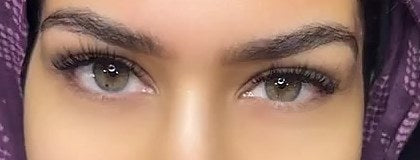
No style is gentler by name: a classic, hybrid, volume or mega volume set can be gentle or damaging. What matters is whether each natural lash carries a weight it can support, and whether every extension or fan sits on one isolated lash. Volume fans use much finer fibres than classic extensions, but a fan's weight still depends on how many fibres it holds, how thick they are and how long they are.
Our guides to types of lash extensions and lash thickness in the lash curl chart explain the options. We offer hybrid, volume and mega volume lash extensions in Woodbridge.
Comparing extensions with a lash lift? The AAO notes that lash lifts and perms carry risks too, because they're done so close to the eye (AAO). Our lash lift vs lash extensions guide compares the two; our studio offers extensions, not lash lifts.
Who should avoid lash extensions?
EyeWiki advises people with existing eye disease or a history of allergy to avoid lash extensions. A few other situations call for a doctor's OK first.
- After eye surgery: the AAO's general eye makeup advice is not to wear makeup around the eyes until your ophthalmologist says it's safe. That advice doesn't mention extensions, so apply the same caution and ask your eye doctor first.
- During an eye infection or irritation: the AAO's general advice is not to use eye makeup until an infection such as pink eye is gone, and Health Canada says to stop using any eye cosmetic that causes irritation or inflammation. Neither addresses extensions directly, so wait until your eyes are healthy and ask your eye doctor first.
- After a past reaction to extensions: talk to your eye doctor first. If you go ahead, a patch test is a sensible first step. But an AAO article on eyebrow and eyelash enhancements such as tinting, perms and lifts notes that people can develop sensitivities with repeated exposure, so one clear test isn't a guarantee.
- With dry eye: ask your eye doctor first, given the 2024 findings above.
Are lash extensions safe during pregnancy?
There's little research to answer this. We couldn't find a published study on lash extensions during pregnancy, and the eye health sources in this guide (the AAO, EyeWiki and Health Canada) don't address it, so there's no evidence-based answer either way. Ask your doctor or midwife before booking, and tell your lash tech you're pregnant.
For lash techs: how to protect your clients' natural lashes
This section is for lash techs. Many of the causes of damage above are decided at the lash bed, so these habits protect your clients' natural lashes.
Screen every client first
Ask about eye disease, allergies and past reactions before every new set. EyeWiki says clients with existing eye disease or an allergy history should avoid extensions, and that allergy questionnaires or skin patch tests may be considered for screening. Suggest that anyone who has reacted before checks with their eye doctor first, offer a patch test if they go ahead, and refer clients with symptoms to an eye doctor.
Match each extension to its natural lash
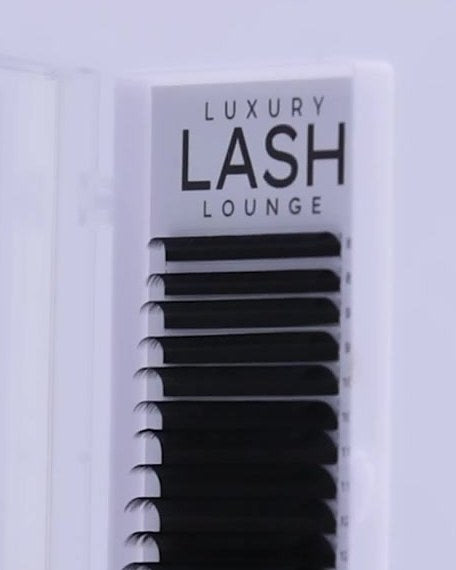
Thickness and length decide how much weight each natural lash carries. Our lash extension trays come in 0.15 mm for classic work, with one extension per natural lash. Our 0.05 mm and 0.03 mm trays are for volume, and 0.03 mm, the finest we carry, is for big fans in mega volume sets.
| Natural lash | Safer approach | Avoid |
|---|---|---|
| Fine, short or sparse | Finer fibres, shorter lengths and lighter fans | Long or thick extensions that outweigh the lash |
| Healthy and strong | Thickness and length in proportion to the lash | Choosing length for the look alone |
| Short new growth | Leave it, or use the lightest option | Bonding a long extension to a very short lash |
| Damaged or patchy | Pause and suggest an eye doctor | Covering gaps with heavier extensions |
Our single length volume trays are 0.05 mm, in C curl 8 to 12 mm and D curl 9 to 19 mm. Our mixed length trays hold 8 to 15 mm on one tray: D curl in 0.03, 0.05 or 0.15 mm, and C, CC or L curl in 0.05 mm. We use the same trays on our own clients.
Isolate cleanly and keep glue off the skin
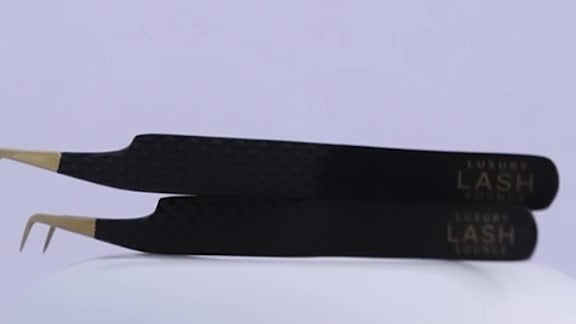
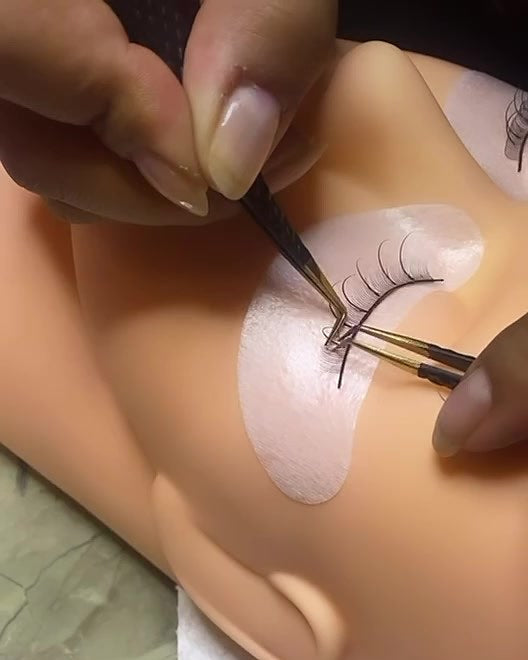
An isolation tweezer separates one natural lash from its neighbours, so the extension attaches to that lash alone. Ours is made from Japanese steel, with a 45 degree tip and a ribbed no-slip grip, and we hand test every one of our lash tweezers before it ships.
Dip only the base of the extension or fan, attach it to one isolated lash and keep the adhesive off the skin. Keep the client's eyes closed, protected and still for the whole application; Health Canada requires a label warning that the eye be protected and immobilized. In our studio, the Pink USB Lash Fan clears glue fumes at the end of an appointment, before the client opens their eyes.
Place gel eye pads close to the lash line but off the waterline; they're the same pads we use in our own appointments. Use tape with care, because EyeWiki notes that eyelid tapes can erode the eye's surface. Before the client opens their eyes, brush through every section with a spoolie and check the front of the set with a lash mirror for gaps and crisscrossing.
Remove gently and keep everything clean
Our Eyelash Extension Cream Remover is for trained professionals only. Leave it on for 3 to 5 minutes, or until the extensions come away easily, then slide them off with a clean micro swab or tweezer. Never pull, and avoid pressing on the eye: EyeWiki links compression during removal to subconjunctival hemorrhage.
EyeWiki also stresses hand hygiene during application. Clean and then disinfect reusable tools such as tweezers between clients; our tweezers shouldn't go in an autoclave. Our guide on how to become a lash tech in Ontario covers the province's public health rules.
At every refill, look closely at the natural lashes. Gaps, broken lashes or red lid margins are a reason to lighten the set or pause, and to suggest an eye doctor. Our 1-on-1 Eyelash Extension Masterclass covers isolation, removals, patch tests, eyelash growth cycles, eye anatomy, allergy and infection knowledge, and sanitization.
FAQ
Do eyelash extensions ruin your real lashes?
Not when they're matched to your lashes, applied by a trained lash tech and removed professionally, although the AAO lists temporary or permanent lash loss among the risks. Damage usually comes from extensions that are too heavy, lashes glued together, picking, rubbing or removing extensions yourself. If you notice gaps or broken lashes, have the set removed professionally and see an eye doctor.
Do lashes get thinner after extensions?
Your lashes may look thinner right after a removal, partly because the contrast with a full set makes them look sparse. The research in this guide documents lash loss from traction, rubbing and pulling, which can show up as gaps, bare patches or broken lashes. If gaps don't fill in, see an eye doctor, because lash loss can have other causes too.
What is the healthiest option for fake lashes?
From an eye-health view, the gentlest option is your own lashes, and EyeWiki suggests that people with eye disease or an allergy history consider mascara, used properly, as a safer alternative to extensions. The AAO's eye makeup guide also suggests wearing false lashes for special occasions only. If you choose extensions, the healthiest set is light enough for your natural lashes, applied by a trained lash tech, kept clean and removed professionally.
What are the downsides of eyelash extensions?
The main downsides are health risks and upkeep: the AAO lists injury to or infection of the eyelid or cornea, allergic reactions to the glue, and temporary or permanent lash loss. You also have to keep them clean, avoid rubbing and picking, and book a professional removal when you want them off. There's the ongoing cost and time of refills, too.
Is it damaging to wear lash extensions all the time?
It doesn't have to be, but wearing them back to back means your natural lashes always carry extra weight, and there's no research-based rule for breaks. A self-reported 2013 national survey in Japan did link short intervals between extensions with health problems. Ask your lash tech to check your natural lashes at each visit, and take a break if you see gaps, broken lashes or irritation.
Are lash extensions safe?
They can be: the AAO says extensions can be safe if you take precautions, and its eye makeup guide says they can be done safely if applied by a professional. In Canada, lash extension glue may only be sold for professional use. The risks are real, so choose a trained lash tech, mention any eye conditions or allergies, and see an eye doctor if anything hurts.
Can lash extensions cause dry eye?
They may make it worse for some people: in a 2024 study of 31 women with dry eye complaints, symptoms and test results improved 4 weeks after their extensions were removed. The study was small and short, so it doesn't prove that extensions cause dry eye. If you already have dry eyes, talk to your eye doctor before booking.
Can lash extensions cause an eye infection?
Yes. The AAO lists infection of the eyelid or cornea among the risks, and a 2013 case report described a bacterial infection of the cornea at the spot where an extension's glue touched the eye. Keep your lashes clean, never share eye makeup, and see an eye doctor promptly for pain, redness, discharge or blurred vision, without removing the extensions yourself.
Can taking lash extensions off damage your natural lashes?
Yes, if they're pulled or picked off, because pulling an extension pulls the natural lash it's bonded to. The AAO warns that tugging and pulling can break lashes and damage follicles. A professional removal is safest: a trained lash tech loosens the glue with a professional remover until the extensions slide off, and our studio does it for $20.
What should I do if I think I got a bad lash set?
Don't pick at it, and if anything hurts or your eyes are red, itchy or swollen, see an eye doctor first without removing the extensions yourself. If nothing hurts but you can see stuck lashes or extensions that look too heavy, ask your lash tech to fix them or book a professional removal. You can contact our Woodbridge studio to book a removal.
About the author
Alessia Simonetta is the owner, master lash artist and certified lash trainer at Luxury Lash Lounge in Woodbridge (Vaughan), Ontario. She has been lashing since 2018, holds five certifications (Classic Lash Artist, Hybrid Lash Artist, Volume Lash Artist, Mega Volume Artist and Certified Lash Trainer), and has worked with thousands of lash clients and trained hundreds of students.
Book lash extensions at our Woodbridge studio, or learn with Alessia in a 1-on-1 lash course.
Sources
- American Academy of Ophthalmology. Mukamal R, reviewed by Taylor RJ, MD. "Eyelash Extension Facts and Safety." February 23, 2018. https://www.aao.org/eye-health/tips-prevention/eyelash-extension-facts-safety
- American Academy of Ophthalmology. Gudgel D, reviewed by Taylor RJ, MD. "How To Use Cosmetics Safely Around Your Eyes." October 27, 2026. https://www.aao.org/eye-health/glasses-contacts/eye-makeup
- American Academy of Ophthalmology. Vimont C, reviewed by Taylor RJ, MD. "Know the Risks of Eyebrow and Eyelash Enhancement." December 11, 2019. https://www.aao.org/eye-health/news/eyebrow-eyelash-coloring-could-harm-your-vision
- EyeWiki, American Academy of Ophthalmology. "Eyelash Extensions." Reviewed May 10, 2026. https://eyewiki.aao.org/Eyelash_Extensions
- Health Canada. "Eye cosmetics." https://www.canada.ca/en/health-canada/services/cosmetics/eye-cosmetics.html
- Health Canada. "Cosmetic Ingredient Hotlist" (Table 2, restricted ingredients: cyanoacrylate-based adhesives). Modified August 13, 2025. https://www.canada.ca/en/health-canada/services/consumer-product-safety/cosmetics/cosmetic-ingredient-hotlist-prohibited-restricted-ingredients/hotlist.html
- Masud M, Moshirfar M, Shah TJ, Gomez AT, Avila MR, Ronquillo YC. "Eyelid Cosmetic Enhancements and Their Associated Ocular Adverse Effects." Medical Hypothesis, Discovery and Innovation in Ophthalmology. 2019;8(2):96-103. PubMed 31263720. https://pubmed.ncbi.nlm.nih.gov/31263720/
- Amano Y, Nishiwaki Y. "National Survey on Eyelash Extensions and Their Related Health Problems." Nippon Eiseigaku Zasshi (Japanese Journal of Hygiene). 2013;68(3):168-174. https://www.jstage.jst.go.jp/article/jjh/68/3/68_168/_article/-char/en/
- Grupcheva CN, Grupchev DI, Usheva N, Grupcheva LO. "Beauty versus Health: How Eyelash Extensions May Affect Dry Eye Disease?" Journal of Clinical Medicine. 2024;13(11):3101. https://www.mdpi.com/2077-0383/13/11/3101
- Aumond S, Bitton E. "The eyelash follicle features and anomalies: A review." Journal of Optometry. 2018;11(4):211-222. https://www.journalofoptometry.org/en-the-eyelash-follicle-features-anomalies-articulo-S1888429618300487
- Ullrich K, Saha N. "Semipermanent eyelash extensions causing bacterial keratitis: a case report." Canadian Journal of Ophthalmology. 2013;48(3):e50-e51. doi:10.1016/j.jcjo.2012.12.010 (PubMed 23769794). https://www.canadianjournalofophthalmology.ca/article/S0008-4182(12)00572-8/fulltext
- American Academy of Dermatology. "Hairstyles that pull can lead to hair loss." Last updated November 6, 2024. https://www.aad.org/public/diseases/hair-loss/causes/hairstyles