
Quick answer
A lash curl chart compares the common lash curl types, which typically run from nearly straight J curls to very curled DD curls, plus angled L shapes. C curl gives a more natural look, CC typically sits between C and D, and D curl is curlier and more lifted.
Alessia Simonetta, our owner and master lash artist, calls D the most popular curl with lash techs: a universal curl that looks good on everyone. L and L+ curls are commonly used to lift straight or downward lashes, and curl names vary by manufacturer, so compare the side profile, not just the letter.
Lash curl chart: the common lash curl types at a glance
The chart below lists the lash curls most lash techs work with, from straightest to curliest, plus the angled L shapes. Treat it as a typical guide: each manufacturer makes its own curls, and one brand's D can look closer to another brand's CC.
This guide is for lash techs and students first. Clients choosing between C and D can jump to the "C vs D curl" and "For clients" sections.
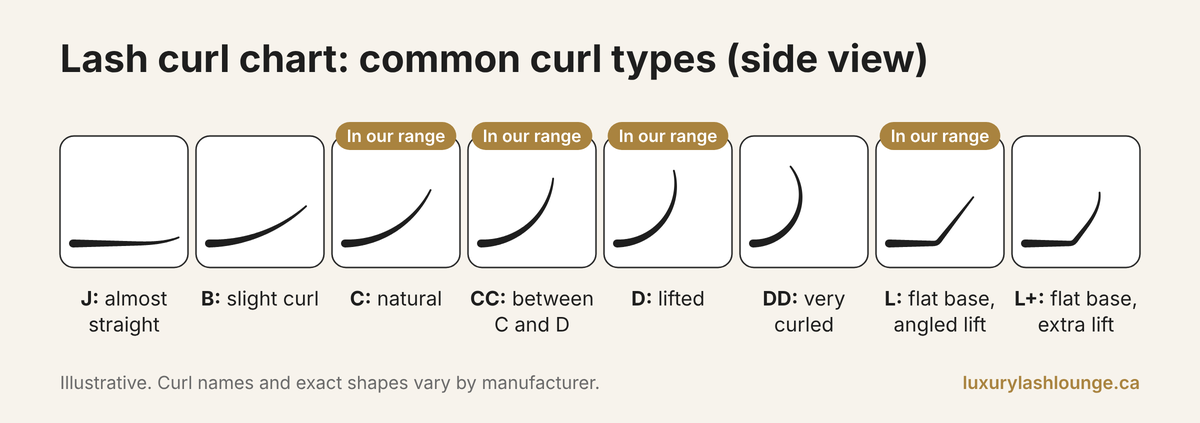
| Curl | Typical shape (side view) | Look | Commonly chosen for | In our range |
|---|---|---|---|---|
| J | Almost straight, slight bend near the tip | Very subtle | Soft looks on lashes that already curl | No |
| B | Slight, even curve | Soft, natural | Naturally curly lashes | No |
| C | Medium curl, open arc | Natural, visible lift | Everyday natural sets | Yes: single length and mixed, 0.05 mm |
| CC | Between C and D | Soft but lifted | When C looks flat and D too strong | Yes: mixed, 0.05 mm |
| D | Strong curl, tighter arc | Open, lifted | Open-eye looks, volume sets | Yes: single length 0.05 mm; mixed 0.03, 0.05 and 0.15 mm |
| DD | Tighter than D | Dramatic | Straight lashes that need a lot of lift | No |
| L | Flat base, angled lift | Lift from a straight base | Straight or downward lashes; often hooded or monolid eyes | Yes: mixed, 0.05 mm |
| L+ | Flat base, angled lift, extra curl at the tip | More lift than L | Straight or downward lashes that need more curl | No |
Four rules make any lash curl chart easier to use:
- The letter is only the curl. Thickness and length are separate choices, covered below.
- Shapes vary by brand. Some brands sell extra shapes, such as LC or LD, with their own definitions.
- Compare the side profile. Hold two trays side by side, or test a few lashes on a practice head, before trusting an unfamiliar letter.
- Know our range. Our single length volume trays come in C and D curl, and our mixed length trays in C, CC, D and L. Compare every option in our lash extension trays collection.
C curl lashes
C curl lashes have a medium curl that lifts the lash in a soft, open arc. Alessia's summary is simple: C curl gives a more natural look.
From the side, a C curl rises gently and keeps more of its length pointing forward. From the front, it tends to show length more than lift.
C curl commonly suits:
- Natural lashes that already lift a little
- Clients who want a soft finish rather than a lifted one
- Fairly curly lashes that need only a little more lift
C may not be enough on lashes that grow straight out or point down, or under a hooded lid. The set can then look flat, and a CC, D or L curl often shows better.
Our single length volume trays come in C curl from 8 to 12 mm, in 0.05 mm. Our mixed length trays also come in C curl 0.05 mm, with 8 to 15 mm on one tray.
CC curl lashes
CC curl lashes typically sit between C and D: more lift than a C, softer than a D. Lash techs commonly use CC as the middle step when C looks flat on a client but D looks too curled.
CC can help when natural lashes grow fairly straight and need a little extra lift. It can also suit a client moving on from C who wants more lift without a dramatic change.
Not every brand makes a CC, and some sell a similar shape under another name, so two CC trays may not match. We carry CC curl on our mixed length trays in 0.05 mm, 8 to 15 mm.
D curl lashes
D curl lashes have a strong curl that lifts the lashes up and away from the eye for an open, wide-awake look. In Alessia's words, D curl is the most popular curl with lash techs: a universal curl that looks good on everyone.
From the side, a D curl bends more of its length upward. Next to a C of the same labelled length, it tends to show more lift and a little less forward length. Lash techs commonly choose D for volume sets and open-eye maps.
Take more care with D in two situations:
- Very curly natural lashes. A strong curl can look over-curled or turn back toward the lid.
- Lashes that point straight down. The curve may not sit along the natural lash, so the base touches less of it. An L curl may sit better.
D is the curl we carry in the most options. Single length volume trays come in every length from 9 to 19 mm in 0.05 mm. Mixed length D curl trays come in 0.03, 0.05 and 0.15 mm, and every tray in our lash training kits is D curl.
Other curls: J, B, DD, L and L+
Typically, J and B are softer than C, DD is stronger than D, and L and L+ have a flat base with an angled lift. Of these, we carry L curl on our mixed length trays.
J, B and DD curls
J is typically almost straight, with a slight bend near the tip, and B is a slight, even curl. Both commonly suit natural lashes that already curl, where a stronger curl could look overdone. DD is typically tighter than D, for dramatic looks or straight lashes that need a lot of lift.
Is B or C curl better?
Neither is better; they suit different lashes. B typically gives a softer lift, while C adds more visible lift and still looks natural. On straight or downward lashes, both can look flat.
L and L+ curls
L curls typically have a flat, straight base and then an angled lift. The idea is that the base sits along a straight or downward natural lash, and the angle turns the extension up. L+ commonly adds extra curl after the bend.
Natural lash direction really does differ between people. One study found that Asian women's lashes had lower lift-up and curl-up angles, fewer lashes and a thicker diameter, on average, than Caucasian women's (Na et al., British Journal of Dermatology). A 2018 review adds that lashes are curved in everyone, but how much varies between individuals (Aumond and Bitton, Journal of Optometry).
Averages don't describe the client in your chair, so assess every set of lashes. Our L curl comes on mixed length trays in 0.05 mm, 8 to 15 mm.
C vs D curl: which is curlier, and which should you choose?
D curl is curlier than C. Choose C for a softer, natural look and D for a lifted, open look; if you're unsure, D is the universal option Alessia describes.
| C curl | D curl | |
|---|---|---|
| Curl strength | Medium | Strong |
| Look | Natural, with a soft lift (Alessia: more natural) | Open and lifted (Alessia: most popular with lash techs, looks good on everyone) |
| Shows most from the front | Length | Lift |
| Natural lashes it commonly suits | Lashes with some lift already, or fairly curly lashes | Fairly straight to lifted lashes |
| On hooded lids | Can hide under the fold | Often lifts lashes into view |
| In our range | Single length 0.05 mm, 8 to 12 mm; mixed 0.05 mm | Single length 0.05 mm, 9 to 19 mm; mixed 0.03, 0.05 and 0.15 mm |
Two practical points help when you're torn between them:
- Match the lash first. Pick the curl that suits the natural lash direction, then shape the look with the map.
- Plan for classic work. In our range, 0.15 mm classic lashes come in D curl only, on mixed length trays.
How to choose a lash curl
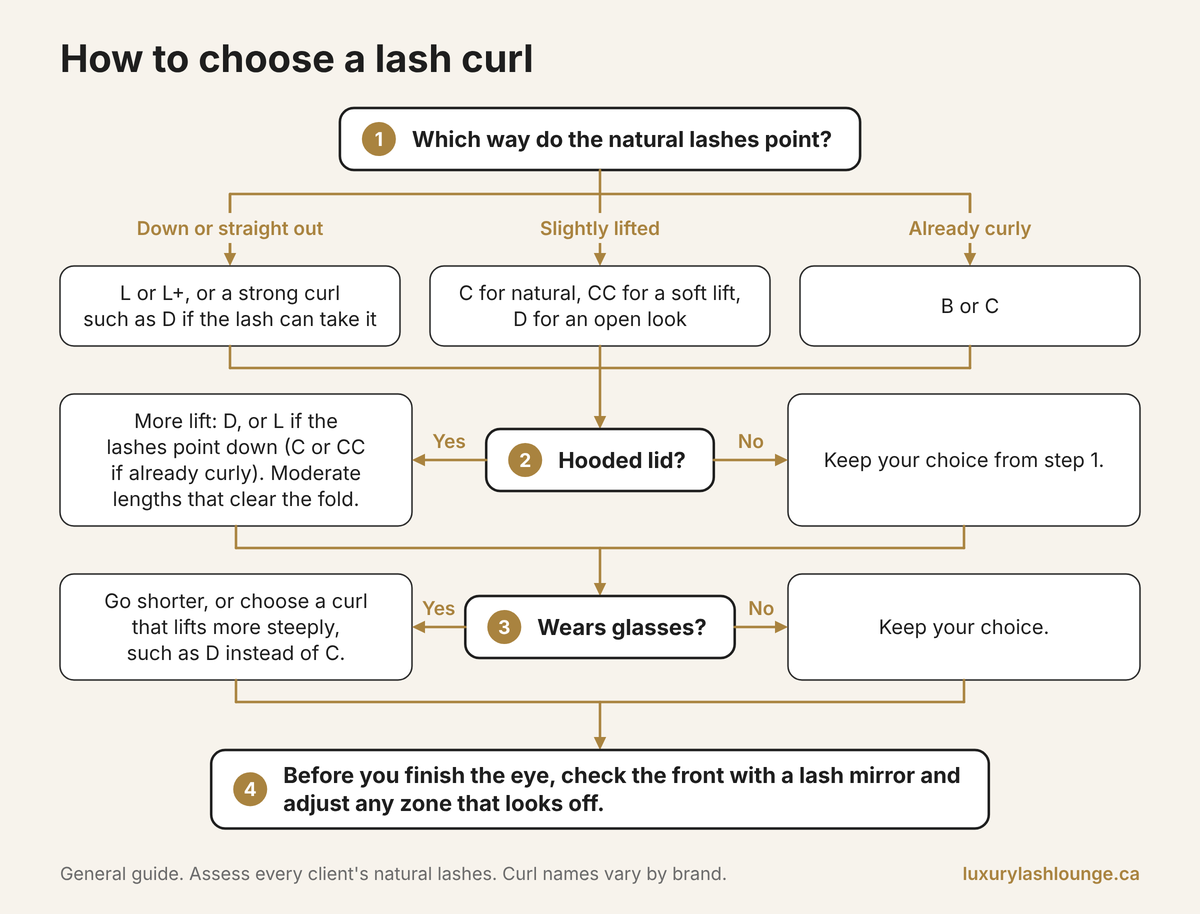
Start with the direction the natural lashes grow. Then factor in the look the client wants, the lid shape and anything in the way, such as glasses. The lash curl chart above shows what each curl does; this section helps you pick one.
Check the natural lash direction
Look at the lashes from the side, with the eyes open and closed. Do they point down, grow straight out, lift slightly or already curl up?
Most lash techs aim for an extension whose base sits along the natural lash. When the curl fights the lash direction, less of the base touches the lash and the tip can point at an odd angle.
| Natural lashes | Curls lash techs commonly reach for | Why |
|---|---|---|
| Point down or grow straight out | L or L+, or a strong curl such as D if the lash can take it | The flat L base follows a straight lash, then lifts it |
| Lift slightly | C for natural, CC for a soft lift, D for an open look | The lash already heads up, so you choose the look |
| Already curly | B or C | A strong curl can over-curl and turn toward the lid |
Consider the lid and eye shape
Hooded eyes. A fold of skin can cover part of the lash line, so a soft curl can disappear under it. More lift, such as D (or L if the lashes point down), usually helps the lashes show. If the natural lashes are already curly, a C or CC is often enough, because a strong curl on curly lashes can over-curl. Moderate lengths typically help the tips clear the fold when the eye is open.
Monolids. When the lashes grow straight or point down, L shapes or a stronger curl are frequent choices.
Other eye shapes. The map does most of the work here. Our lash map guide covers maps for each eye shape, including hooded eyes.
Match the look
C typically reads soft and natural, CC softly lifted and D open and lifted. For a dramatic look, lash techs commonly use D, or DD in brands that make it. The map, not the curl, decides where the longest lashes sit, so a cat eye and a doll eye can both be done in D.
Glasses wearers
Ask the client to wear their glasses during the consultation. If the planned length would touch the lenses, the usual fix is to go shorter or choose a curl that lifts more steeply, such as D instead of C.
Check the result
Before you finish the eye, check the front of the set with a lash mirror while the client's eyes stay closed. Adjust the curl in any zone that looks off.
Lash thickness guide: 0.03 to 0.20 mm
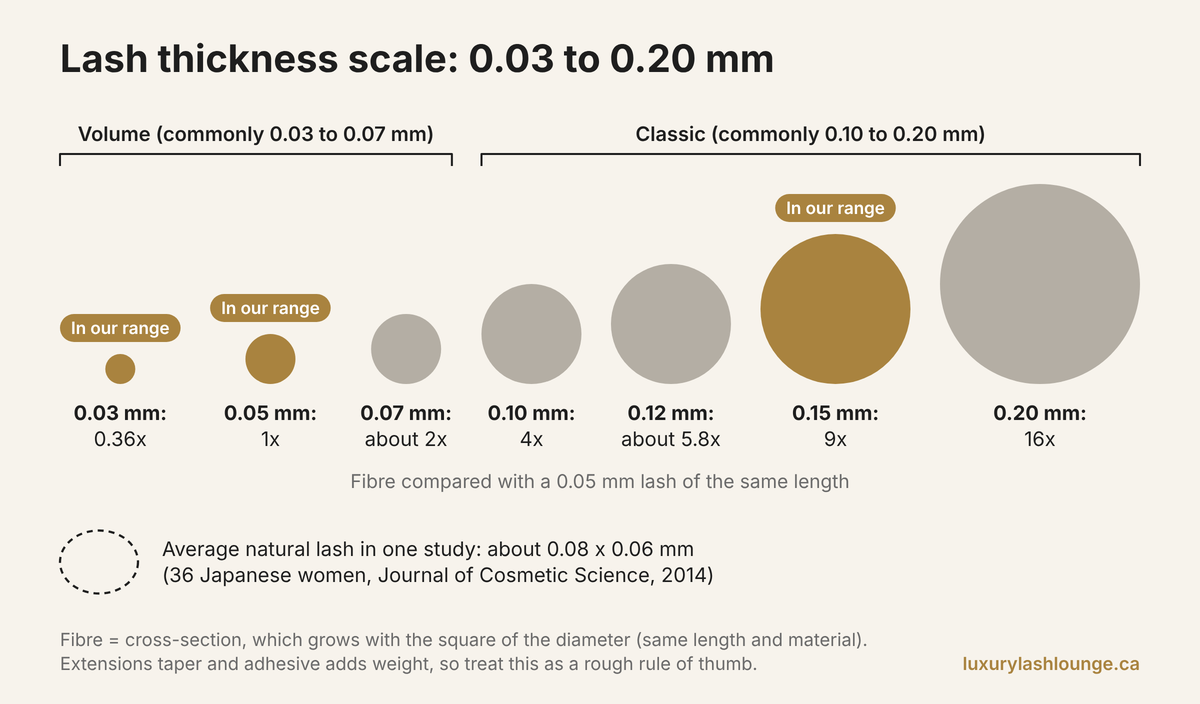
Lash thickness is the diameter of each extension, in millimetres. Volume lashes commonly run from 0.03 to 0.07 mm and classic lashes from about 0.10 to 0.20 mm; we carry 0.03, 0.05 and 0.15 mm.
How thick is a natural lash?
Natural lashes vary. In an imaging study of lashes from 36 Japanese women, the lash shaft was oval, about 78 by 63 micrometres on average (Journal of Cosmetic Science, 2014). That is roughly 0.08 by 0.06 mm.
As a rough rule of thumb, for lashes like these, a 0.05 mm extension is finer than the natural lash and a 0.15 mm extension is about twice as wide. Thickness also varies between groups: Na and colleagues found thicker lashes, on average, in Asian women than in Caucasian women.
Classic, hybrid and volume thicknesses
- Classic places one extension on each natural lash, so it uses thicker lashes. Ours is 0.15 mm; lighter options such as 0.10 or 0.12 mm are common elsewhere.
- Volume places a fan of several fine lashes on each natural lash. Ours is 0.05 mm; 0.07 mm is common elsewhere.
- Mega volume uses even finer lashes for bigger fans. In our studio, 0.03 mm lashes are used to make big fans for mega volume sets.
- Hybrid mixes classic lashes and volume fans, so keep both 0.15 mm and 0.05 mm trays on hand.
For how these sets look and who they suit, see our guide to types of lash extensions.
Lash thickness chart
| Thickness | Fibre compared with 0.05 mm (same length, rough rule of thumb) | Typically used for | In our range |
|---|---|---|---|
| 0.03 mm | About 0.36 times | Big mega volume fans | Yes: D curl mixed trays |
| 0.05 mm | 1 (baseline) | Volume fans and the fans in hybrid sets | Yes: single length (C, D) and mixed (C, CC, D, L) |
| 0.07 mm | About 2 times | Volume fans with fewer, bolder lashes | No |
| 0.10 mm | 4 times | Light classic or hybrid work | No |
| 0.12 mm | About 5.8 times | Classic, lighter than 0.15 mm | No |
| 0.15 mm | 9 times | Classic, one extension per natural lash | Yes: D curl mixed trays |
| 0.20 mm | 16 times | Heavy classic, offered by some brands | No |
Why a small change in thickness adds a lot of weight
For the same length and material, a fibre's weight follows its cross-section, which grows with the square of the diameter. Triple the thickness and you get about nine times the fibre. Our trays are all Korean PBT fibre; for more on materials, see what lash extensions are made of.
So one 0.15 mm classic lash holds roughly the fibre of nine 0.05 mm lashes. A 3-lash fan of 0.05 mm has about a third as much, and a 6-lash fan about two-thirds, before adhesive.
Length counts too: a longer fibre has more material and reaches further from the natural lash, so it pulls with more leverage. Extensions usually taper, and some brands make flat lashes, so treat these numbers as a rough rule of thumb.
This matters for the natural lash. EyeWiki, from the American Academy of Ophthalmology, lists traction alopecia, where natural lashes are lost to the pull of synthetic lashes, as a complication (EyeWiki). The AAO also lists temporary or permanent loss of eyelashes as a risk (AAO).
Our guide to whether lash extensions ruin your lashes covers lash damage, lash loss and regrowth.
0.05 vs 0.15 lashes: what is the difference?
0.05 mm is a volume thickness, used to make fans of several lashes. 0.15 mm is a classic thickness, used one extension per natural lash.
A 0.15 mm lash is three times as wide as a 0.05 mm lash and, as a rough rule of thumb, has about nine times the fibre for the same length. That's why one bold classic lash or a whole fan of fine lashes can sit on a single natural lash.
| 0.05 mm | 0.15 mm | |
|---|---|---|
| On each natural lash | A fan of several lashes | One extension |
| Fibre compared with 0.05 mm (rough rule of thumb) | 1 | About 9 times |
| Typical look | Soft, fluffy fullness | Defined, one-to-one lashes |
| Sets that use it | Volume, and the fans in hybrid sets | Classic, and the classics in hybrid sets |
| In our range | Single length C (8 to 12 mm) and D (9 to 19 mm); mixed C, CC, D and L | Mixed length D curl, 8 to 15 mm |
Choose 0.15 mm when you place one lash on each natural lash and that lash is strong enough for it. Choose 0.05 mm when you make fans. On fine natural lashes, even classic work may call for something lighter than 0.15 mm.
Our studio offers hybrid, volume and mega volume sets rather than classic sets. Alessia is certified in classic, though, and classic theory is part of our Eyelash Extension Masterclass.
Lash extension length guide
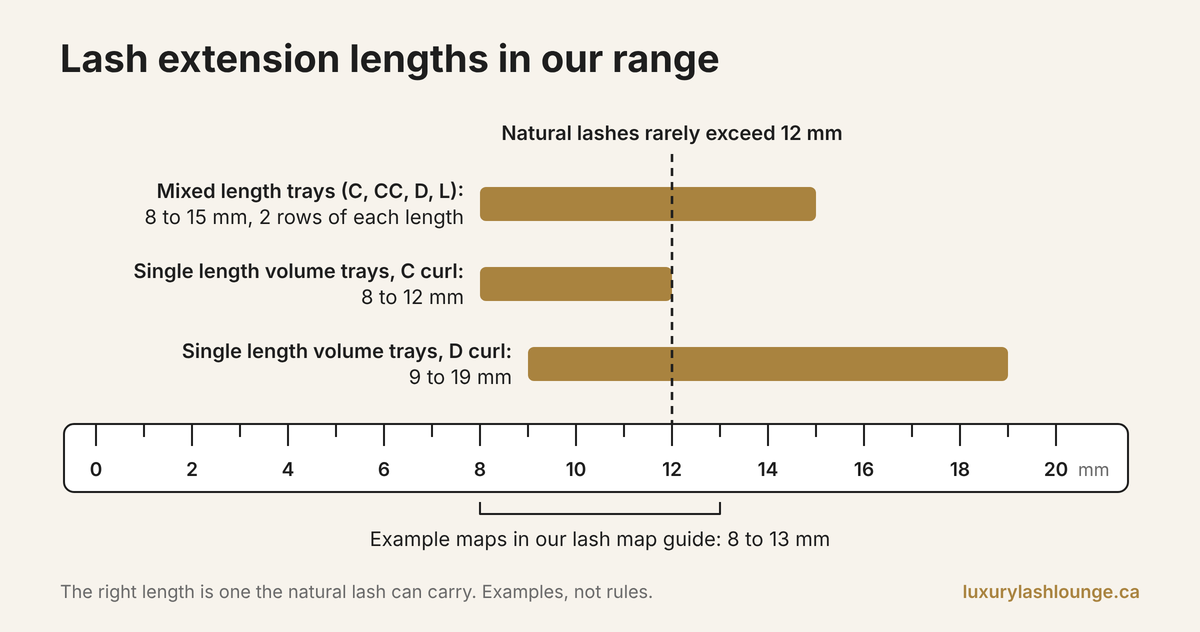
Lash extension length is given in millimetres, and the right length is one the natural lash can carry. Our trays run from 8 to 19 mm, but most sets use a spread of lengths set by a lash map.
How lash lengths are labelled
Each row on a tray holds one length, written in mm. A curl bends part of that length upward, so a C and a D with the same label can look different on the eye. When you change curl, check the length from the front again.
How long are natural lashes?
Natural lashes rarely grow longer than 12 mm, and they grow only about 0.12 to 0.14 mm a day (Aumond and Bitton, Journal of Optometry). Because lashes grow and shed in cycles, a lash line holds mature lashes, new growth and lashes in between.
That's why one length rarely suits a whole lash line. For the growth cycle in detail, see how long lash extensions last.
Longer isn't automatically better for the eye, either. The same review describes a wind-tunnel study on a model eye that found an optimal lash length of about one-third of the eye's width. Longer lashes pushed airflow toward the eye's surface.
The authors write that changing lash length, including through cosmetic procedures, would affect this protective effect, and they call for more research.
Choosing lengths the natural lash can support
- Find the longest healthy lashes in each zone. Use them as your guide for that part of the map.
- Stay close to the natural length. A common rule of thumb: only a few millimetres longer than the natural lash, and less on fine lashes.
- Go shorter at the inner corner. Every example map in our lash map guide starts at 8 or 9 mm there.
- Size new growth separately. Short, new lashes usually need short, light extensions, or none until they grow.
Mixed vs single length trays
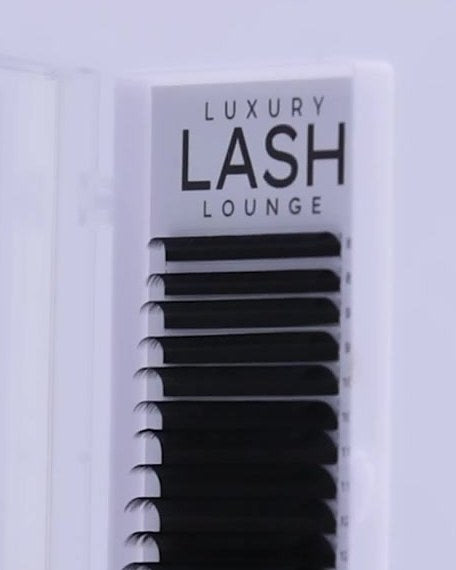
Our mixed length trays hold 8 to 15 mm on one 16-row tray, with 2 rows of each length. They suit practice, training and sets that use many lengths.
A single length tray holds one length on every row, so you restock only the lengths you use most. Ours have 16 rows of 0.05 mm volume lashes, in C curl from 8 to 12 mm and D curl from 9 to 19 mm.
The two ranges leave a few gaps worth knowing:
- 8 mm in D curl comes only on the mixed tray, because single length D starts at 9 mm.
- 13 to 15 mm in C curl comes only on the mixed tray, because single length C stops at 12 mm.
- 16 to 19 mm comes only in single length D curl.
Lash extension sizes: how to read a lash tray label
A lash extension size is usually written as curl, thickness and length. For example, D 0.05 12 mm means a D curl lash, 0.05 mm thick and 12 mm long.
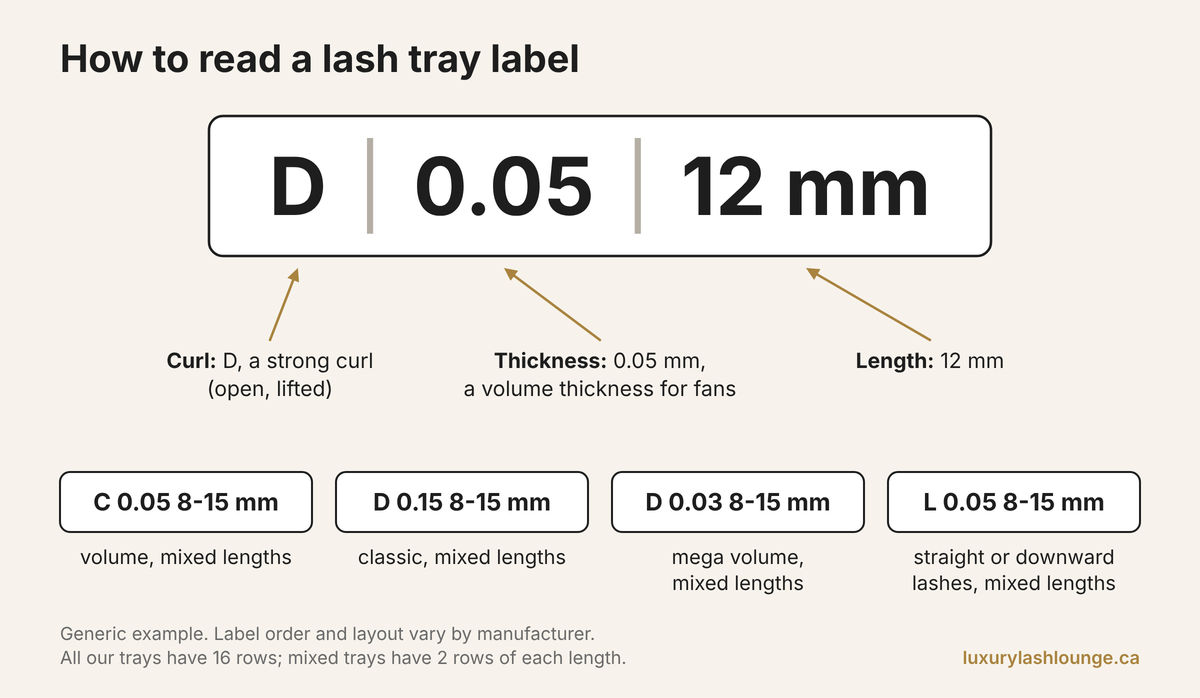
Read every label in this order:
- Curl. The letter is the shape: D here, a strong curl.
- Thickness. The diameter in mm: 0.05 here, a volume thickness for fans.
- Length. The length in mm: 12 here. A mixed tray shows a range instead, such as 8 to 15 mm.
- Brand. Label order and layout vary by manufacturer, and one brand's curl letter may not match another's.
Other sizes in our range include D 0.15 (classic), D 0.03 (mega volume fans) and L 0.05 (straight or downward lashes). All three come on mixed length trays of 8 to 15 mm.
When you order from us, you choose length, curl and thickness as separate options, and each choice is a separate tray. Single length trays are $15 CAD, and mixed length trays are $15, or $17 for 0.03 mm and L curl.
All product sales are final, with no refunds or exchanges, for hygiene and safety reasons. Check all three values before you order, and compare every option in our lash trays collection.
Putting it together: curl, thickness and length by look
Think of a set as three separate choices. The map decides where each length goes, the curl decides how lifted the set looks, and the thickness decides density and weight.
The examples below use the example maps from our lash map guide. They're starting points, not rules: a lash tech adjusts every map to the client's natural lashes, eye shape and lash health.
| Map style | Example curl | Example thickness | Example lengths, inner to outer corner (mm) | Trays in our range that cover it |
|---|---|---|---|---|
| Natural | C | 0.05 mm fans | 8, 9, 10, 11, 11, 10 | C single length 8, 9, 10 and 11 mm, or a C mixed tray |
| Doll eye (open eye) | D | 0.05 mm fans | 9, 10, 12, 12, 11, 10 | D single length 9, 10, 11 and 12 mm, or a D mixed tray |
| Cat eye | D | 0.05 mm fans | 8, 9, 10, 11, 12, 13 | D mixed tray (single length D starts at 9 mm) |
| Squirrel | D | 0.05 mm fans | 8, 9, 10, 12, 13, 11 | D mixed tray |
| Wispy (spiky) | D | 0.05 mm fans | Base of 8, 9, 10, 11, 11, 10, plus spikes of 11, 12, 13, 13, 12 | D mixed tray |
Every example map here uses lengths from 8 to 13 mm. One mixed length tray, which holds 8 to 15 mm, covers any of them in a single curl.
Changing the set type
Keep the map and change the thickness or curl:
- Classic: a 0.15 mm D curl mixed tray, one extension per natural lash.
- Hybrid: a 0.15 mm D curl mixed tray for the classics, plus 0.05 mm D curl trays for the fans.
- Mega volume: a 0.03 mm D curl mixed tray, our finest fibre, for big fans.
- Straight or downward lashes: a 0.05 mm L curl mixed tray.
- Longer, dramatic lengths: single length D curl up to 19 mm, only for natural lashes strong enough to carry it.
Working with your trays
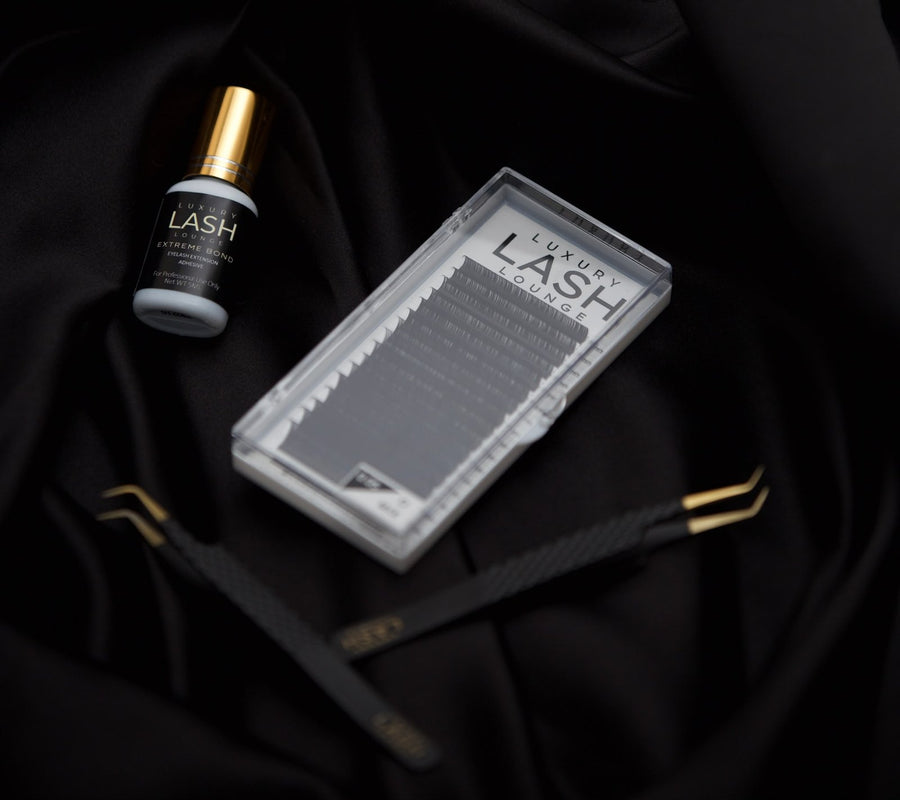
- Pick lashes off the strip on a weighted surface, such as a marble lash tile.
- Isolate each natural lash with an isolation tweezer, which has a 45 degree tip.
- Pick up and fan with a volume pick-up and fanning tweezer, whose precise 90 degree tip makes wide and narrow fans.
- Plan lengths with lash mapping stickers over gel eye pads or tape, never on their own to hold down the bottom lashes.
- Brush through the set with a lash spoolie to check that no lashes are stuck together.
We hand test every tweezer for pick-up and fanning before it ships. Everything we sell is used on our own clients, from the trays to the tweezers.
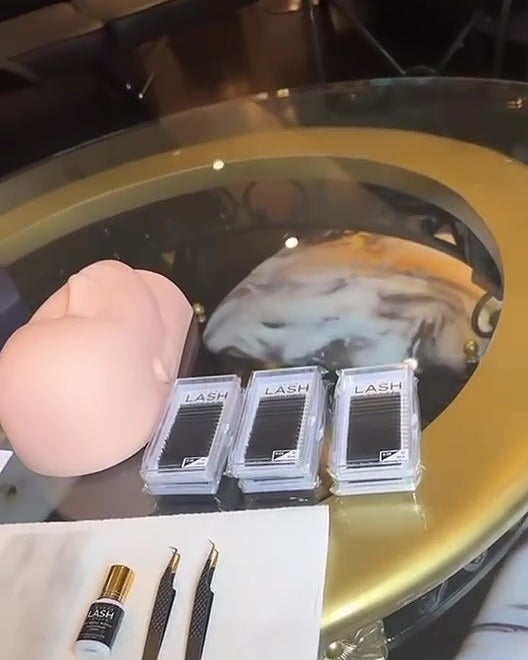
Practising combinations
Curl, thickness and length are easiest to learn on a practice head. Every tray in our lash course kits is D curl, in mixed lengths from 8 to 15 mm. Small kits have 2 trays in 0.05 mm and 2 in 0.15 mm, and large kits have 4 in 0.05 mm and 2 in 0.15 mm.
Our 1-on-1 Eyelash Extension Masterclass ($1,200) covers lash styling and mapping, fan making, and classic to mega volume theory. It includes our Large Lash Training Kit, mannequin practice and live model application.
Planning a career? Read how to become a lash tech in Ontario.
Common curl, thickness and length mistakes
Most problems come from one of three things. The extension is too heavy for the natural lash, the curl fights the lash direction, or the length is more than the lash can carry.
| Mistake | What you see | What to do instead |
|---|---|---|
| Extension too thick or too long for the natural lash | Lashes droop or twist, and the natural lash is under strain | Go finer or shorter, or switch to light fans |
| Curl too strong for straight or downward lashes | The base lifts off the lash and tips point at odd angles | Use L or L+, or a curl that follows the lash |
| Curl too soft for hooded lids or downward lashes | Extensions hide under the lid or point down | Add lift with CC, D or L |
| Strong curl on curly lashes | Lashes look over-curled or turn toward the lid | Soften to C, or B in brands that make it |
| One length on mature and new lashes | Long extensions sitting on short new growth | Size each extension to the lash it sits on |
| Mixing brands and assuming the curls match | Uneven lift across the set | Compare side profiles and use one brand per set |
| Tips touching glasses or the lid | Lashes bend or get pushed out of place | Go shorter or choose a curl with more lift |
A note on safety
If a client has itching, burning, swelling, pain or changes in vision after a set, they should not try to remove the extensions themselves. The American Academy of Ophthalmology warns that removing them yourself after a reaction could damage your eyes, and advises seeing an ophthalmologist (a medical eye doctor) right away (AAO). A doctor, optometrist or pharmacist can advise on next steps.
Lash adhesive is for trained professionals. Health Canada's Cosmetic Ingredient Hotlist says cyanoacrylate eyelash extension adhesives must be sold for professional use only, not directly to consumers.
For clients: C or D at your appointment
If you want a soft, natural look, ask about C curl. If you want a lifted, open look, ask about D curl, the universal curl Alessia describes. If you'd rather curl your own lashes without extensions, see lash lift vs lash extensions.
A good lash tech still matches the curl, thickness and length to your natural lashes. It helps to tell them:
- The look you want, ideally with a photo
- Whether you wear glasses
- Whether you've reacted to lash extensions before (our patch test is $20, about 15 minutes)
- Whether you'd like a hybrid, volume or mega volume set
We offer hybrid ($120), volume ($135) and mega volume ($150) full sets, before HST. Read about our lash extensions in Woodbridge or contact us to book. Afterwards, our lash extension aftercare guide shows you how to look after your set.
FAQ
Which is curlier, C or D lashes?
D curl is curlier than C, and CC typically sits between them. A C curl follows a softer, more open arc for a natural look, while a D curl bends more of the lash upward. Shapes vary by manufacturer, so one brand's D can look like another brand's CC, and it pays to compare side profiles before you switch.
Which lash curl is most popular, C or D?
D curl. Alessia Simonetta, our owner and master lash artist, calls D the most popular curl with lash techs: a universal curl that looks good on everyone. C suits clients who want a more natural look, but the right curl always depends on the client's natural lashes.
Is B or C curl better?
Neither is better; they suit different lashes. B is typically a slight curl for a very soft look or already-curly lashes, while C adds more visible lift and still looks natural. On straight or downward lashes both can look flat, and an L curl or a stronger curl often works better.
What curl is best for hooded eyes?
Hooded lids usually need more lift so the lashes show below the fold of the lid. Many lash techs choose D, or L and L+ when the natural lashes grow straight or point down. Keep lengths moderate so the tips clear the lid when the eye is open, and check the result from the front.
What is the difference between 0.05 and 0.15 lashes?
0.05 mm is a volume thickness: several 0.05 mm lashes make one fan for each natural lash. 0.15 mm is a classic thickness, placed one per natural lash, and hybrid sets use both. For the same length, a 0.15 mm lash is three times as wide and, as a rough rule of thumb, holds about nine times the fibre.
What lash length should I get?
There's no single right length: it should be one your natural lashes can carry, and a 2018 review found they rarely grow past 12 mm. For example, the natural map in our lash map guide runs 8, 9, 10, 11, 11 and 10 mm from inner to outer corner. Your lash tech adjusts any map to your own lashes.
Are lash curl names the same in every brand?
No: each manufacturer sets its own curl, so the same letter can look different from brand to brand. Some brands also add shapes such as LC or LD. Compare trays side by side, and keep to one brand within a set so the curl stays consistent.
What does "D 0.05 12 mm" mean on a lash tray?
It's the lash size: D is the curl, 0.05 is the thickness in millimetres and 12 mm is the length. So the tray holds strong-curl lashes, fine enough for volume fans, all 12 mm long. A mixed length tray shows a range, such as 8 to 15 mm, and label order varies by brand.
Can you mix different curls in one lash set?
Yes, as long as each curl suits the natural lashes where you place it. Some lash techs use a softer curl where the lashes already lift and more curl where they grow straight or point down. Keep changes gradual so the set looks even, and stay within one brand so the curls relate as you expect.
What are 0.03 mm lashes used for?
0.03 mm is the finest fibre we carry, and in our studio it's used to make big fans for mega volume sets. As a rough rule of thumb, each 0.03 mm lash has just over a third (about 0.36 times) of the fibre of a same-length 0.05 mm lash, so big fans stay light. Ours come on D curl mixed length trays.
About the author
Alessia Simonetta is the owner, master lash artist and certified lash trainer at Luxury Lash Lounge in Woodbridge (Vaughan), Ontario. She has been lashing since 2018 and holds 5 certifications: Classic Lash Artist, Hybrid Lash Artist, Volume Lash Artist, Mega Volume Artist and Certified Lash Trainer.
She has worked with thousands of lash clients and trained hundreds of students. Learn with her in our 1-on-1 lash training, or book lash extensions at our Woodbridge studio.
Sources
- Health Canada. "Cosmetic Ingredient Hotlist: Prohibited and restricted ingredients" (entry for cyanoacrylate-based adhesives). https://www.canada.ca/en/health-canada/services/consumer-product-safety/cosmetics/cosmetic-ingredient-hotlist-prohibited-restricted-ingredients/hotlist.html
- American Academy of Ophthalmology. "Eyelash Extension Facts and Safety" (Reena Mukamal; reviewed by Rebecca J. Taylor, MD; 2018). https://www.aao.org/eye-health/tips-prevention/eyelash-extension-facts-safety
- American Academy of Ophthalmology, EyeWiki. "Eyelash Extensions." https://eyewiki.aao.org/Eyelash_Extensions
- Aumond S, Bitton E. "The eyelash follicle features and anomalies: A review." Journal of Optometry, 2018;11(4):211-222. https://pmc.ncbi.nlm.nih.gov/articles/PMC6147748/
- Na JI, Kwon OS, Kim BJ, et al. "Ethnic characteristics of eyelashes: a comparative analysis in Asian and Caucasian females." British Journal of Dermatology, 2006;155(6):1170-1176 (journal abstract page; DOI 10.1111/j.1365-2133.2006.07495.x; PMID 17107385). https://academic.oup.com/bjd/article-abstract/155/6/1170/6637367
- Fukami K, Inoue T, Kawai T, et al. "Internal structure changes of eyelash induced by eye makeup." Journal of Cosmetic Science, 2014;65(4):217-224 (link opens p. 220, which gives the measurements). https://library.scconline.org/v065n04/14