
Quick answer
How to become a lash tech in Ontario: train with an experienced lash educator, practise on a mannequin and then on live models, earn your trainer's certificate and set up a workspace that meets public health rules. We could not find a provincial lash tech licence in Ontario's laws or its skilled trades list, so confirm the rules with your public health unit and municipality before you open.
In our reading, a lash studio is a personal service setting, so O. Reg. 136/18 requires written notice to your local medical officer of health at least 14 days before you start. Job Bank puts Ontario's median wage for nails and lashes applicators at $19.00 an hour.
What does a lash technician do?
A lash technician applies semi-permanent extensions to the natural lashes, attaching each extension or handmade fan to a single, isolated natural lash. The job also covers consultations, refills, removals, patch tests, aftercare advice and strict hygiene. Our guide to what lash extensions are explains the service from the client's side.
Each appointment starts with a consultation about eye shape, natural lashes and the look the client wants. The lash tech then plans a lash map and chooses the curl, thickness and length, all explained in our lash curl chart. Sets range from classic, with one extension per natural lash, to hybrid, volume and mega volume; our guide to types of lash extensions compares them.
Clients come back for refills as extensions fall out. Anyone who has reacted before can book a patch test first. In our studio, itching, stinging, burning or swelling within 24 hours of a patch test may mean a sensitivity or allergy.
Do you need a licence or certification to do lashes in Ontario?
We could not find a provincial licence or trade certificate for lash technicians in Ontario's laws or in its list of skilled trades. What Ontario regulates is the place where you work: in our reading, a lash studio is a personal service setting under O. Reg. 136/18, and your city may require a business licence or permit. Confirm both with your public health unit and your municipality before you open.
To work in one of Ontario's 23 compulsory trades, such as hairstylist, you must hold a valid certificate of qualification, provisional certificate of qualification or registered training agreement. Neither esthetician nor lash technician appears among the 144 trades in Skilled Trades Ontario's trades list, which we checked on November 1, 2026.
The personal service settings regulation, O. Reg. 136/18, sets duties for the operator of a setting; in our reading, it does not create a licence for each worker. Its section 13 requires the operator to take health and safety training "if required by a medical officer of health or public health inspector to do so", so ask your inspector what training they expect.
The Health Protection and Promotion Act defines a personal service setting as premises where personal services are offered with a risk of exposure to blood or body fluids, and its examples include aesthetic services. York Region's operator fact sheet on makeup, eyelashes and eyebrows covers strip and cluster lashes but does not name extensions. In our reading, you should plan your lash room as a personal service setting, but ask your public health inspector to confirm.
What is a lash certification?
A lash certification, or eyelash extension certification, is a certificate from your training provider showing that you completed their program. It is not a government licence, but it matters.
The federal profile for this occupation group, NOC 63211, lists "nails and lashes applicator" among its job titles. It says estheticians "usually require certification from an esthetician's educational or training institution."
Health Canada adds a safeguard. Its Cosmetic Ingredient Hotlist states: "Cyanoacrylate adhesives for eyelash extensions must be sold for professional use only (i.e., not for direct sale to consumers)."
The Hotlist also lists the warnings these adhesives need, and says warnings "must appear on the label in both English and French." For eyelash extension adhesives, the warnings are to the effect of "For application by trained professionals only", "Ensure the eye is protected and immobilized during application.", "WARNING. BONDS SKIN INSTANTLY. AVOID CONTACT WITH EYES, MOUTH AND SKIN. KEEP AWAY FROM CHILDREN." and "Eyelid bonding: consult a physician. Skin bonding: soak and ease apart gently."
Never apply professional lash glue to yourself, and never practise on friends or family without a trainer's supervision.
The rules at a glance
| Requirement | Who handles it | Applies to lash techs in Ontario? |
|---|---|---|
| Training certificate | Your lash trainer | Not required by any law we could find, but strongly recommended |
| Provincial lash tech licence | None we could find | We could not find one; confirm with your public health unit and municipality |
| Notice of intention to operate | Your local medical officer of health | Yes, in writing, at least 14 days before opening |
| Public health inspections | Your public health unit | Yes; at least every 12 months in York Region |
| Business name registration | ServiceOntario, through the Ontario Business Registry | Yes, if you trade under a name other than your own |
| Municipal licence or permit | Your city | Depends on the city; check before you open |
| GST/HST registration | Canada Revenue Agency | Once your sales pass the $30,000 small supplier threshold |
How to become a lash tech in Ontario, step by step
The path breaks down into nine steps. The order matters, because public health notice, business registration and HST all depend on when you start taking paying clients.
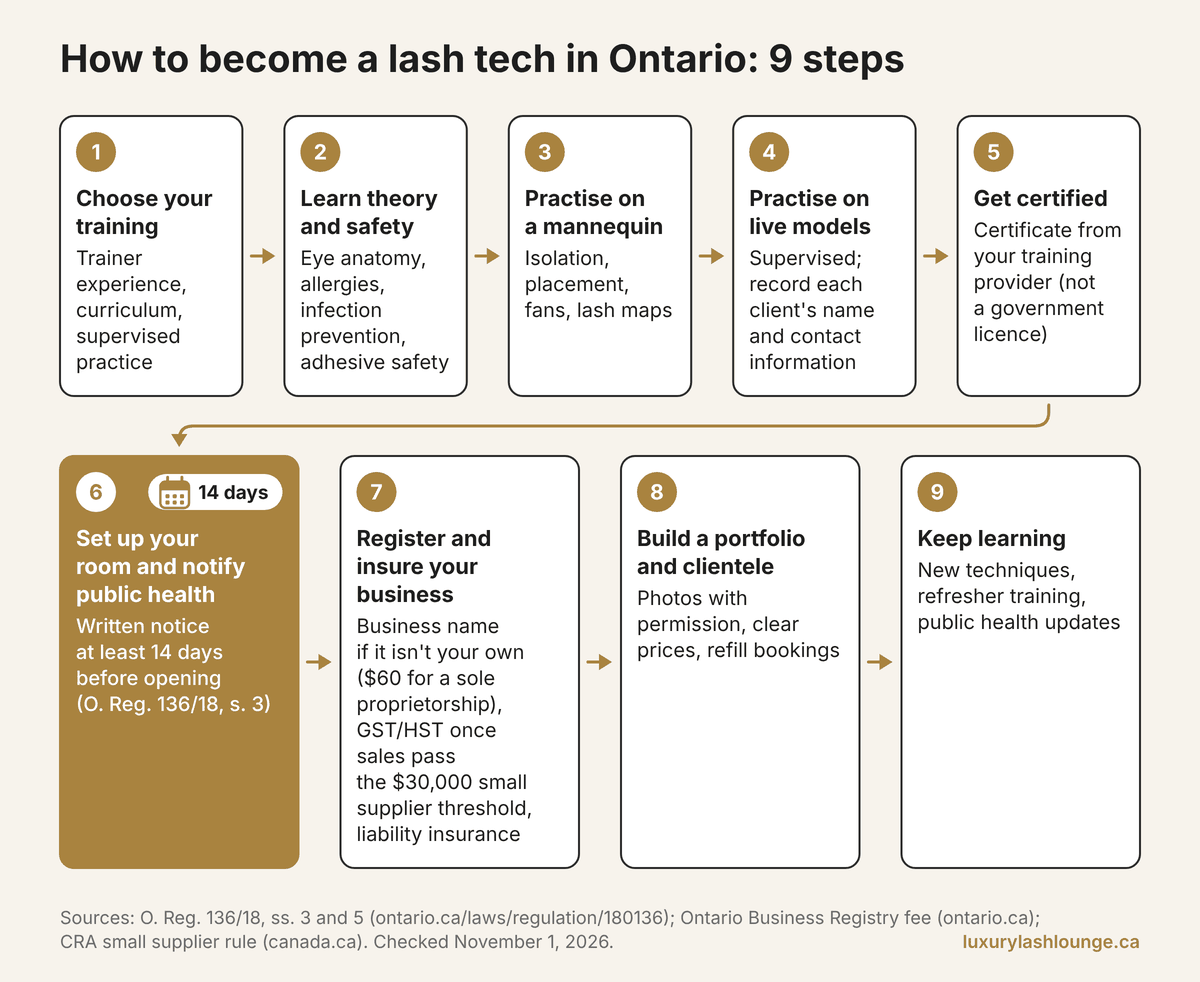
- Choose your training. Look for a trainer with real client experience, a clear curriculum and supervised live model practice. Compare what's included before you pay a deposit. Locally, we teach 1-on-1 lash training in Vaughan.
- Learn the theory and safety first. Study eye and lash anatomy, the eyelash growth cycle, allergies, infection prevention and adhesive safety. The American Academy of Ophthalmology lists infection of the eyelid or cornea and allergic reaction to the glue among the risks of lash extensions. Our lash glue allergy guide covers allergic reactions and patch tests, for clients and lash techs.
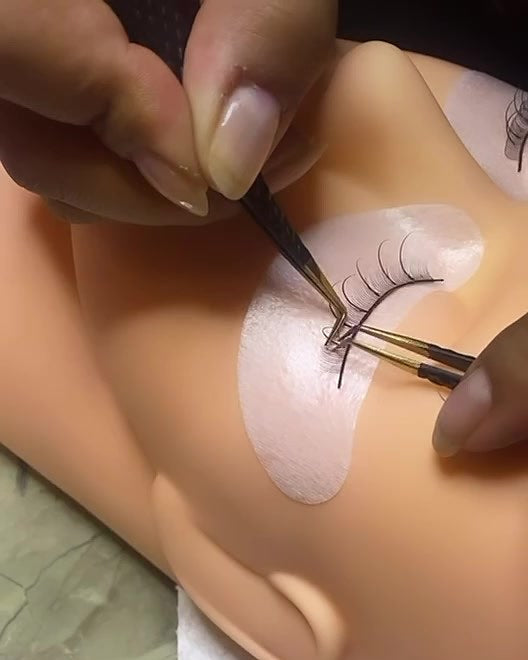
- Practise on a mannequin. A mannequin head with self-adhesive practice strip lashes lets you repeat isolation, placement and fan making with no risk to anyone's eyes. Map every practice set before you start.
- Practise on live models. Real eyes teach what a mannequin can't: natural growth patterns, eye movement and client comfort. Work under supervision and cover the lower lashes. Record each model's name and contact information first, as O. Reg. 136/18 requires for every client (section 5).
- Get certified. Your trainer issues a certificate when you finish. Keep a copy, and know which techniques it covers. Our 1-on-1 Eyelash Extension Masterclass includes 4 certifications.
- Set up your room and notify public health. Plan around O. Reg. 136/18: a hand-wash sink, a separate reprocessing sink if you reuse tools, cleanable surfaces and a room that isn't used as a dwelling. Then give written notice to your medical officer of health "at least 14 days before commencing the operation."
- Register and insure your business. Register your business name if it isn't your own name. Track your sales against the $30,000 GST/HST threshold, and ask a licensed insurance broker about liability coverage for lash services.
- Build a portfolio and clientele. Photograph your work with clients' permission and price clearly. Our guide to lash extension cost in Ontario shows how full sets and refills are priced. Refill bookings turn first-time clients into a steady schedule.
- Keep learning. Techniques, products and public health guidance change. Many lash techs add volume and mega volume once their classic work is consistent.
How to choose a lash training program
Choose training that teaches safety and theory as thoroughly as technique, includes mannequin and supervised live model practice, comes with a real kit and manual, and offers support afterwards. Ask how many students share one trainer, since that sets how much hands-on correction you get.
What a good program covers
As an example, our Masterclass curriculum covers:
- Classic, hybrid, volume and mega volume theory
- Fan making techniques, isolation, lash wrapping and proper placement
- Lash styling and lash mapping
- Lash refills, lash removals and patch tests
- Eyelash growth cycles and anatomy of the eye
- Allergy and infection knowledge
- Proper sanitization and disinfection methods
- Lash room set-up and legal responsibilities
- Client consultations and client retention
- Brand and business building
- Mannequin practice and live model application
If a program skips safety, sanitation or legal topics, ask why: inspectors and clients will hold you to them.
1-on-1 or group training?
| Factor | 1-on-1 training | Group training |
|---|---|---|
| Trainer attention | All of it is yours | Shared among the students |
| Pace | Set around your progress | Set for the whole group |
| Feedback | Correction at every step | Depends on group size |
| Learning from others | Limited to you and the trainer | You hear other students' questions |
| Scheduling | Arranged with the trainer | Often fixed class dates |
Kit, manual and live model practice
Check what the kit includes and what you'd still need to buy. Our Masterclass, for example, includes the Large Lash Training Kit and the printed, 47-page Eyelash Extension Training Manual.
Also ask whether supervised live model work is included and who supplies the models.
Questions to ask a trainer
- How long have you been lashing and teaching, and can I see your work?
- How many students do you teach at the same time?
- Which techniques does the course cover: classic, hybrid, volume, mega volume?
- Does the course cover O. Reg. 136/18, cleaning and disinfection, and record-keeping?
- What support do I get afterwards? (Ours includes lifetime support and mentorship.)
- What are the deposit and rescheduling terms?
How much does it cost to become a lash tech?
Budget for three things: training, a starter kit, and the setup of a compliant room and business. Prices vary by provider, so the table shows ours as an example, in Canadian dollars (CAD), plus the one government fee we confirmed.
| Item | Our price | What you get |
|---|---|---|
| Eyelash Extension Masterclass (beginners, 1-on-1) | $1,200 | Large Lash Training Kit, manual, 4 certifications, lifetime support and mentorship |
| Lash Refresher (certified lash techs) | $550 | Customized course, mini lash kit, certification and manual |
| Small Lash Training Kit | $161 | 4 mixed trays, 2 tweezers, EXTREME BOND adhesive, remover, USB fan, tape and disposables |
| Small Lash Training Course Kit + Training Manual | $215 | The small kit plus the manual |
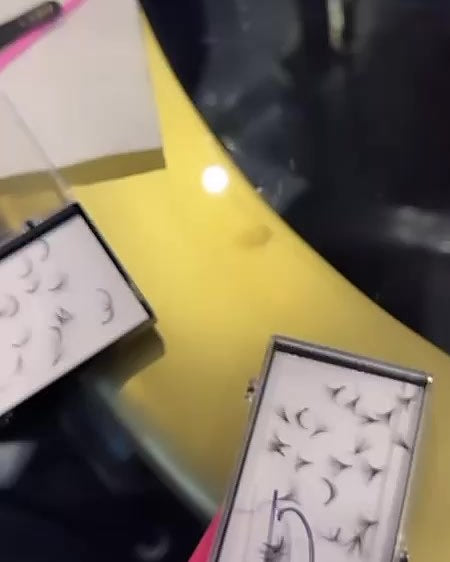
| Large Lash Training Kit | $314 | 6 mixed trays, mannequin head, practice strip lashes, cleanser, lash tile and more |
| Large Lash Training Course Kit + Training Manual | $350 | The large kit plus the manual |
| Eyelash Extension Training Manual | $50 | Printed, 47 pages |
| Mannequin Head | $35 | Silicone and PVC practice head (lashes not included) |
| Practice Strip Lashes | $4.99 | 5 pairs of single-use, self-adhesive strips |
| Ontario business name registration (sole proprietorship) | $60 | Government fee; the registration expires every 5 years |
A non-refundable $150 deposit by e-transfer secures a training date with us, and we need 48 hours' notice to reschedule it. The Masterclass already includes its kit and manual, so you wouldn't buy those separately. Compare all our lash extension kits.
Plan for these costs too:
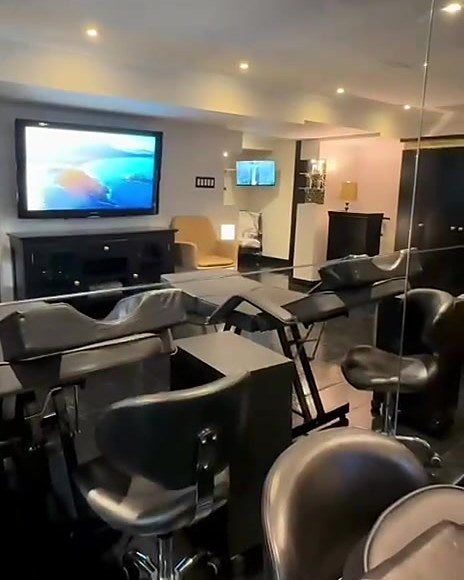
- Furniture: a lash bed, an adjustable stool, a good light, a trolley and closed storage.
- Plumbing: a hand-wash sink and, if you reuse tools such as tweezers, a separate reprocessing sink (O. Reg. 136/18, section 8).
- Hygiene supplies: alcohol-based hand rub, soap in a dispenser, single-use towels and a disinfectant with a Health Canada DIN or NPN.
- Business costs: insurance, any municipal licence or permit fees, booking software and marketing.
- Restocking: trays, adhesive and disposables. An opened bottle of our EXTREME BOND keeps for 3 months.
Public health rules for lash techs in Ontario
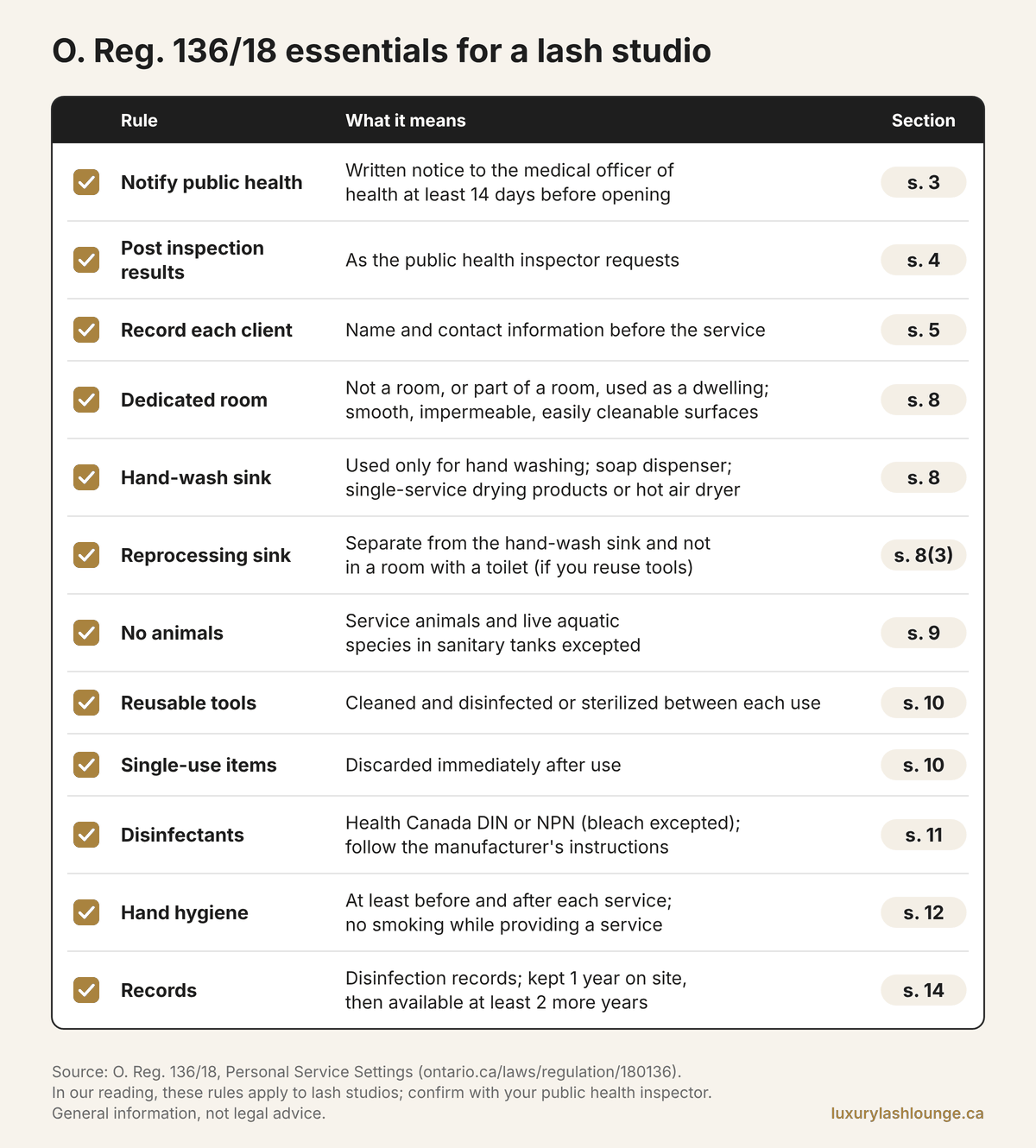
In our reading, lash studios are personal service settings under O. Reg. 136/18; ask your public health inspector to confirm. That means notifying public health before opening, keeping the room sanitary, cleaning and disinfecting reusable tools between uses, discarding single-use items, cleaning your hands before and after each service, keeping records and accepting inspections.
The essentials of O. Reg. 136/18
Section numbers refer to the regulation on e-Laws, so check the current text there before you open.
| Rule | What the regulation says | Section |
|---|---|---|
| Notice before opening | Written notice to the medical officer of health at least 14 days before you start, with the setting's name (if any) and location, your name and contact information, and your list of services. Adding services needs 14 days' notice too. | s. 3 |
| Inspection results | Posted as the public health inspector requests. | s. 4 |
| Client information | Each client's name and contact information, before the service. | s. 5 |
| The room | Free of health hazards; smooth, impermeable, easily cleanable surfaces; hot and cold running water; enough light and ventilation; waste receptacles and storage. It cannot be a room, or part of a room, used as a dwelling. | s. 8 |
| Hand-wash sink | Used only for hand washing, near the work area and always accessible, with soap in a dispenser and hand drying with single-service products or a hot air dryer. | s. 8 |
| Reprocessing sink | Needed if you reuse equipment: not the hand-wash sink, big enough to immerse your largest tool, not in a room with a toilet and separated from the service area. | s. 8(3) |
| Animals | None in the setting, except service animals and live aquatic species kept in sanitary tanks. | s. 9 |
| Equipment | Maintained as the manufacturer instructs, instructions kept on site. Reusable equipment cleaned and disinfected or sterilized between each use; single-use items discarded immediately. | s. 10 |
| Products and disinfectants | Products stored and dispensed to prevent contamination; disinfectants with a Health Canada DIN or NPN (bleach excepted), used according to the manufacturer's instructions. | s. 11 |
| Hygiene | Hands cleaned at least before and after each service; no smoking while providing a service. | s. 12 |
| Training | Health and safety training for the operator; ask your inspector what they expect. | s. 13 |
| Records | Disinfection records (product, concentration, and preparation and discard dates, if applicable). Stored on site for one year, then kept available for at least two more years. | s. 14 |
Lash extensions go on the natural lashes, not through the skin. In our reading, that means the rules for invasive procedures, such as sterile sharps and invasive procedure records, generally won't apply to lash work, but ask your inspector, especially before you add a new service.
What Ontario's infection prevention guidance adds for lash work
York Region points operators to Public Health Ontario's Guide to Infection Prevention and Control in Personal Service Settings (3rd edition, revised July 2019) and to its own fact sheets. For lash work, these points stand out:
- Hand hygiene: the guide says hand hygiene is considered "the most important and effective IPAC measure" (IPAC means infection prevention and control). Alcohol-based hand rub is preferred when hands aren't visibly soiled; choose one with at least 70% alcohol and a Health Canada NPN.
- Nails and jewellery: the guide explains that chipped polish, polish worn longer than four days, artificial nails and rings can limit hand hygiene.
- Tweezers: York Region's fact sheet on makeup, eyelashes and eyebrows covers strip lashes and cluster lashes applied with glue, not extensions by name. It lists tweezers used to apply false eyelashes among the reusable instruments that "are to be cleaned and disinfected after each use."
- Lashes off the tray: the same fact sheet lists "Unused decanted products (e.g., eye lashes, makeup)" with its single-use, disposable items. Lashes you set out for one client shouldn't go back on the tray.
Inspections and disclosure in York Region
York Region's Spa and Salon Safety page says Public Health inspects personal service settings at least once every 12 months, as the Ontario Public Health Standards require. It also inspects in response to client concerns and complaints.
Inspection reports are published through YorkSafe, and clients are told to look for the green YorkSafe Proof of Public Health Inspection sign.
You can file your notice through York Region's online Notification of Intention form. Its General Operational Requirements fact sheet says headrests, worktables and chairs must be cleaned and disinfected with a low-level disinfectant after each client. Alternatively, cover them with a single-use towel or linen for each client and disinfect them at least once a day.
York Region's Spa and Salon Safety page lists its general inquiries line: 1-877-464-9675 (TTY users dial 711). Elsewhere in Ontario, contact your own public health unit.
Can you run a lash business from home in Ontario?
Often yes, if you use a dedicated room that meets O. Reg. 136/18 and your city's zoning and licensing rules allow it. Check with public health and your municipality, and review your lease, condo rules and insurance, before you book a client.
What public health requires in a home studio
The regulation says the setting "must not be a room or part of a room that is used as a dwelling, including for dining, sleeping or preparing, selling, handling, eating or storing food" (section 8). When services are provided in part of a dwelling, these setting rules apply only to the rooms used to provide them. Ask your public health inspector how that applies to the room you plan to use.
- You need a hand-wash sink in the premises, near your work area and always accessible.
- If you reuse tools such as tweezers, you also need a reprocessing sink that is not in a room with a toilet. York Region notes that a two-compartment sink can be a reprocessing station, but not a reprocessing and hand-washing station together.
- Keep pets out, since the setting must be free from animals (section 9).
- York Region's general requirements fact sheet says workers' personal items, such as food and medication, must be stored separately from client supplies, and that smoking, eating and drinking are not allowed while providing services.
What the City of Vaughan requires
Vaughan's economic development office notes on its business name registration page that "A municipal business licence may be required." The City's Business Licensing By-law 122-2022, consolidated June 1, 2026, has a section on personal services establishments, a term it defines to include an "aesthetician." The City's business licensing section also has a Hair and Esthetics Permit page, so ask the City whether it applies to lash services.
For home occupations, section 4.0(6) of the by-law lets the Chief Licensing Officer vary licensing conditions if the business meets every listed condition. These include the Zoning By-law's home occupation rules and no clients attending "except as provided for under the City's Zoning By-law."
Since By-law 038-2026 took effect on February 24, 2026, section 5.9.3 of Zoning By-law 001-2021 reads: "For any personal service, art studio, clinic, business service, office or instruction home occupation use, a maximum of one client shall be permitted on the premises at any given time."
In our reading, a home lash studio in Vaughan falls under this rule, so plan for one client at a time. Start with the City's home-based businesses page, then confirm with the City the licence, permit and zoning rules that apply to your address.
Other checks before your first home client
- Lease or condo rules: some restrict businesses or client visits, so read them first.
- Insurance: ask a licensed broker whether your home and liability policies cover clients visiting your home.
- Other cities: zoning and licensing differ, and York Region's general requirements fact sheet tells operators to contact the local municipality.
How much do lash techs make in Ontario?
Job Bank puts the median wage for nails and lashes applicators (NOC 63211) in Ontario at $19.00 an hour, with a low of $17.95 and a high of $30.00. In Job Bank's Toronto Region, the high end reaches $33.00 an hour. These are wages paid to employees; self-employed income depends on your prices, bookings and costs.
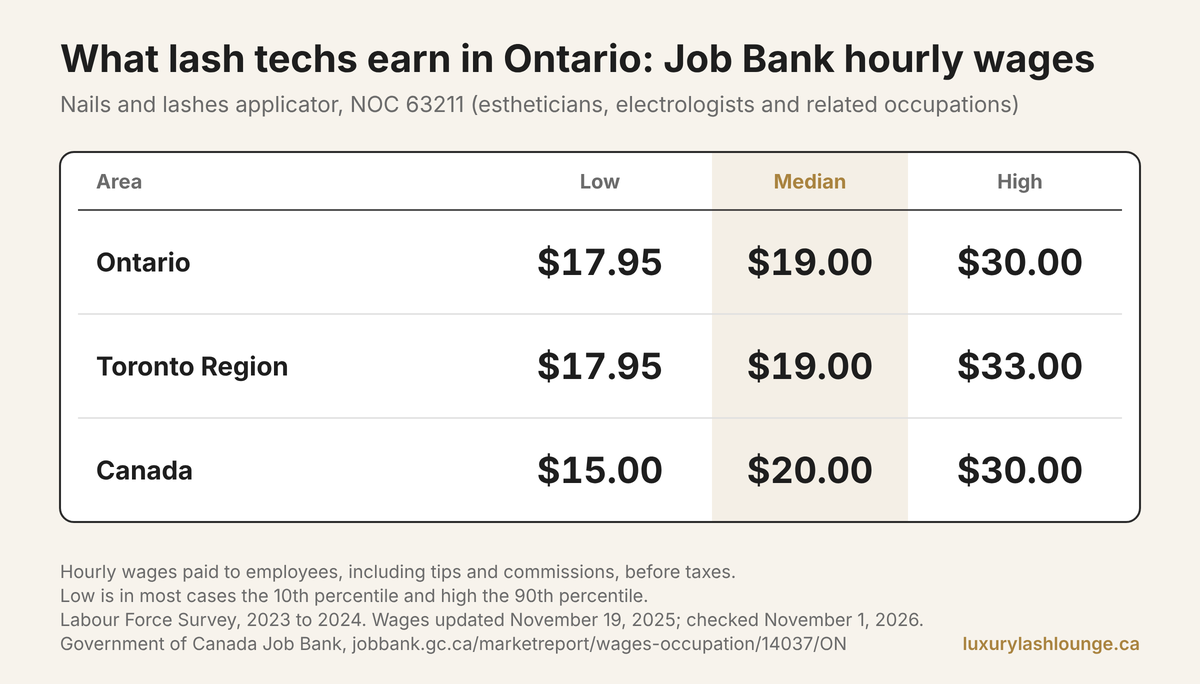
| Area | Low | Median | High |
|---|---|---|---|
| Ontario | $17.95 | $19.00 | $30.00 |
| Toronto Region | $17.95 | $19.00 | $33.00 |
| Canada | $15.00 | $20.00 | $30.00 |
Source: Job Bank, Nails and Lashes Applicator in Ontario, Labour Force Survey data for 2023 to 2024. "These wages were updated on November 19, 2025," and we checked the page on November 1, 2026.
Job Bank's wage methodology says the low wage is in most cases the 10th percentile, and the high wage the 90th. These wages "include tips and commissions, before taxes and other deductions," and they describe pay to employees.
The low figure matches Ontario's general minimum wage of $17.95 an hour, in effect since October 1, 2026. Job Bank adjusts its wages periodically to reflect the current minimum wage.
What a lash tech salary looks like over a year
Job Bank reports hourly wages, not salaries. This table multiplies each wage by 2,080 hours (40 hours a week for 52 weeks), before tax. It is our arithmetic, not a Job Bank figure.
| Area | Low | Median | High |
|---|---|---|---|
| Ontario | $37,336 | $39,520 | $62,400 |
| Toronto Region | $37,336 | $39,520 | $68,640 |
What drives income for self-employed lash techs
We found no official data on self-employed lash income; these levers decide it:
- Prices and service mix: at our studio, a hybrid full set is $120, volume $135 and mega volume $150.
- Capacity: your speed, your hours and, for a home studio in Vaughan, the one-client-at-a-time zoning rule.
- Rebooking: refills keep your calendar full. Ours need at least 40% of the extensions left, or the visit is charged as a full set.
- Costs: supplies, rent, insurance, licence fees, software and marketing.
- Cancellations: a clear policy protects your time; we ask for 24 hours' notice.
- Taxes: HST once you pass the small supplier threshold, and income tax on your profit.
An example week at our prices
This is an illustration only, not a forecast or a promise. It uses the hybrid prices for our lash extension services, which are before HST.
| Service | Price | Appointments in the example week | Revenue |
|---|---|---|---|
| Hybrid full set | $120 | 4 | $480 |
| Hybrid refill | $65 | 10 | $650 |
| Total | 14 | $1,130 |
That $1,130 is revenue, not income. Supplies, rent, insurance, fees and income tax come out of it, and slow weeks or cancellations reduce it.
When do you have to charge HST?
Under the Canada Revenue Agency's small supplier rule, you generally don't have to register while your taxable sales stay at or under $30,000 over four consecutive calendar quarters. For sole proprietors, that total includes all your businesses.
- Over $30,000 in a single calendar quarter: your registration is effective "no later than the day of the supply that made you exceed $30,000."
- Over $30,000 across four quarters: you are "no longer a small supplier at the end of the month following the quarter in which you exceed $30,000."
- Voluntary registration: you can register before you reach the threshold.
At the pace of the example week, sales would pass $30,000 in about 27 weeks. Ontario's HST rate is 13%, so a $120 service becomes $135.60 for the client.
What skills and qualities make a successful lash tech?
Steady hands, patience and an eye for symmetry get you through a set. Hygiene discipline, honest consultations and business basics keep clients coming back, and almost all of these improve with deliberate practice.
- Fine motor control: isolating one natural lash and placing an extension cleanly, again and again.
- An eye for symmetry: matching both eyes and following your lash map.
- Hygiene discipline: the same cleaning, disinfection and hand hygiene steps for every client.
- Clear communication: honest consultations and simple instructions; our lash extension aftercare guide is a good model.
- Safety judgment: the American Academy of Ophthalmology says an allergic reaction "can trigger pain, itching, redness and swelling." It advises seeing an eye doctor immediately rather than removing the extensions yourself. If a client reports these symptoms or any change in their vision, tell them not to remove the extensions themselves and to see an eye doctor promptly.
- Business skills: pricing, booking, bookkeeping and tracking your sales for HST.
- Stamina: long sessions seated over a client, so set your bed and stool heights for good posture.
What do you need in a lash tech kit?
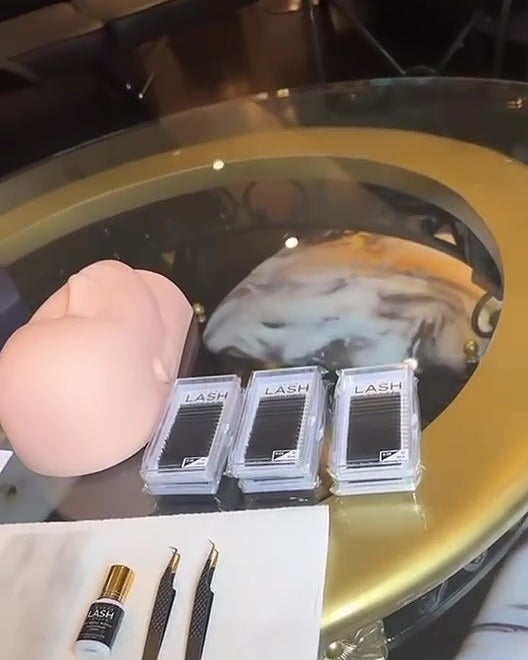
A starter kit needs an isolation tweezer and a volume tweezer, lash trays in classic and volume thicknesses, a professional adhesive, lower-lash protection, prep and removal products, and practice tools. Your room then needs furniture, lighting and hygiene supplies.
| Item | What to look for | Where to find ours |
|---|---|---|
| Tweezers | One isolation and one volume tweezer; ours are Japanese steel, 12 cm long, with 45 and 90 degree tips | Lash tweezers |
| Lash trays | 0.15 mm for classic, 0.05 or 0.03 mm for volume, C or D curl, and mixed 8 to 15 mm trays for practice | Lash extension trays |
| Adhesive | A professional glue with a clear ingredient list and shelf life; our EXTREME BOND dries in 0.5 to 1 second and works best at 50 to 70% humidity | Lash extension glue |
| Lower-lash protection | Gel eye pads and tape, with mapping stickers on top | Gel eye pads and lash mapping stickers |
| Prep, application and removal | Micro swabs, glue rings, a lash tile, spoolies, a cream remover and a foam lash cleanser | Eyelash tools |
| Practice | A mannequin head, practice strip lashes and a training manual | Included in our large kits (manual in the course kit) |
To start with everything in one box, compare the Small Lash Training Kit ($161) with the Large Lash Training Course Kit + Training Manual ($350), both linked in the cost table above. All the trays in our kits are D curl, which Alessia calls the most popular curl with lash techs: a universal curl that looks good on everyone.
In our studio, everything we sell is used on our own clients. We use the Pink USB Lash Fan at the end of an appointment to clear glue fumes before the client opens their eyes.
Your room also needs:
- A lash bed, an adjustable stool, a good light, a trolley and closed storage.
- A hygrometer, so you can keep the room within your adhesive's recommended humidity.
- Hand-wash supplies, an alcohol-based hand rub and a disinfectant with a DIN or NPN.
- A waste receptacle and a simple log for your disinfection records.
Single-use items stay single-use. Use a fresh pair of gel eye pads and a fresh glue ring for each client, and discard lashes you set out but didn't use.
How long does it take to become a lash tech?
It depends on your course format and, even more, on how much you practise afterwards. We could not find an Ontario law that sets a minimum number of training hours for lash extensions, so readiness is about the quality of your work, not a number on a certificate.
Course lengths vary between providers, so ask how many hours are hands-on. After the course, practise on a mannequin until your isolation is clean. Then build up live model sets and ask your models for feedback at their refills.
You're ready for paying clients when you can reliably:
- Isolate every natural lash, with no extensions stuck together.
- Keep adhesive off the skin and the lash line clean.
- Match both eyes to your lash map.
- Keep your client comfortable for the whole appointment.
Our guide to whether lash extensions ruin your lashes has a section for lash techs on protecting clients' natural lashes.
Plan the business steps alongside your practice. Public health needs written notice at least 14 days before you open, and city licences, permits and registrations take time too.
Frequently asked questions
Do you need to be certified to do lashes in Ontario?
We could not find an Ontario law that requires a lash certification, and lash technician isn't one of Ontario's skilled trades. A certificate from your training provider is still the usual proof that you've trained, and your public health unit and municipality can confirm any local requirements.
Health Canada also requires cyanoacrylate lash adhesives to be sold for professional use only. Our Lash Refresher requires proof of certification.
Do you need a licence to do lashes in Ontario?
We could not find a provincial lash tech licence in Ontario's laws or trades list, so confirm with your public health unit and municipality. The rules we found focus on your workplace instead.
Under O. Reg. 136/18, you must notify your local medical officer of health in writing at least 14 days before opening, and public health inspects the setting. Your city may also require a business licence or permit.
Can I run a lash business from home?
Often, yes, but check first. O. Reg. 136/18 covers services provided in part of a dwelling: the lash room itself can't be living space, including for dining, sleeping or food, and it needs a hand-wash sink and, if you reuse tools, a separate reprocessing sink.
City rules apply too: in Vaughan, the Zoning By-law allows a maximum of one client at a time for a personal service home occupation. Confirm with your public health unit and the City before you book clients.
What qualifications do you need to become a lash tech?
We could not find a legal minimum qualification for lash extensions in Ontario. In practice, you need training from an experienced lash educator, a certificate from that program and enough practice to work safely.
Learn eye anatomy, allergies, infection prevention and adhesive safety as well as technique. The federal NOC profile says estheticians usually require certification from their training institution.
How do you become a lash tech in Canada?
The path is similar across Canada: train, practise, get certified and set up a safe workspace. Health Canada's rule that cyanoacrylate lash adhesives are for professional use only applies nationally.
Provincial and municipal rules differ, though. For example, the NOC profile notes that trade certification for estheticians is compulsory in Manitoba, so check your province's rules before you start.
How much do lash techs make in Ontario?
Job Bank reports a median wage of $19.00 an hour in Ontario for nails and lashes applicators (NOC 63211), with $17.95 at the low end and $30.00 at the high end. In Job Bank's Toronto Region, the high end is $33.00.
These are employee wages, updated November 19, 2025. Self-employed income depends on your prices, bookings and costs.
Do I have to tell public health before I start doing lashes?
Yes, in our reading of the rules. O. Reg. 136/18 requires written notice to the medical officer of health of your health unit at least 14 days before you start.
The notice includes the setting's name, if any, and location, your name and contact information, and the services you'll offer. In York Region, you can file it through the Region's online form.
Do lash techs have to charge HST?
Only once you're no longer a small supplier. The CRA's threshold is $30,000 in taxable sales over four consecutive calendar quarters, counting all your businesses if you're a sole proprietor.
If you pass $30,000 in a single quarter, registration is effective no later than the sale that put you over. Ontario's HST rate is 13%.
Do I need to register my lash business name?
Yes, if you use a name other than your own. As the City of Vaughan's economic development office puts it, "The name of a new business must be registered if it is different than the business owner's legal name." Registering a sole proprietorship through the Ontario Business Registry costs $60, and the registration expires every 5 years.
Can I do lash extensions in clients' homes?
O. Reg. 136/18 does not apply to "the dwelling of a person receiving a personal service where the personal service is provided at that dwelling" (section 2). Still, ask your public health unit before you offer mobile lash services, and bring the same cleaning, disinfection and hand hygiene routine you'd use in a studio.
Check your city's licensing rules too, and confirm that your insurance covers mobile work.
Questions about training dates or your first kit? Contact our studio.
About the author
Alessia Simonetta is the owner, master lash artist and certified lash trainer at Luxury Lash Lounge in Woodbridge, Vaughan, Ontario. She has been lashing since 2018 and holds 5 certifications: Classic Lash Artist, Hybrid Lash Artist, Volume Lash Artist, Mega Volume Artist and Certified Lash Trainer. She has worked with thousands of lash clients and trained hundreds of students.
Learn about her 1-on-1 lash training, or book lash extensions in Woodbridge.
Sources
- Ontario e-Laws, O. Reg. 136/18: Personal Service Settings, under the Health Protection and Promotion Act (current version from April 11, 2022; checked November 1, 2026): https://www.ontario.ca/laws/regulation/180136
- Ontario e-Laws, Health Protection and Promotion Act, R.S.O. 1990, c. H.7 (definition of "personal service setting"): https://www.ontario.ca/laws/statute/90h07
- Public Health Ontario, Guide to Infection Prevention and Control in Personal Service Settings, 3rd edition, first revision July 2019: https://www.publichealthontario.ca/-/media/documents/G/2019/guide-ipac-personal-service-settings.pdf
- York Region, Spa and Salon Safety (updated April 7, 2026): https://www.york.ca/BeSpaSafe
- York Region, Personal Service Settings Notification of Intention (online form): https://www.york.ca/form/personal-service-settings-notifi
- York Region Public Health, General Operational Requirements for Personal Service Settings (fact sheet): https://www.york.ca/media/116186/download?attachment
- York Region Public Health, Makeup Application, Eyelashes and Eyebrows (operator fact sheet): https://www.york.ca/media/116231/download?attachment
- York Region, YorkSafe Inspection Program: https://www.york.ca/health/inspections-investigations-and-monitoring/yorksafe-inspection-program
- Health Canada, Cosmetic Ingredient Hotlist: List of Ingredients that are Prohibited or Restricted for Use in Cosmetic Products (date modified August 13, 2025): https://www.canada.ca/en/health-canada/services/consumer-product-safety/cosmetics/cosmetic-ingredient-hotlist-prohibited-restricted-ingredients/hotlist.html
- Skilled Trades Ontario, Work in the compulsory trades: https://www.skilledtradesontario.ca/about-trades/work-in-the-compulsory-trades/
- Skilled Trades Ontario, Trades information (list of trades): https://www.skilledtradesontario.ca/about-trades/trades-information/
- Employment and Social Development Canada, NOC 2021 unit group 63211: Estheticians, electrologists and related occupations: https://noc.esdc.gc.ca/Structure/NOCProfile?GocTemplateCulture=en-CA&code=63211&version=2021.0
- Government of Canada Job Bank, Nails and Lashes Applicator in Ontario: Wages (wages updated November 19, 2025; checked November 1, 2026): https://www.jobbank.gc.ca/marketreport/wages-occupation/14037/ON
- Government of Canada Job Bank, Questions and Answers on Wages (wage methodology): https://www.jobbank.gc.ca/trend-analysis/search-wages/wage-methodology
- Government of Ontario, Your guide to the Employment Standards Act: Minimum wage (checked November 1, 2026): https://www.ontario.ca/document/your-guide-employment-standards-act-0/minimum-wage
- Government of Ontario, Register your business online (registration fees; checked November 1, 2026): https://www.ontario.ca/page/business/start/register-your-business-online
- Government of Ontario, Ontario Business Registry: all services (5-year registration term): https://www.ontario.ca/page/ontario-business-registry-all-services
- Canada Revenue Agency, When to register for and start charging the GST/HST (checked November 1, 2026): https://www.canada.ca/en/revenue-agency/services/tax/businesses/topics/gst-hst-businesses/when-register-charge.html
- Canada Revenue Agency, GST/HST calculator (and rates): https://www.canada.ca/en/revenue-agency/services/tax/businesses/topics/gst-hst-businesses/charge-collect-which-rate/calculator.html
- City of Vaughan, Business Licensing By-law 122-2022 (consolidated June 1, 2026): https://vaughan.ca/sites/default/files/2023-03/122-2022%20%28Consolidated%29.pdf
- City of Vaughan, By-law 038-2026, amending Zoning By-law 001-2021 (in effect February 24, 2026): https://www.vaughan.ca/media/336761/download
- City of Vaughan, Hair and Esthetics Permit: https://www.vaughan.ca/business/business-licensing-and-permits/hair-and-esthetics-permit
- City of Vaughan, Home-based businesses: https://www.vaughan.ca/home-based-businesses
- Vaughan Economic Development, Business name registration: https://vaughanbusiness.ca/business-name-registration/
- American Academy of Ophthalmology, Eyelash Extension Facts and Safety (February 23, 2018): https://www.aao.org/eye-health/tips-prevention/eyelash-extension-facts-safety