
Quick answer
A lash glue allergy is an allergic reaction to an ingredient in eyelash extension glue, which is built on cyanoacrylate; research shows cyanoacrylate glues can release formaldehyde, a known allergen, as they break down. It usually shows up as itchy, red, swollen eyelids and watery eyes, sometimes hours or days after your appointment.
If you react, don't rub your eyes or try to remove the extensions yourself: the American Academy of Ophthalmology (AAO) says to see an ophthalmologist immediately. A patch test before a full set can lower the risk of surprises, but no test or glue can guarantee you'll never react.
This guide is general information, not medical advice. If your eyes hurt, look swollen or your vision changes, contact an eye doctor first. Lash techs, your section is near the end.
What is a lash glue allergy?
A lash glue allergy, also called an eyelash glue allergy or lash extension allergy, is allergic contact dermatitis around the eyes. Your immune system reacts to an ingredient in the glue after you've become sensitized to it.
"Allergic contact dermatitis occurs when a person's immune system responds to contact with something you are allergic to," explains the American Contact Dermatitis Society (ACDS). On the eyelids, eye doctors describe it as allergic blepharitis.
It doesn't start on first contact: the Canadian Centre for Occupational Health and Safety (CCOHS) explains that "the skin allergy begins with a process called sensitization." That process lasts from four days to three weeks, with no visible change to the skin. After that, the next exposure can set off a reaction.
The US Food and Drug Administration (FDA) reminds readers that "the eyelids are delicate, and an allergic reaction, irritation, or other injury in the eye area can be particularly troublesome." A 2019 review of eyelid cosmetic enhancements found allergic blepharitis was the most common complication associated with eyelash extensions. That ranks complications; it doesn't tell you how many clients react.
Can you become allergic after years of extensions?
Yes. Because sensitization comes before symptoms, years of trouble-free sets don't rule out a future reaction.
The ACDS notes that an allergic reaction "can happen even to substances that you have used safely for years." A doctor quoted by the AAO on eyelash and eyebrow treatments adds, "People can develop sensitivities with repeated exposure."
What's in lash glue, and which ingredients cause reactions?
Professional lash glue is built on cyanoacrylate, a fast-setting adhesive from the acrylate family that cures when it meets moisture. Reactions have been linked both to these acrylic ingredients and to formaldehyde, which can form as cyanoacrylate breaks down.
A 2018 paper in the journal Molecules explains that cyanoacrylate's "rapid anionic polymerization on exposure to surface moisture is responsible for instant adhesion." A 2021 review of acrylate allergy in Advances in Dermatology and Allergology notes that "eyelash glue often contains cyanoacrylates." It describes the reactions seen as "blepharitis in customers or hand eczema in eyelash stylists."
In Canada, these adhesives are restricted. Health Canada's Cosmetic Ingredient Hotlist says cyanoacrylate adhesives for eyelash extensions "must be sold for professional use only (i.e., not for direct sale to consumers)." Their labels must say "For application by trained professionals only" and "Ensure the eye is protected and immobilized during application."
Where formaldehyde comes in
Eye-health sources single out formaldehyde. The AAO notes that "in the past, some of these glues have contained the allergen formaldehyde." EyeWiki, the AAO's eye encyclopedia, says formaldehyde in the glue and eyelid-fixing tapes "are believed to cause the allergic reaction."
It doesn't have to be added to be there. A 2026 lab study of medical cyanoacrylate glues used to close veins, published in Phlebology, opens by noting that "commercially available cyanoacrylates are known to release formaldehyde during degradation."
A 2026 lab study in Contact Dermatitis, which measured formaldehyde given off by a cyanoacrylate wound-closure adhesive, calls formaldehyde "a degradation byproduct of cyanoacrylates and a potent sensitiser." It adds that "prior sensitisation from adhesives such as nail, eyelash or super glues may heighten risk." The abstract mentions eyelash glue only as a possible source of that earlier sensitization; the study didn't test lash glue.
If you know you're allergic to formaldehyde, talk to your doctor before getting lash extensions. If your doctor agrees you can go ahead, mention the allergy at your consultation and at your patch test.
What's in EXTREME BOND
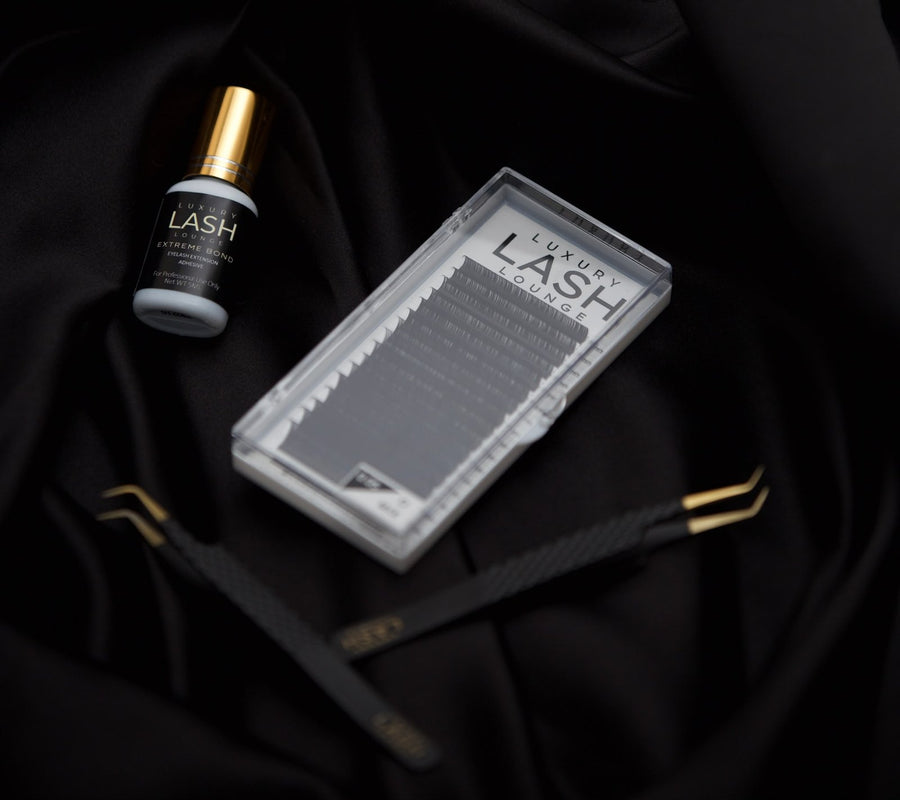
Our own adhesive, EXTREME BOND, lists ethyl cyanoacrylate, PMMA, hydroquinone and carbon black, and it is low-fume, latex-free and made without added formaldehyde, according to its maker. Research shows cyanoacrylate glues can still release formaldehyde as they break down, so we never describe EXTREME BOND as hypoallergenic, sensitive or allergy-safe. As Health Canada requires for cyanoacrylate lash glue, it's sold for trained professionals only.
| Ingredient | What it is | What to know about reactions |
|---|---|---|
| Ethyl cyanoacrylate | The bonding ingredient; it cures on contact with moisture | Its EU (CLP) hazard classification, listed in PubChem, says it causes skin irritation and serious eye irritation, and may cause respiratory irritation |
| Formaldehyde | Made without added formaldehyde, according to the maker, but it can form as cyanoacrylate breaks down | The AAO calls it an allergen that some lash glues have contained, and EyeWiki says it's believed to cause the allergic reaction |
| PMMA (poly(methyl methacrylate)) | An acrylic polymer | The acrylate review calls products containing acrylic polymers "relatively inert," but notes monomer particles are sometimes still released, and monomers are the more allergenic form |
| Hydroquinone | Often found in commercial cyanoacrylate glues: the Molecules paper notes they "often contain radical inhibitors, such as hydroquinone" | Health Canada caps it at 0.1% in cyanoacrylate lash and brow extension adhesives, with the label caution "Avoid skin contact" |
The glue isn't the only suspect: EyeWiki also points to formaldehyde in eyelid-fixing tapes. Our patch test includes the hydrogel eye pad we use in all our lash treatments, to check it works well with your skin.
Lash glue allergy symptoms: what a reaction looks like
The classic signs are itchy, red and swollen eyelids, usually on both sides, with watery eyes. Pain, irritation and, sometimes, a temporary change in your vision can come with them.
EyeWiki says allergic blepharitis "typically presents as redness, irritation, itchiness, tearing and swollen eyelids affecting both eyes." The AAO adds that "an allergic reaction can trigger pain, itching, redness and swelling," and that "it may even temporarily interfere with vision."
Signs to watch for after a set or a patch test:
- Itchy eyelids or lash line
- Red eyelids or red eyes
- Swollen, puffy eyelids
- Watery eyes
- Irritation, stinging or burning
- Pain
- Small blisters on the skin
- Blurry or changed vision
Our patch-test guidance includes stinging and burning, and CCOHS lists small blisters among the general signs of allergic contact dermatitis.
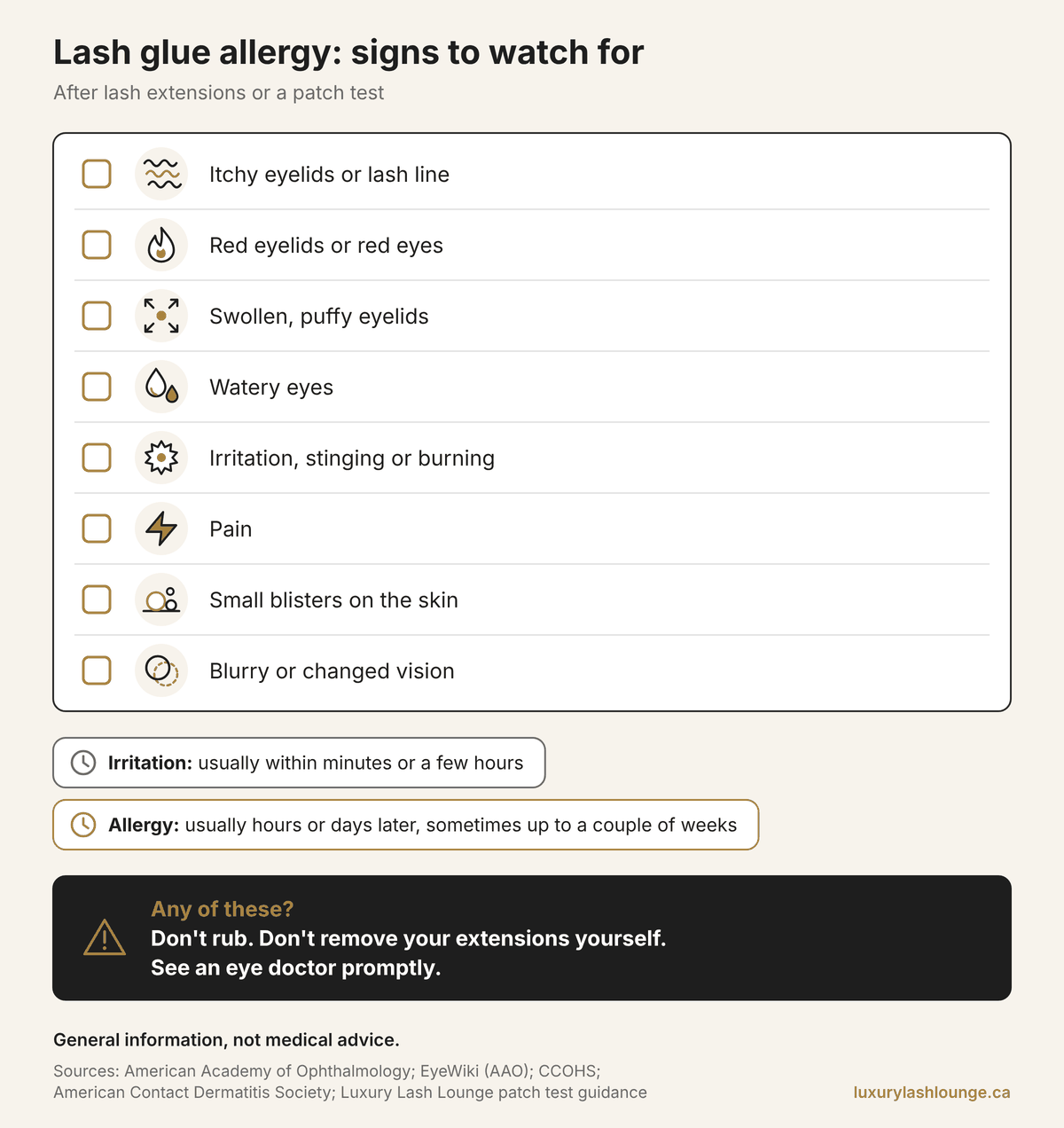
If you were looking for pictures of an allergic reaction to eyelash extensions, we don't publish reaction photos. A photo can't tell an allergy from irritation or from an infection, which the AAO says "can come from inadequate hygiene in the shop or damage to the eye during application." An eye exam can help, and diagnostic patch testing by a doctor can confirm an allergy.
How long after lash extensions can a reaction start?
Anywhere from minutes to days later. Irritation tends to be quick: the ACDS says skin can react to irritating substances "within minutes or hours."
Allergic reactions are usually delayed. EyeWiki notes that symptoms "may not occur until hours or days after the eyelash extensions are applied." The ACDS says allergic reactions in general "typically develop anywhere between a day to a couple of weeks after exposure."
So a set that felt fine when you left the studio can still cause a reaction later.
Eyelash extension allergy vs irritation: how to tell the difference
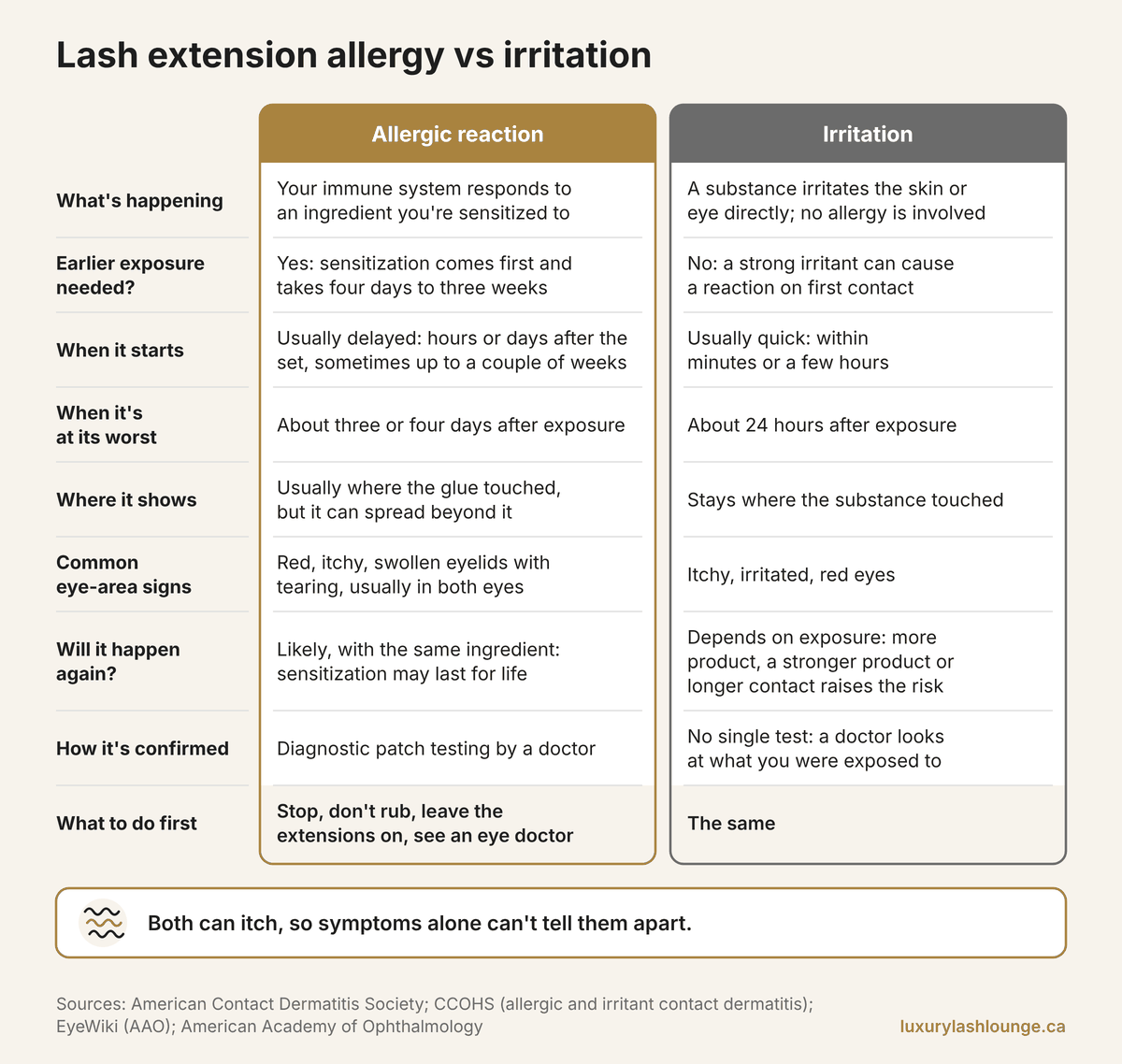
An allergy is your immune system reacting to an ingredient you've been sensitized to. Irritation is a direct reaction to a substance, such as glue fumes or a product reaching your eye, with no allergy involved. The symptoms overlap, so you can't reliably tell them apart at home.
A reaction to chemicals on the surface of the eye can look similar. EyeWiki says extensions can cause keratoconjunctivitis "because of the spread of chemicals onto the ocular surface," and that it "usually presents as ocular itchiness, irritation, and conjunctival hyperemia (redness)."
Since itching shows up in both, symptoms alone can't settle it. CCOHS says "diagnosis of allergic contact dermatitis is confirmed by patch test," while for irritation, "no single test can reliably identify irritants in specific cases."
| Allergic reaction | Irritation | |
|---|---|---|
| What's happening | Your immune system responds to an ingredient you're sensitized to | A substance irritates the skin or eye directly; no allergy is involved |
| Earlier exposure needed? | Yes: sensitization comes first and takes four days to three weeks | No: a strong irritant can cause a reaction on first contact |
| When it starts | Usually delayed: hours or days after the set, sometimes up to a couple of weeks | Usually quick: within minutes or a few hours |
| When it's at its worst | About three or four days after exposure | About 24 hours after exposure |
| Where it shows | Usually where the glue touched, but it can spread beyond it | Stays where the substance touched |
| Common eye-area signs | Red, itchy, swollen eyelids with tearing, usually in both eyes | Itchy, irritated, red eyes |
| Will it happen again? | Likely, with the same ingredient: sensitization may last for life | Depends on exposure: more product, a stronger product or longer contact raises the risk |
| How it's confirmed | Diagnostic patch testing by a doctor | No single test: a doctor looks at what you were exposed to |
| What to do first | Stop, don't rub, leave the extensions on, see an eye doctor | The same |
Sources: ACDS; CCOHS on allergic and irritant contact dermatitis; EyeWiki.
What to do if you have an allergic reaction to lash extensions
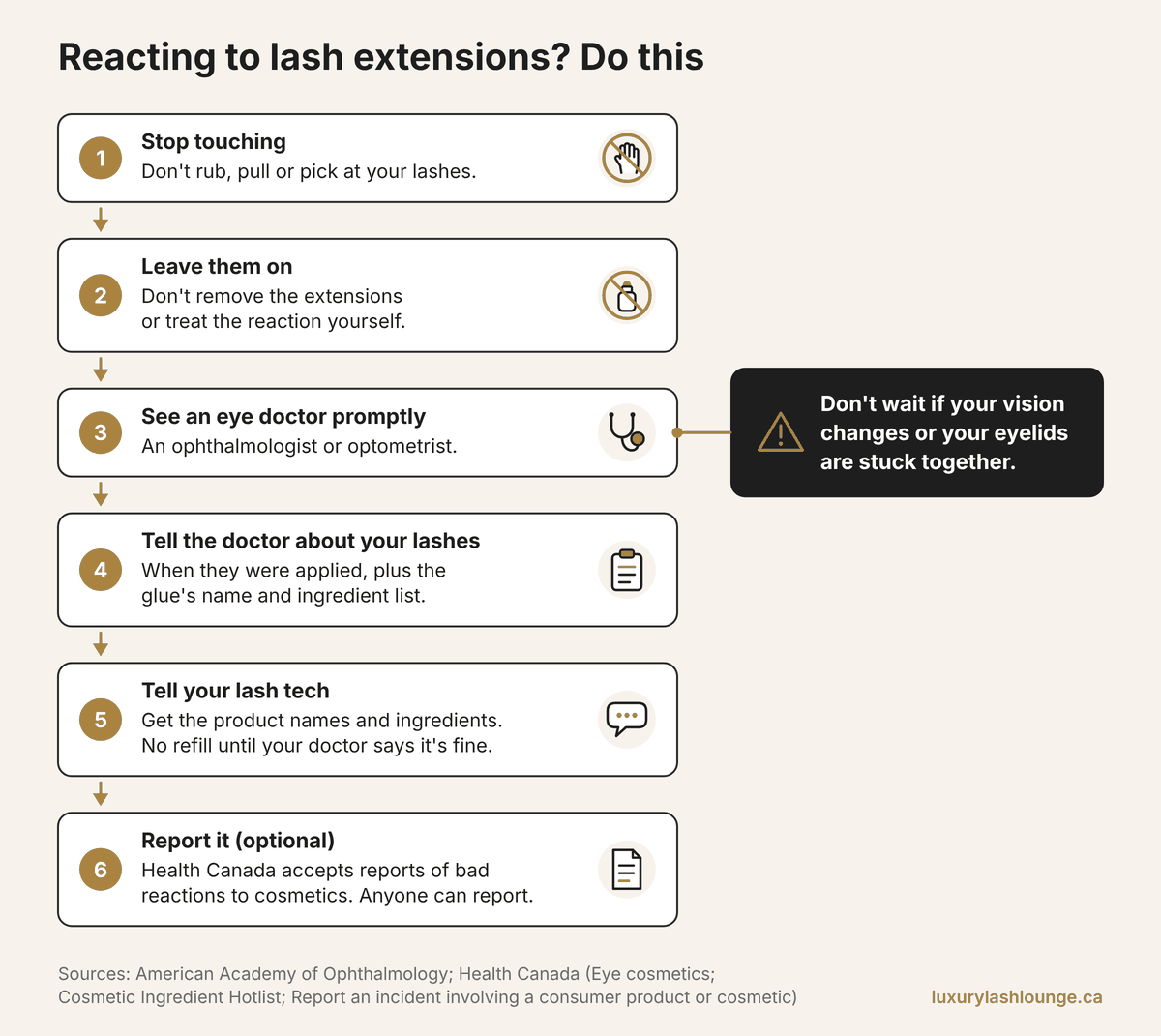
Stop touching your eyes, leave the extensions on, and see an eye doctor promptly. Then tell your lash tech, and consider reporting the reaction to Health Canada.
- Stop rubbing, pulling or picking. The AAO warns that "rubbing, tugging or pulling can fracture your natural lashes, and even cause permanent damage to the eyelash follicle."
- Don't remove the extensions yourself. "If you have an allergic reaction to extensions, do not try to remove them yourself, as this could damage your eyes," the AAO says. It adds, "Do not try to treat the reaction on your own." Professional removers such as our Eyelash Extension Cream Remover are not for clients to use at home.
- See an eye doctor promptly. For an allergic reaction, the AAO says to "go see an ophthalmologist immediately," and an optometrist can also examine your eyes. Don't wait if your vision changes or your eyelids are stuck together: the AAO notes a reaction "may even temporarily interfere with vision," and the warning Health Canada requires on lash glue labels includes "Eyelid bonding: consult a physician."
- Tell the doctor about your lashes. Say when they were applied, and bring the glue's name and ingredient list if you can.
- Tell your lash tech. Ask for the product names and ingredients, and don't book a refill until your doctor says it's fine. Health Canada says to "stop using an eye cosmetic immediately if it causes irritation or inflammation."
- Report it to Health Canada if you wish. Health Canada encourages reports when someone "has a bad reaction from using it," and its incident reporting overview says "anyone can report." Use the consumer reporting page, with the product's name, where you got it, and photos of its labels ready.
Professional removal is the safest way to take lash extensions off, but with symptoms, your eye doctor's advice comes first. For removal questions when your eyes are healthy, see our guide on how to remove lash extensions at home.
Will an allergic reaction to eyelash extensions go away?
The flare-up can be treated, but the allergy itself may not go away. CCOHS says "the allergic sensitization may remain with the individual throughout life," though if there's no further contact, the level of sensitivity may gradually decline, or it may not change.
While the extensions are on, the glue is still at your lash line. The ACDS says treatment of contact dermatitis "is based on avoiding contact with the substance(s) that caused the reaction." So ask your eye doctor whether your extensions should come off, and who should remove them.
Ask your doctor, too, how long your flare-up is likely to last. Our guide to how long lash extensions last explains how long a set stays on by itself, but don't wait out a reaction without medical advice.
How is an eyelash extension allergy treated?
Treatment is your eye doctor's decision. EyeWiki says treatment for allergic blepharitis "may include antihistamine eye drops and/or oral tablet, and antibiotics and/or steroid eye drops." It also says people with these symptoms "should seek prompt professional medical advice."
Don't start drops, creams or home remedies on your own; the AAO advises against treating the reaction yourself. Instead, follow your doctor's plan and avoid the trigger, which the ACDS says is the basis of treatment.
Can you still get lash extensions if you're allergic to lash glue?
Possibly not, and that decision belongs with your doctor, not your lash tech. EyeWiki advises that "clients with existing eye disease or allergy history should avoid eyelash extensions."
If your doctor confirms an allergy to a glue ingredient, switching glues may not help. Lash glues often share the same cyanoacrylate chemistry, and the acrylate review says people who react to several acrylates may have "cross-reactions between acrylic monomers."
Labels don't settle it either. The US FDA says "there are no Federal standards or definitions that govern the use of the term 'hypoallergenic.'" It adds that "the term means whatever a particular company wants it to mean."
The only adhesive we sell, EXTREME BOND, is a cyanoacrylate glue, and we don't promise it suits anyone with a glue allergy. If your reaction turned out to be irritation, or your doctor isn't sure, ask whether extensions are reasonable for you and whether a lash patch test makes sense first. Our studio recommends one for anyone who has had a reaction or sensitivity to lash extensions before.
What can I use if I'm allergic to lash glue?
Start with your doctor, then consider these options:
- Mascara. EyeWiki says people who should avoid extensions "may consider mascara as a safer alternative if used properly." See our guide to mascara and makeup with lash extensions.
- A lash lift, with care. It isn't glue-free: the AAO's guide to eyebrow and eyelash enhancement says a lift holds the lashes in place with adhesive while a chemical lotion is applied, so ask your doctor first. Our studio doesn't offer lifts; compare the two in lash lift vs lash extensions.
- Your natural lashes. No glue and no fumes.
Lash patch tests explained
A lash patch test applies a small amount of a studio's products before a full set, so you can watch for a reaction. It isn't a doctor's diagnostic patch test, and a clear result lowers the risk of surprises rather than guaranteeing you'll never react.
Our studio's lash patch test
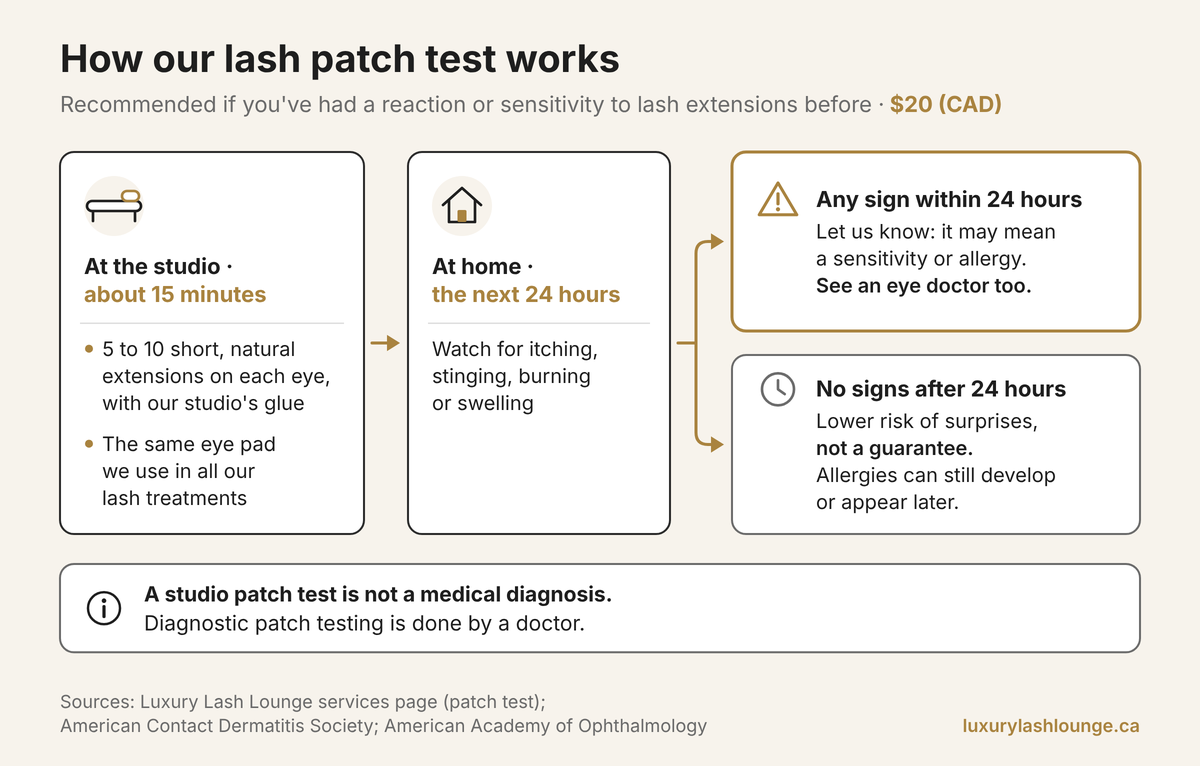
In our studio, a patch test is recommended if you've had a reaction or sensitivity to lash extensions before. It costs $20 (CAD) and takes about 15 minutes.
- We place 5 to 10 short, natural lash extensions on each eye, using our studio's glue.
- We use the same hydrogel eye pad we use in all our lash treatments, to check it works well with your skin.
- You go home and watch your eyes for the next 24 hours.
- If you notice itching, stinging, burning or swelling within 24 hours, let us know: it may mean you have a sensitivity or allergy to eyelash extensions. See an eye doctor too, as you would after any reaction.
Book through our lash extension services page or our contact page.

The AAO's wrist spot test
The AAO suggests a different check. It advises you to "ask for the glue's ingredient list and check it for allergens," and to "request a spot test on the inside of your wrist before the glue is applied to your eyes."
Ask your technician for it rather than trying it at home. In Canada, lash glue must be sold for professional use only, and its label warning begins "WARNING. BONDS SKIN INSTANTLY."
Diagnostic patch testing by a doctor
If you've already reacted and want to know why, ask your doctor about diagnostic patch testing. CCOHS says "diagnosis of allergic contact dermatitis is confirmed by patch test," with "minute amounts of suspected substances" applied, usually on the upper back.
The ACDS describes allergens being "placed on your back for 2 days, then removed," with a second reading about two days after removal. Bring your lash tech's ingredient list to the appointment.
| Our studio patch test | AAO wrist spot test | Diagnostic patch test | |
|---|---|---|---|
| Who does it | Our lash studio | Your lash technician, on request | A doctor |
| Where | The lash line: 5 to 10 extensions per eye, plus the eye pad | The inside of your wrist | Usually the upper back |
| What it checks | How you respond to our glue and eye pad | How your skin responds to the glue | Which specific substances you're allergic to |
| Timing | About 15 minutes, then 24 hours of watching | Before the glue goes near your eyes | Patches stay on 2 days; another reading about 2 days after removal |
| A medical diagnosis? | No | No | Yes |
Does a clear patch test mean you'll never react?
No. A clear result tells you how you reacted this time, not how you'll react in future. As the doctor quoted by the AAO on eyelash and eyebrow treatments puts it, "It is possible to have a reaction even if you have tolerated a treatment without issue in the past."
If symptoms show up after the 24-hour window, treat them like any other reaction: see an eye doctor and let your lash tech know.
How to lower your risk of a reaction
Choose a trained lash professional, share your allergy history, keep your eyes closed until you're told to open them, and look after your lashes between visits. No step makes a reaction impossible, but each follows advice from health authorities or our own studio practice.
- Choose a trained professional. Health Canada's eye cosmetics advice is to "ensure that the person applying the eyelash extensions is a trained professional," and the AAO suggests asking about their training, certification and experience.
- Share your history and check the ingredients. Tell your lash tech about past reactions, known allergies (including formaldehyde or acrylates) and eye conditions, and check the glue's ingredient list, as the AAO recommends. EyeWiki notes that allergy questionnaires or skin patch tests "may be considered for screening allergy."
- Keep your eyes closed and still. Health Canada says that "during application, the eyes must be protected and immobilized," and warns that the glue "may bond your eyelids instantly."
- Let the fumes clear first. In our studio, we use the Pink USB Lash Fan at the end of an appointment to clear glue fumes before you open your eyes.
- Add one new eye product at a time. The AAO advises you to "introduce only one new eye makeup or care product at a time, especially if you tend to have allergic reactions easily."
- Keep your lash line clean. The AAO notes that "if not removed properly, eye makeup can cause irritation." Alessia recommends washing your lashes ideally every day with an oil-free cleanser, such as our Lash Cleanser Kit; our lash extension aftercare guide covers how.
- Stop at the first sign of trouble. Don't book a refill over itchy, red or swollen eyes; see an eye doctor first.

For the wider safety picture, including lash damage and signs of a poor set, read do lash extensions ruin your lashes. New to extensions? What lash extensions are and how they're applied walks you through a first appointment.
For lash techs: lash glue allergies and your own health
Lash techs can react to lash glue too, on the skin and in the airways. Published reports describe hand eczema in eyelash stylists, and occupational asthma and rhinitis caused by cyanoacrylate lash glue.
What the research shows
The acrylate review notes that acrylates can reach the face and eyelids through airborne particles or "by contaminated tools or hands." For people wearing acrylate-containing eyelash adhesive, it adds, "sometimes the first manifestations may be conjunctivitis and rhinitis."
A 2013 report in Occupational Medicine described two beauty professionals who applied lash extensions for several hours a day and had work-related rhinitis. In clinical inhalation challenges with the glue, both had positive rhinitis reactions on a second challenge, and the one with the longer work history also had a late asthmatic reaction.
During the glue challenge test, ethyl cyanoacrylate, the glues' main component, was measured in the air at 0.4 mg/m³, while total volatile organic compounds stayed below the irritant threshold. The authors concluded that applying extensions "using small amounts of cyanoacrylate-based glues can cause OA and OR," meaning occupational asthma and rhinitis.
That report covers two people, so it shows this can happen, not how often. CCOHS's advice is blunt: "Sensitized workers should avoid further exposure to the allergen." For a lash tech, that means the glue at your station.
How to protect yourself and your clients
- Control fumes. CCOHS's general workplace advice is that "local exhaust systems should be used where toxic substances may escape into the workroom." At the chair, our Air Pump Blower helps the adhesive dry and reduces fumes around your client's eyes. The Pink USB Lash Fan clears fumes at the end of the appointment.
- Work with small, fresh drops. Follow EXTREME BOND's directions: a small drop on a fresh glue ring or pallet, replaced as it thickens. Date the bottle when you open it and use it within 3 months.
- Keep glue off skin, yours and your client's. The glove advice in the acrylate review is for nail technicians, not lash techs: in gel nail work, it notes, "nitrile gloves are considered to be a more effective option than latex gloves, but only if exposure is brief (15–20 min)."
- Use fresh single-use items. Use a fresh pair of Gel Eye Pads for every client; they're the same pads we use in our own appointments. EyeWiki also links formaldehyde in eyelid-fixing tapes to reactions, so note which tapes and pads each client had.
- Screen every client. Ask about past reactions, allergies and eye conditions, and offer a patch test to anyone who has reacted before. Never apply over irritated eyes, and send a client with symptoms to an eye doctor before any refill or removal.
- Keep the glue professional. Health Canada requires cyanoacrylate lash adhesives to be sold for professional use only, so never sell or give glue to clients. Our lash extension glue collection is for trained lash professionals.
- Watch your own health. See your doctor about hand eczema, itchy or swollen eyelids, a runny or blocked nose, or wheezing linked to work. Tell them what you work with, and ask about patch testing.
- Know Ontario's rules. Public health requirements for lash studios are covered in our guide on how to become a lash tech in Ontario.
Allergy training
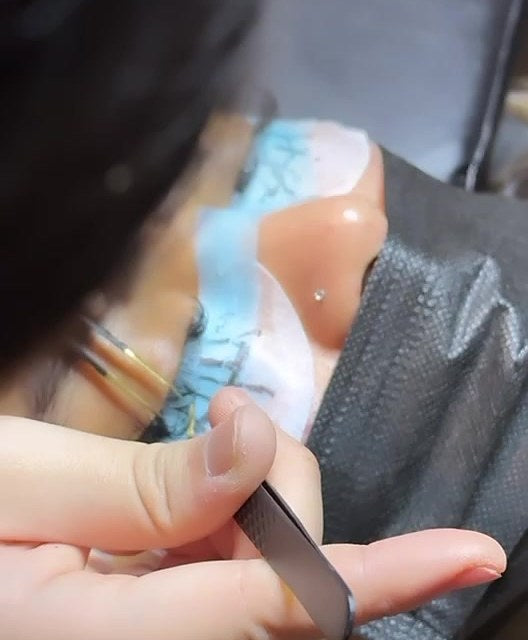
Allergy and infection knowledge is part of our Eyelash Extension Masterclass, along with patch tests, removals, sanitization and disinfection, and lash room set-up and legal responsibilities. Certified lash techs can fill gaps with our customized Lash Refresher, and EXTREME BOND is the adhesive included in our lash extension kits.
Frequently asked questions
What is the ingredient in lash glue that people are allergic to?
There isn't a single culprit: lash glue is built on cyanoacrylate, an acrylate, and a dermatology review calls acrylates a significant cause of allergic contact dermatitis. Formaldehyde, which cyanoacrylates can release as they break down, is the other main suspect. Formaldehyde in eyelid tapes has been linked to reactions too, and diagnostic patch testing by a doctor can show which one affects you.
What does a lash glue allergy look like?
Usually red, itchy, swollen eyelids, often on both sides, with watery eyes. Some people also feel pain, stinging or burning, and the AAO notes a reaction may temporarily interfere with vision. We don't publish reaction photos, because a photo can't tell an allergy from irritation or infection; that takes an eye exam, and sometimes diagnostic patch testing by a doctor.
How long after lash extensions can a reaction start?
Irritation can start within minutes or hours. Allergic reactions are usually delayed. EyeWiki says symptoms may not appear until hours or days after the extensions are applied, and the ACDS says allergic reactions typically develop anywhere from a day to a couple of weeks after exposure.
Will an allergic reaction to eyelash extensions go away?
The flare-up can be treated, but the allergy may stay: CCOHS says sensitization may remain throughout life. While the extensions are on, the glue is still at your lash line, so ask your eye doctor whether they should come off and who should remove them. Don't wait it out without medical advice.
Is there a way to cure an allergic reaction to lash extensions?
Don't try to cure it at home: the AAO advises against treating a reaction on your own. The ACDS says treatment is based on avoiding what caused the reaction, and EyeWiki says an eye doctor's treatment may include antihistamine drops or tablets, and sometimes antibiotic or steroid eye drops. So get your eyes checked.
What can I use if I'm allergic to lash glue?
Ask your doctor first. EyeWiki suggests mascara as a safer alternative for people who should avoid extensions, when used properly, but a lash lift isn't glue-free: the AAO says lifts also use an adhesive. Another lash glue may not help, because many share the same cyanoacrylate chemistry, and in the US, the FDA says "hypoallergenic" has no federal standard or definition.
Should I take my extensions off myself if I'm having a reaction?
No: the AAO says not to try removing them yourself during an allergic reaction, because this could damage your eyes. Leave them on and see an eye doctor, who can advise whether they should come off and who should remove them. Professional removers, including ours, are not for use at home.
Is EXTREME BOND hypoallergenic?
No, and we don't describe any lash glue that way. EXTREME BOND's ingredients are ethyl cyanoacrylate, PMMA, hydroquinone and carbon black, and it's for trained lash professionals only. It's low-fume, latex-free and made without added formaldehyde, according to its maker, but research shows cyanoacrylate glues can release formaldehyde as they break down.
I'm allergic to formaldehyde. Can I get lash extensions?
Talk to your doctor before booking. Formaldehyde can form as cyanoacrylate glue breaks down, and eye-health sources link it to reactions to lash glue. If your doctor agrees you can try extensions, mention your formaldehyde allergy at your consultation and before any patch test.
Can lash techs become allergic to lash glue?
Yes: a dermatology review describes hand eczema in eyelash stylists, and a 2013 report described two beauty professionals with work-related rhinitis, one also with asthma, confirmed with inhalation challenges using cyanoacrylate lash glue. Ventilation and keeping glue off your skin are sensible steps. See a doctor early about any skin, eye or breathing symptoms.
About the author
Alessia Simonetta is the owner, master lash artist and certified lash trainer at Luxury Lash Lounge in Woodbridge (Vaughan), Ontario. She has been lashing since 2018 and holds five certifications: Classic Lash Artist, Hybrid Lash Artist, Volume Lash Artist, Mega Volume Artist and Certified Lash Trainer.
She has worked with thousands of lash clients and trained hundreds of students. Book lash extensions or a patch test at the studio, or learn with her in a 1-on-1 lash course.
Sources
- American Academy of Ophthalmology, "Eyelash Extension Facts and Safety" (February 2018): https://www.aao.org/eye-health/tips-prevention/eyelash-extension-facts-safety
- American Academy of Ophthalmology, "How To Use Cosmetics Safely Around Your Eyes" (October 2026): https://www.aao.org/eye-health/glasses-contacts/eye-makeup
- American Academy of Ophthalmology, "Know the Risks of Eyebrow and Eyelash Enhancement" (December 2019): https://www.aao.org/eye-health/news/eyebrow-eyelash-coloring-could-harm-your-vision
- EyeWiki (American Academy of Ophthalmology), "Eyelash Extensions": https://eyewiki.aao.org/Eyelash_Extensions
- Health Canada, "Eye cosmetics": https://www.canada.ca/en/health-canada/services/cosmetics/eye-cosmetics.html
- Health Canada, Cosmetic Ingredient Hotlist (prohibited and restricted ingredients; cyanoacrylate-based adhesives and hydroquinone entries): https://www.canada.ca/en/health-canada/services/consumer-product-safety/cosmetics/cosmetic-ingredient-hotlist-prohibited-restricted-ingredients/hotlist.html
- Health Canada, "Report an incident involving a consumer product or cosmetic: overview": https://www.canada.ca/en/health-canada/services/consumer-product-safety/report-incident.html
- Health Canada, "Report an incident involving a consumer product or cosmetic: Consumers": https://www.canada.ca/en/health-canada/services/consumer-product-safety/report-incident/consumers.html
- US Food and Drug Administration, "Eye Cosmetic Safety": https://www.fda.gov/cosmetics/cosmetic-products/eye-cosmetic-safety
- US Food and Drug Administration, "'Hypoallergenic' Cosmetics": https://www.fda.gov/cosmetics/cosmetics-labeling-claims/hypoallergenic-cosmetics
- Canadian Centre for Occupational Health and Safety (CCOHS), "Dermatitis, Allergic Contact": https://www.ccohs.ca/oshanswers/diseases/allergic_derm.html
- Canadian Centre for Occupational Health and Safety (CCOHS), "Dermatitis, Irritant Contact": https://www.ccohs.ca/oshanswers/diseases/dermatitis.html
- American Contact Dermatitis Society, "Contact Dermatitis FAQ": https://www.contactderm.org/patient-support/contact-dermatitis-faq
- Duffy C, Zetterlund PB, Aldabbagh F. "Radical Polymerization of Alkyl 2-Cyanoacrylates." Molecules. 2018;23(2):465: https://www.mdpi.com/1420-3049/23/2/465
- PubChem (US National Library of Medicine), "Ethyl cyanoacrylate" (CID 81530), Safety and Hazards: GHS Classification: https://pubchem.ncbi.nlm.nih.gov/compound/Ethyl-cyanoacrylate
- Gracé J, Connor DE, Day RO, et al. "Formaldehyde is released from cyanoacrylate adhesives used in venous occlusion systems." Phlebology. 2026;41(9):797-807 (PubMed abstract): https://pubmed.ncbi.nlm.nih.gov/41544622/
- Rouhani DS, Villalobos PM, Zeng S, et al. "Formaldehyde Emissions From 2-Octyl Cyanoacrylate: Quantified Risk for Allergic Contact Dermatitis." Contact Dermatitis. 2026;94(6):635-644 (PubMed abstract): https://pubmed.ncbi.nlm.nih.gov/41698688/
- Masud M, Moshirfar M, Shah TJ, et al. "Eyelid Cosmetic Enhancements and Their Associated Ocular Adverse Effects." Med Hypothesis Discov Innov Ophthalmol. 2019;8(2):96-103 (PubMed abstract): https://pubmed.ncbi.nlm.nih.gov/31263720/
- Kucharczyk M, Słowik-Rylska M, Cyran-Stemplewska S, et al. "Acrylates as a significant causes of allergic contact dermatitis – new sources of exposure." Advances in Dermatology and Allergology. 2021;38(4):555-560: https://www.termedia.pl/Acrylates-as-a-significant-causes-of-allergic-contact-dermatitis-new-sources-of-exposure,7,40795,1,1.html
- Lindström I, Suojalehto H, Henriks-Eckerman ML, Suuronen K. "Occupational asthma and rhinitis caused by cyanoacrylate-based eyelash extension glues." Occupational Medicine. 2013;63(4):294-297 (abstract): https://academic.oup.com/occmed/article-abstract/63/4/294/1429196