
Quick answer
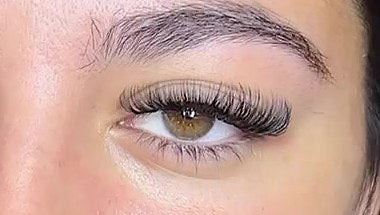
Cat eye lash extensions are a lash extension style that gets gradually longer from the inner corner to the outer corner, where the longest lashes sit. The result lifts and elongates the eye, a little like a flick of winged eyeliner.
Lash techs commonly suggest a cat eye for round, almond and close-set eyes, and adapt it for hooded, downturned or wide-set eyes. This guide covers professional lash extensions, bonded to your natural lashes by a trained lash tech, not strip lashes you apply yourself.
Who this guide is for: clients choosing a style, with a labelled section for lash techs near the end. Alessia Simonetta, our owner and master lash artist, does cat eye sets at our Woodbridge studio in Vaughan, Ontario.
What are cat eye lash extensions?
Cat eye lash extensions are a lash style defined by where the longest lashes sit: at the outer corner. The lengths build steadily outward, so the lash line sweeps up and out and the eye looks longer and more lifted.
A style, not a type of set
A style is the shape of a set. A type is how many extensions go on each natural lash: classic, hybrid, volume or mega volume. Any type can be shaped into a cat eye, and our guide to types of lash extensions compares all four.
At our studio, we offer hybrid, volume and mega volume sets, not classic sets. Lash techs plan the shape with a lash map, a length in mm for each zone of the eye, as our lash map guide explains.
Cat eye lash extensions vs cat eye false lashes
Search for "cat eye lashes" and you'll find plenty of strip lashes: bands of lashes you glue along your lash line and take off yourself.
Lash extensions are different. A trained lash tech bonds each extension, or each fan of fine extensions, to one natural lash. The American Academy of Ophthalmology (AAO) notes that extensions fall off as your natural lashes shed.
The glue is a professional product, too. Health Canada's Cosmetic Ingredient Hotlist says cyanoacrylate adhesives for eyelash extensions "must be sold for professional use only." The AAO's guide to cosmetics around the eyes adds that extensions "can be done safely, if applied by a professional."
How a cat eye set is built
A cat eye starts with length: each zone is a little longer than the last, up to the outer corner. Curl decides how lifted it looks, and thickness and fan size decide how dense and heavy it is.
Length builds toward the outer corner
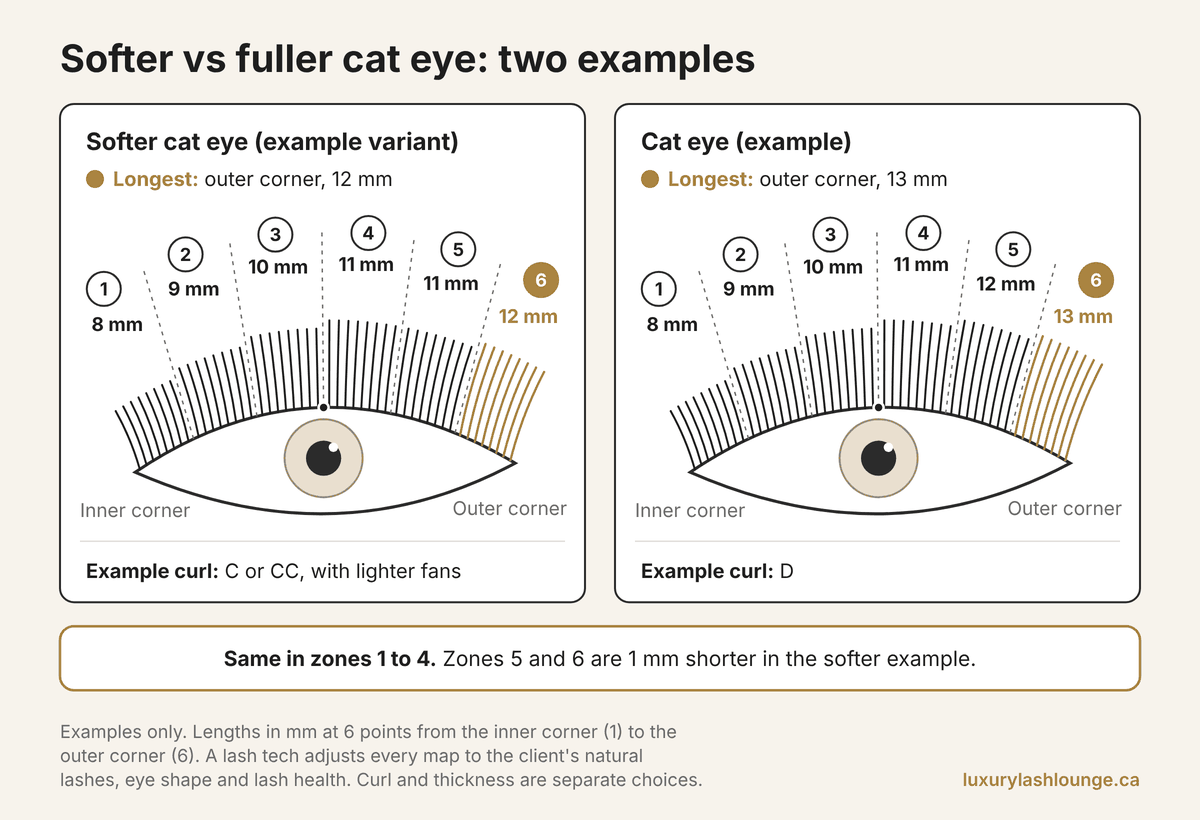
Here is our example cat eye, in mm, across 6 zones from the inner corner (1) to the outer corner (6):
| Zone | 1 | 2 | 3 | 4 | 5 | 6 |
|---|---|---|---|---|---|---|
| Length (mm) | 8 | 9 | 10 | 11 | 12 | 13 |
Each zone is 1 mm longer than the last, so the line rises smoothly instead of jumping at the corner. The inner corner stays shortest, because long inner corners can look heavy and crowded.
This is an example, not a prescription. A lash tech adjusts every map to your natural lashes, eye shape and lash health, as our lash map guide explains.
Curl decides how lifted it looks
The map decides where the length goes; the curl decides how much it lifts. A cat eye can be done in any curl.
| Curl | Typical effect in a cat eye |
|---|---|
| C | Softer and more natural; Alessia describes C curl as giving a more natural look |
| CC | Typically between C and D, for a soft lift |
| D | More lifted and open; Alessia calls D the most popular curl with lash techs, a universal curl that looks good on everyone |
| L | A flat base with an angled lift, commonly used on straight or downward-pointing lashes |
A curlier extension ends closer to its base than a straighter one of the same length, so it can look shorter from the front. Curl shapes also vary by manufacturer, and our lash curl chart compares them side by side.
Thickness and fans decide density and weight
Thickness and fan size set how full the outer corner looks and how much weight each natural lash carries. As a rough calculation for round fibres of the same material and length, weight rises with the square of the thickness. So a 0.15 mm classic extension carries about nine times the fibre of a 0.05 mm one.
That's why volume fans are made from fine fibres. In a hybrid or volume cat eye, many lash techs give the outer zones the fullest fans. That makes the corner the darkest, densest part of the set.
Keeping the outer corner right for your natural lashes
The outer corner holds a cat eye's longest lashes, so the natural lashes there have to be strong enough to carry them. A good set takes its outer length from your own lashes, not from a photo.
For scale, natural lashes rarely grow longer than 12 mm, according to a 2018 review in the Journal of Optometry. A common rule of thumb among lash techs is to go only a few mm longer than the natural lash, and less on fine lashes.
Length adds weight as well as drama. As a rough calculation, a 13 mm extension carries just over 60% more fibre than an 8 mm one of the same thickness. Because it reaches further from the lash line, it also pulls with more leverage.
That pull matters. EyeWiki, from the AAO, describes traction alopecia as "the condition where natural lashes are lost due to the traction of synthetic lashes." The AAO adds that rubbing, tugging or pulling can fracture natural lashes and even cause permanent damage to the follicle.
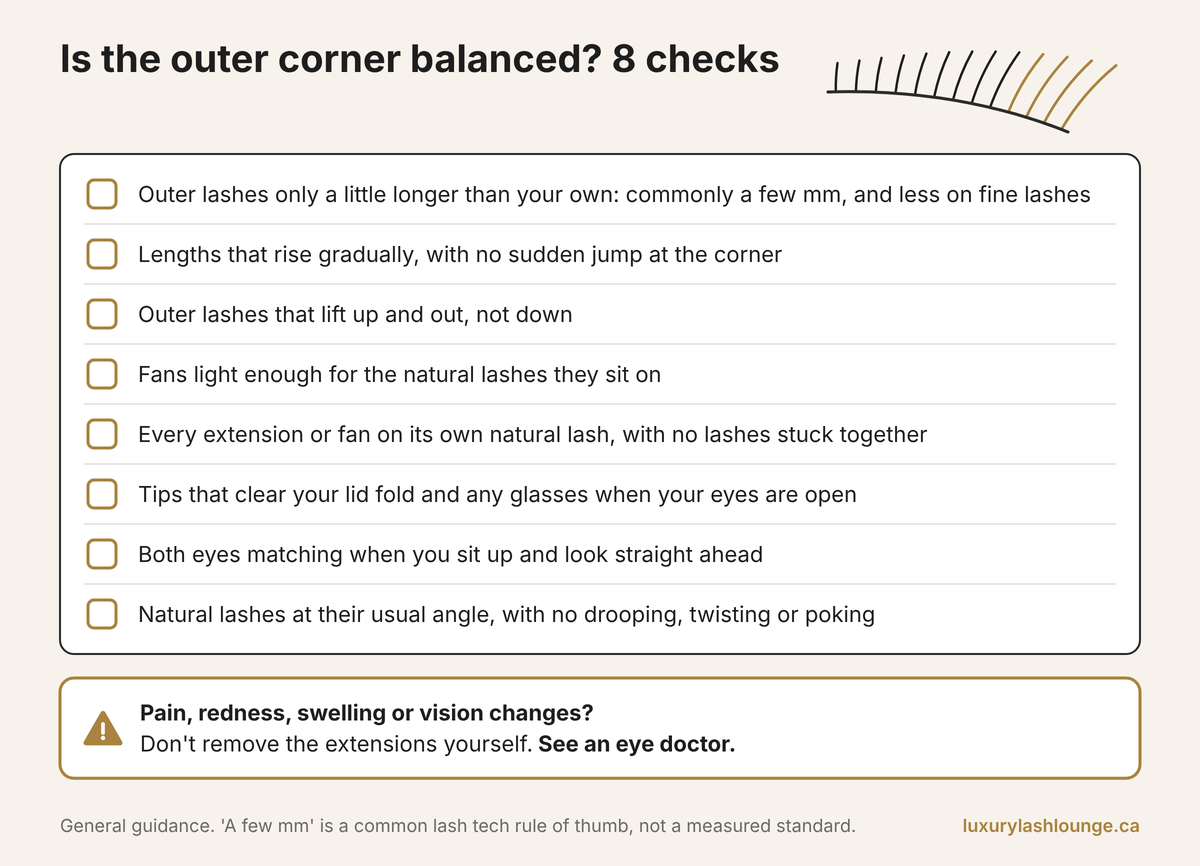
Our guide to whether lash extensions ruin your lashes covers weight, lash loss and regrowth. A well-balanced cat eye corner usually shows these eight signs:
- Outer lashes only a little longer than your own: commonly a few mm, and less on fine lashes
- Lengths that rise gradually, with no sudden jump at the corner
- Outer lashes that lift up and out, not down
- Fans light enough for the natural lashes they sit on
- Every extension or fan on its own natural lash, with no lashes stuck together
- Tips that clear your lid fold and any glasses when your eyes are open
- Both eyes matching when you sit up and look straight ahead
- Natural lashes at their usual angle, with no drooping, twisting or poking
What eye shape do cat eye lashes suit?
Cat eye lashes commonly suit round, almond and close-set eyes, because length at the outer corner makes the eye look longer and draws attention outward. They play up the lift of upturned eyes, and lash techs typically adapt them for hooded, downturned, wide-set and monolid eyes.
Treat this as common guidance from lash techs, not a rule. Your natural lashes, and the look you want, matter as much as your eye shape.
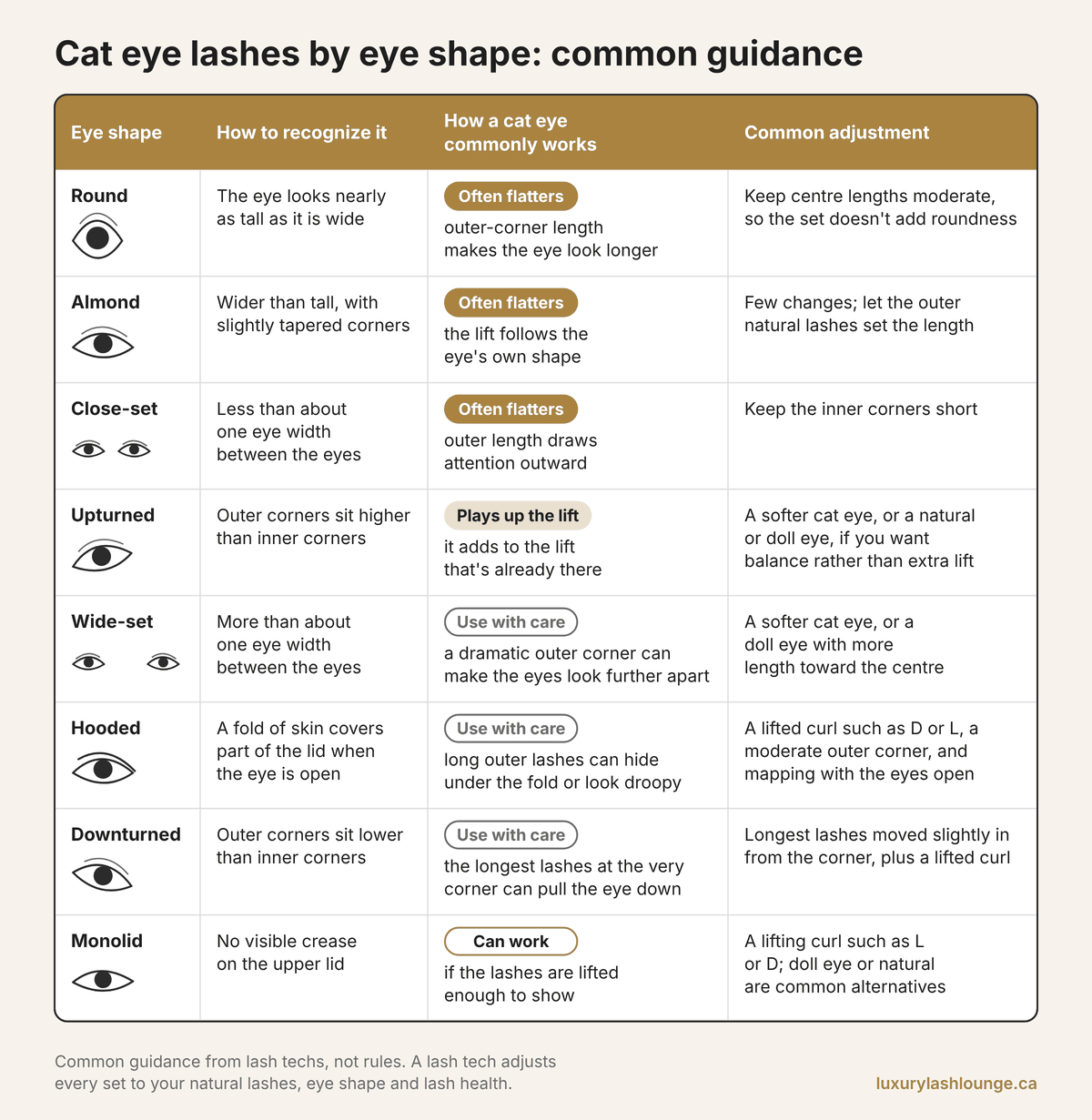
| Eye shape | How to recognize it | How a cat eye commonly works | Common adjustment |
|---|---|---|---|
| Round | The eye looks nearly as tall as it is wide | Often flatters: outer-corner length makes the eye look longer | Keep centre lengths moderate, so the set doesn't add roundness |
| Almond | Wider than tall, with slightly tapered corners | Often flatters: the lift follows the eye's own shape | Few changes; let the outer natural lashes set the length |
| Close-set | Less than about one eye width between the eyes | Often flatters: outer length draws attention outward | Keep the inner corners short |
| Upturned | Outer corners sit higher than inner corners | Plays up the lift: it adds to the lift that's already there | A softer cat eye, or a natural or doll eye, if you want balance rather than extra lift |
| Wide-set | More than about one eye width between the eyes | Use with care: a dramatic outer corner can make the eyes look further apart | A softer cat eye, or a doll eye with more length toward the centre |
| Hooded | A fold of skin covers part of the lid when the eye is open | Use with care: long outer lashes can hide under the fold or look droopy | A lifted curl such as D or L, a moderate outer corner, and mapping with the eyes open |
| Downturned | Outer corners sit lower than inner corners | Use with care: the longest lashes at the very corner can pull the eye down | Longest lashes moved slightly in from the corner, plus a lifted curl |
| Monolid | No visible crease on the upper lid | Can work: if the lashes are lifted enough to show | A lifting curl such as L or D; doll eye or natural are common alternatives |
Many people have more than one feature, such as hooded and downturned eyes. Lash techs commonly start with the feature that changes the lash line most, which is often the hood.
How to tell your eye shape
Look straight ahead into a mirror with your face relaxed, and check four things:
- Crease. No visible crease on the upper lid means a monolid; a fold of skin covering part of the lid suggests hooded eyes.
- Corners. Picture a line from your inner to your outer corner. Sloping up means upturned; sloping down means downturned.
- Shape. Eyes nearly as tall as they are wide are round; eyes wider than tall, with slightly tapered corners, are almond.
- Spacing. Less than about one eye width between your eyes suggests close-set; more suggests wide-set.
Corners are a matter of degree. EyeWiki's canthoplasty article describes the ideal outer corner as sitting up to 3 mm higher than the inner corner, and notes that it may drift lower with age.
The one-eye-width test is rough, too. In a 2015 study in Head & Face Medicine, that rule (the orbital canon) held for only 25% of the women and 29% of the men. The study measured young adults from the Arabian Peninsula.
Cat eye lash extensions for hooded or downturned eyes
Cat eye lash extensions can work on hooded or downturned eyes, but lash techs commonly adapt them. The usual changes are a more lifted curl, a moderate outer corner and, for downturned eyes, the longest lashes moved slightly in from the very corner.
Hooded eyes
With hooded eyes, a fold of skin covers part of the lid when your eyes are open. Some of the lash line, and its length, can disappear under it. One cause is dermatochalasis, which EyeWiki describes as "loose and redundant eyelid skin" and a common sign of aging around the eyes.
Common adjustments for a hooded cat eye:
- Map with your eyes open. Your lash tech checks where the fold sits while you sit up and look straight ahead, not only while you lie back.
- Add lift before length. A curlier curl, such as D, or L for straight or downward lashes, helps the lashes clear the fold.
- Keep the outer corner moderate. A very long corner can press against the fold or look droopy.
- Put density where it shows. Fuller fans along the visible part of the lash line often do more than extra length.
If excess lid skin gets in the way of your sight, see an eye doctor. EyeWiki notes that drooping lid tissue, classically known as lateral hooding, can reduce peripheral vision.
Downturned eyes
With downturned eyes, the outer corners sit lower than the inner corners. A cat eye puts its longest lashes right at the outer corner, so without changes it can make a downturned eye look heavier there.
Many lash techs move the longest lashes slightly in from the very corner, so the lift doesn't sit at the lowest point of the eye. A lifted curl helps the outer lashes point up and out, and lighter fans keep the very corner from looking weighed down.
If a cat eye still drags your eye down, many lash techs suggest a squirrel shape, which peaks about three-quarters across, or a doll eye. Our lash map guide shows example maps for both.
Cat eye hybrid, volume and wispy versions
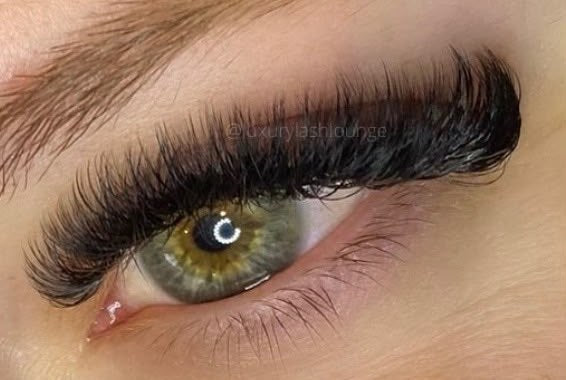
The cat eye shape stays the same across set types; the type changes how dense, dark and textured it looks. A cat eye hybrid looks soft and textured, a volume cat eye fuller and darker, and a wispy cat eye spiky.
At our studio, prices are listed by set type. Hybrid is $120 for a full set and $65 for a refill, volume $135 and $70, and mega volume $150 and $80, in CAD before HST. See lash extensions in Woodbridge for details.
Cat eye hybrid
A cat eye hybrid mixes classic singles, one extension per natural lash, with light fans. Many lash techs place more fans toward the outer corner, so the lift looks fuller where the lashes are longest.
Hybrid suits you if you want a fuller look than your natural lashes, without the bold, dark look of volume. It typically uses two thicknesses, such as 0.15 mm singles and 0.05 mm fans.
Cat eye volume and mega volume
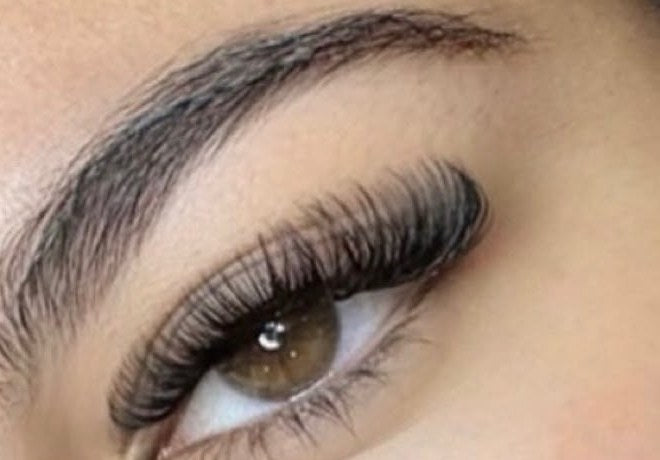
A volume cat eye puts a fan of several fine extensions on each natural lash, for a denser, fluffier lash line and a darker outer corner. Mega volume uses bigger fans of even finer extensions; in our studio, we use 0.03 mm lashes to make big fans for mega volume sets.
Fuller doesn't automatically mean heavier. By the rough calculation above, a fan of three 0.05 mm extensions has about a third of the fibre of one 0.15 mm classic of the same length. But every fan still sits on one natural lash, so fan size, thickness and length all add up at the corner.
Wispy cat eye
A wispy cat eye adds longer "spikes" over a base that follows the cat eye shape, so you get texture as well as lift. Our guide to wispy lash extensions explains how spikes are planned.
How a cat eye compares with doll eye and fox eye
The main difference is where the longest lashes sit. A cat eye peaks at the very outer corner, a doll eye in the centre, and a fox eye holds its peak across the outer zones.
Cat eye vs doll eye. Neither is better; they do different jobs. A doll eye puts the longest lashes in the centre, above the pupil, for a rounder, more open eye.
A cat eye lengthens and lifts the eye instead. Our guide to doll eye lash extensions compares the two in detail.
Cat eye vs fox eye. Both lift the outer corner, but a fox eye steps up from the centre and holds its longest length across the outer two zones. It commonly uses a lifting curl such as L.
A cat eye builds more gradually, to a single longest point at the very corner. Our fox eye lashes guide covers the full comparison.
Subtle vs dramatic cat eye
You can make a cat eye softer or bolder with four levers: outer-corner length, curl, set type and fan density. Many lash techs add drama with density and curl first, and with length only when the natural lashes can carry it.
One example variant, a softer cat eye, runs 8, 9, 10, 11, 11 and 12 mm from the inner to the outer corner. It matches our natural example in the first five zones, then rises to 12 mm at the corner instead of tapering to 10 mm. That last zone is what makes it a cat eye.
Compared with our fuller example, zones 5 and 6 are each 1 mm shorter. The softer version might pair with a C or CC curl and lighter fans, and the fuller one with a D curl.
| Lever | Softer cat eye | Bolder cat eye |
|---|---|---|
| Outer-corner length | Shorter, such as 12 mm in our softer example | Longer, such as 13 mm in our fuller example, on strong outer lashes only |
| Curl | C or CC, for a natural lift | D, or L for straight or downward lashes, for more lift |
| Set type | Hybrid | Volume or mega volume |
| Fans | Lighter fans, or more singles in a hybrid | Fuller fans, concentrated in the outer zones |
| Inner corner | Short and light | Still short, because long inner corners can look heavy |
If you're unsure, start softer: you can ask for more length or density later, if your natural lashes can carry it.
Upkeep and refills
A cat eye needs the same upkeep as any set: each extension falls off as its natural lash sheds, and gaps at the outer corner can soften the lift.
In a small 2024 study of 31 women with dry eye complaints who wore extensions, 28 had them maintained every 2 to 3 weeks. Your own lash cycle sets the pace, as our guide to how long lash extensions last explains.
To keep the outer corner looking lifted between visits:
- Wash your lashes. Alessia recommends washing them ideally every day with an oil-free cleanser. Our Lash Cleanser Kit removes dirt and makeup without breaking down the adhesive bond.
- Brush, don't rub. Once your lashes are dry, brush them into place with a clean lash spoolie.
- Leave loose extensions alone. Picking at one pulls on the natural lash it's bonded to, so ask your lash tech to take it off instead.
Our lash extension aftercare guide has the full routine.
How to ask for a cat eye set
Ask for a cat eye by name, say how lifted and how bold you want it, and bring a photo or two. Then let your lash tech check your natural lashes and eye shape before you agree on the lengths.
Before your appointment
- Bring two or three photos. Note what you like in each. A photo shows someone else's lashes and eye shape, so treat it as a guide to the look, not the lengths.
- Choose a set type. At our studio, hybrid lash extensions give a fuller look than your natural lashes without the bold, dark look of volume. Volume lash extensions give a denser, fluffier lash line, and mega volume a very dramatic set.
- Share your eye health. EyeWiki advises that people with existing eye disease or a history of allergy should avoid extensions. Mention any of these, or a past reaction, and check with your eye doctor first.
- Book a $20 patch test if you've reacted before. It takes about 15 minutes: 5 to 10 short, natural lash extensions on each eye, using our glue and the hydrogel eye pad we use in all our lash treatments. Itching, stinging, burning or swelling within 24 hours may mean a sensitivity or allergy.
Questions to ask at your consultation
- Does a cat eye suit my eye shape, or would you adapt it?
- What length will you use at the outer corner, and can my natural lashes carry it?
- Will you record my map, so my refills keep the same shape?
The AAO also suggests asking about your lash tech's training, certification and experience. It recommends asking for the glue's ingredient list too, so you can check it for allergens.
Booking a cat eye set with us
Alessia does cat eye sets at our private, appointment-only studio at 118 Pioneer Ln in Woodbridge, Vaughan. Full sets and refills take around 1 hour, and 1.5 hours at most.
To book, text or call 647-533-7202, send a DM to @luxurylashlounge on Instagram, email luxurylashloungevaughan@gmail.com, or use the form on our contact page. We need 24 hours' notice to cancel an appointment. If you're wearing another lash tech's extensions, book a removal ($20) with your full set.
If your eyes become itchy, red, painful or swollen, or your vision changes, don't remove the extensions yourself. The AAO advises seeing an ophthalmologist right away after a reaction, and an optometrist or pharmacist can also advise you.
For lash techs: mapping and balancing a cat eye
This section is for lash techs. A balanced cat eye needs an outer corner the natural lashes can carry and lengths that rise evenly. It also needs a curl that suits the lash direction, and both eyes checked with the client sitting up.
A cat eye workflow
- Assess the outer third on its own. Check the length, strength and direction of the natural lashes there. Base the corner length on the healthy, mature lashes, and go shorter or lighter on new growth.
- Check the eye shape with the eyes open. Sit the client up, ask them to look straight ahead, and note any hood, the corner tilt and the spacing.
- Protect, then plan. Secure the lower lashes with gel eye pads and/or tape, then place a lash mapping sticker on top. Our stickers come 7 pairs to a sheet and should never be used alone to secure the bottom lashes.
- Set the corner, then step inward. Choose the outer length first, then work toward the inner corner in small steps, typically 1 mm per zone as in our example.
- Match curl and fans to each zone. If the outer lashes grow straight or point down, an L curl or a stronger curl often shows the length you mapped. Keep the fans at the very corner light enough for the lashes there.
- Check from the front. Brush through with a spoolie and look for stickies and crisscrossing. Then sit the client up and compare both eyes against the outer corner checklist above.
Record each client's map, so refills keep the same shape. Our lash map guide covers the full mapping process, step by step.
Trays for a cat eye
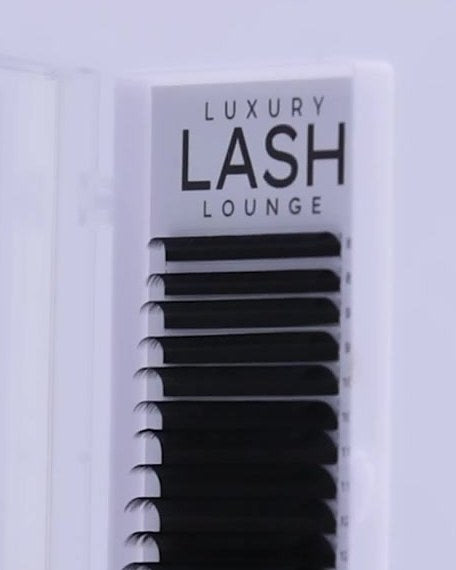
Our lash extension trays are Korean PBT fibre with 16 rows per tray, in two formats:
- Mixed length trays: 8 to 15 mm on one tray, with 2 rows of each length, so every length in our example is on one tray. Choose D curl in 0.03, 0.05 or 0.15 mm, or C, CC or L curl in 0.05 mm. Trays are $15, or $17 for 0.03 mm and L curl.
- Single length volume trays: one length per tray in 0.05 mm, for $15. C curl comes in 8 to 12 mm and D curl in 9 to 19 mm. An 8 mm D curl inner corner or a 13 mm C curl outer corner needs a mixed tray.
For a hybrid cat eye, keep 0.15 mm and 0.05 mm trays on hand. In our range, 0.15 mm comes in D curl, on mixed length trays.
Tweezers and fans
Clean isolation keeps each extension or fan on one natural lash, including at the outer corner, where the longest extensions sit. Our lash tweezers include 45 degree isolation tweezers and a 90 degree volume pick up and fanning tweezer for wide or narrow fans. All are Japanese steel, 12 cm long and hand tested by us before they ship.
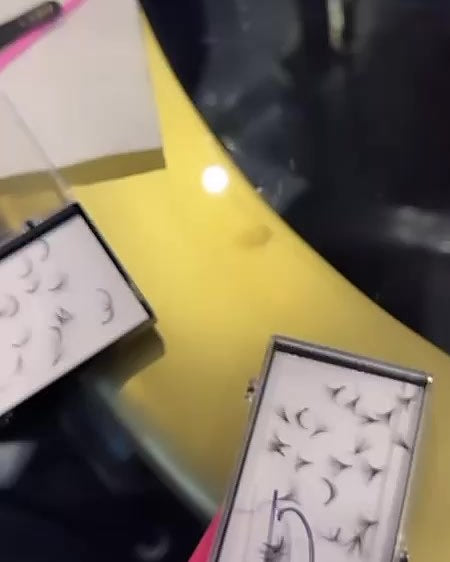
Fan size is a weight decision: the more fibres in a fan, the more its natural lash carries. Match each fan to the lash it sits on.
Learn lash styling 1-on-1
Lash styling and lash mapping are part of our 1-on-1 Eyelash Extension Masterclass ($1,200) in Woodbridge. Certified lash techs can focus on them in the customized Lash Refresher ($550).
Frequently asked questions
What are cat eye eyelash extensions?
Cat eye eyelash extensions are a lash extension style that gets gradually longer toward the outer corner, for a lifted, elongated look. Our example runs from 8 mm at the inner corner to 13 mm at the outer corner. A lash tech adjusts every map to your natural lashes, eye shape and lash health.
What eye shape do cat eye lashes suit?
Lash techs commonly suggest cat eye lashes for round, almond and close-set eyes, because length at the outer corner makes the eye look longer. They also play up the lift of upturned eyes. On hooded, downturned, wide-set or monolid eyes, a cat eye is usually adapted with more curl, a moderate outer corner or a peak moved slightly inward.
Is a doll eye or cat eye better?
Neither is better: a doll eye puts the longest lashes in the centre, above the pupil, so eyes look rounder and more open. A cat eye puts them at the outer corner to lift and lengthen.
Round eyes often suit a cat eye, while hooded eyes often suit a doll eye. See our guide to doll eye lash extensions for the full comparison.
What's the difference between fox eye and cat eye lashes?
Both lift the outer corner, but they build it differently. A cat eye gets gradually longer, to a single longest point at the very corner.
A fox eye steps up from the centre and holds its longest length across the outer two zones, commonly with a lifting curl such as L. Our guide to fox eye lashes covers the full comparison.
Do cat eye lash extensions work on hooded eyes?
Often, with adjustments: the lid fold can hide part of the lash line. Lash techs commonly use a more lifted curl, such as D or L, keep the outer corner moderate and check the shape with your eyes open. If long outer lashes still disappear or look droopy, a doll eye may suit you better.
What lengths are used in a cat eye set?
Our example runs from 8 to 13 mm, inner to outer corner, though a softer set can stop shorter at the corner. Natural lashes rarely grow beyond 12 mm, according to a 2018 review. So a lash tech sets the outer length from your own lashes, commonly only a few mm longer.
Can I wear cat eye lash extensions with glasses?
Usually, as long as the outer lashes clear your lenses, so wear your glasses to the consultation. If the planned length would touch the lenses, the usual fix is a shorter outer corner. Another option is a curl that lifts more steeply, such as D instead of C.
Can I do cat eye lash extensions at home?
No: Health Canada requires cyanoacrylate adhesives for eyelash extensions to be sold for professional use only, labelled for application by trained professionals. Its eye cosmetics page also warns that the glue "may bond your eyelids instantly." Book a trained lash tech instead, or learn properly in a professional lash course.
Does your studio do cat eye lash extensions?
Yes: Alessia does cat eye sets at our private, appointment-only studio in Woodbridge, Vaughan. We offer hybrid, volume and mega volume sets, with prices listed by set type on our services page. Full sets and refills take around 1 hour, 1.5 hours at most, and if you've reacted to lash extensions before, book our $20 patch test first.
About the author
Alessia Simonetta is the owner, master lash artist and certified lash trainer at Luxury Lash Lounge in Woodbridge (Vaughan), Ontario. She has been lashing since 2018 and holds 5 certifications: Classic Lash Artist, Hybrid Lash Artist, Volume Lash Artist, Mega Volume Artist and Certified Lash Trainer. She has worked with thousands of lash clients and trained hundreds of students.
Book lash extensions at our Woodbridge studio, or learn lash styling with her in our 1-on-1 lash training.
Sources
- American Academy of Ophthalmology. Mukamal R, reviewed by Taylor RJ, MD. "Eyelash Extension Facts and Safety." February 23, 2018. https://www.aao.org/eye-health/tips-prevention/eyelash-extension-facts-safety
- Health Canada. "Cosmetic Ingredient Hotlist: Prohibited and restricted cosmetic ingredients" (Table 2, cyanoacrylate-based adhesives). Date modified 2025-08-13. https://www.canada.ca/en/health-canada/services/consumer-product-safety/cosmetics/cosmetic-ingredient-hotlist-prohibited-restricted-ingredients/hotlist.html
- American Academy of Ophthalmology. Gudgel D, reviewed by Taylor RJ, MD. "How To Use Cosmetics Safely Around Your Eyes." October 27, 2026. https://www.aao.org/eye-health/glasses-contacts/eye-makeup
- Aumond S, Bitton E. "The eyelash follicle features and anomalies: A review." Journal of Optometry. 2018;11(4):211-222. https://www.journalofoptometry.org/en-the-eyelash-follicle-features-anomalies-articulo-S1888429618300487
- EyeWiki, American Academy of Ophthalmology. "Eyelash Extensions." Last edited July 21, 2026. https://eyewiki.aao.org/Eyelash_Extensions
- EyeWiki, American Academy of Ophthalmology. "Canthoplasty (Medial and Lateral Canthoplasty)." Last edited September 4, 2026. https://eyewiki.aao.org/Canthoplasty
- Al-Sebaei MO. "The validity of three neo-classical facial canons in young adults originating from the Arabian Peninsula." Head & Face Medicine. 2015;11:4. https://pmc.ncbi.nlm.nih.gov/articles/PMC4369102/
- EyeWiki, American Academy of Ophthalmology. "Dermatochalasis." Last edited November 1, 2026. https://eyewiki.aao.org/Dermatochalasis
- Grupcheva CN, Grupchev DI, Usheva N, Grupcheva LO. "Beauty versus Health: How Eyelash Extensions May Affect Dry Eye Disease?" Journal of Clinical Medicine. 2024;13(11):3101. https://www.mdpi.com/2077-0383/13/11/3101
- Health Canada. "Eye cosmetics." Date modified 2016-12-05. https://www.canada.ca/en/health-canada/services/cosmetics/eye-cosmetics.html