
Quick answer
Fox eye lashes are a lash extension style that lengthens and lifts the outer corner of the eye. Our example fox eye lash map steps up from the centre to 13 mm and holds it across the outer two zones, commonly in a lifting curl such as L.
A cat eye builds gradually to its longest lash at the very corner; a fox eye builds sooner and leans on lift. Fox eye lashes commonly suit almond, round and close-set eyes, and hooded or downturned eyes can wear them with adjustments.
About this guide: it covers professional lash extensions, not strip lashes, at-home clusters or eye makeup. A trained lash tech glues each extension or fan to a single natural lash.
Alessia Simonetta, owner and master lash artist, does fox eye sets at our Woodbridge studio in Vaughan. Lash techs, your section is near the end.
What are fox eye lash extensions?
Fox eye lash extensions are a lash set styled to make the outer third of the eye look longer and lifted. The longest extensions sit in the outer zones, and a lifting curl turns them up.
The effect is visual: extensions don't change the shape of your eye, only where length and lift sit along your lash line.
Many lash techs describe a finished fox eye as swept up and out, toward the tail of the brow. Style names vary between studios, so one studio's fox eye can look like another's cat eye. A photo and a talk about the map clear that up.
Fox eye lashes at a glance
| Fox eye lashes | |
|---|---|
| Where the length sits | Builds from the centre; longest across the outer two zones |
| Example map, inner to outer corner | 8, 9, 11, 12, 13, 13 mm |
| Curl | Outer two zones commonly in a lifting curl such as L |
| Look | An elongated, lifted outer corner |
| Commonly suits | Almond, round and close-set eyes |
| Needs adjusting for | Hooded, downturned and wide-set eyes |
| Set types | Hybrid, volume or mega volume; a wispy version adds spikes |
In any set, the style sets the shape, the curl sets the lift, and the type (hybrid, volume or mega volume) sets how full the lash line looks. Our guide to the types of lash extensions compares the types and other popular styles.
Fox eye lash map (example)
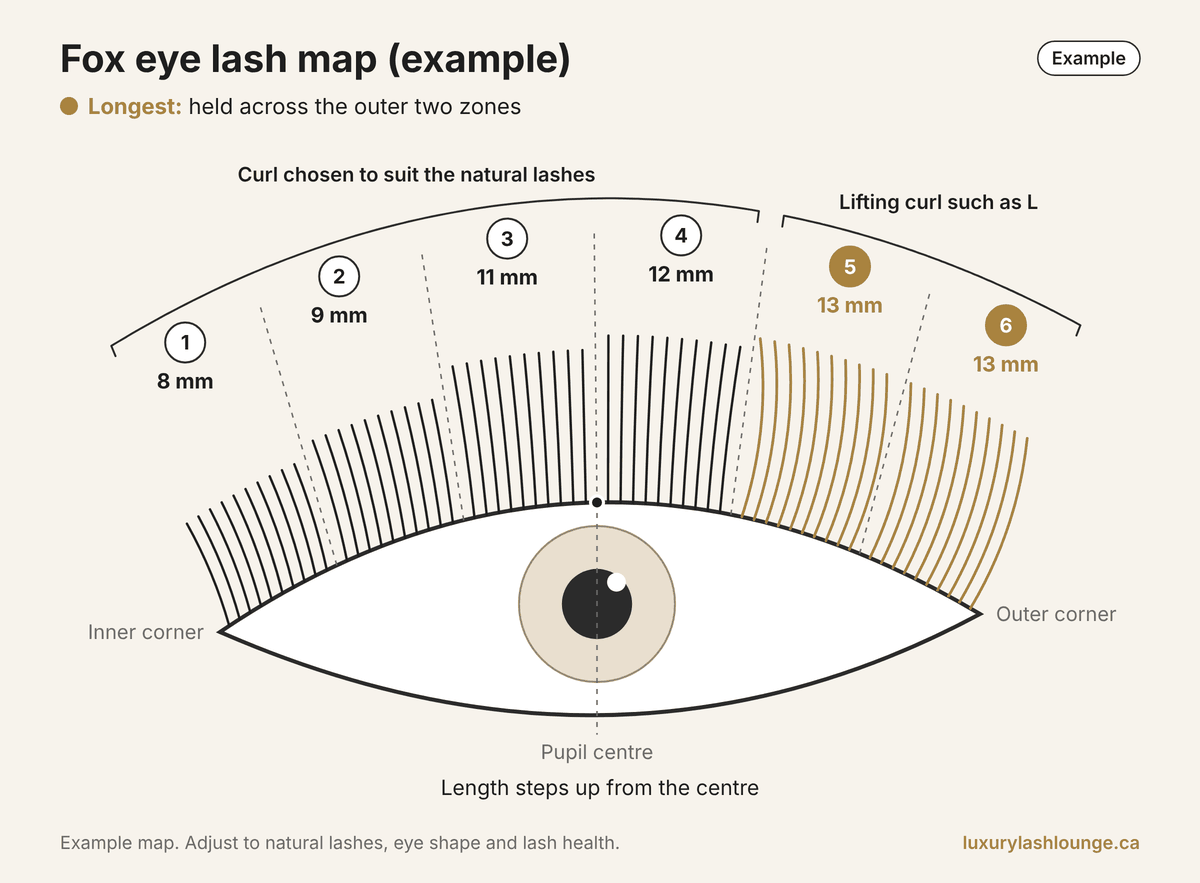
An example fox eye lash map runs 8, 9, 11, 12, 13 and 13 mm from the inner corner to the outer corner. The outer two zones commonly use a lifting curl such as L, for an elongated, lifted outer corner.
It's an example, not a prescription. A lash tech adjusts every map to the client's natural lashes, eye shape and lash health.
| Zone | 1 | 2 | 3 | 4 | 5 | 6 |
|---|---|---|---|---|---|---|
| Length (mm) | 8 | 9 | 11 | 12 | 13 | 13 |
| Curl | To suit the lashes | To suit the lashes | To suit the lashes | To suit the lashes | Lifting, such as L | Lifting, such as L |
Reading the map zone by zone
Zone 1 is the inner corner and zone 6 the outer corner, on both eyes. In our diagrams, the centre of the pupil sits on the line between zones 3 and 4.
- Zones 1 and 2 (8 and 9 mm): short and light, so the inner corner stays soft.
- Zone 3 (11 mm): the build starts at the centre of the eye, with a 2 mm step up from zone 2.
- Zone 4 (12 mm): length keeps climbing past the pupil.
- Zones 5 and 6 (13 mm): the longest length, held across the outer third instead of peaking at one point. A lifting curl turns these lashes up.
The steps between zones stay small, at 0 to 2 mm, so the lash line blends. Holding 13 mm across two zones is what stretches the outer corner, and the curl is what lifts it.
A curl bends part of each lash upward, so an L curl and a softer curl of the same labelled length can look different from the front. Lash techs check the front and adjust.
How a lash tech maps it
Lash techs write the lengths on lash mapping stickers placed over gel eye pads or tape. A sticker should never be used on its own to hold down the lower lashes.
For zones, notation and every mapping step, see our lash map guide. It also shows the example maps for other styles.
Fox eye vs cat eye: what's the difference?
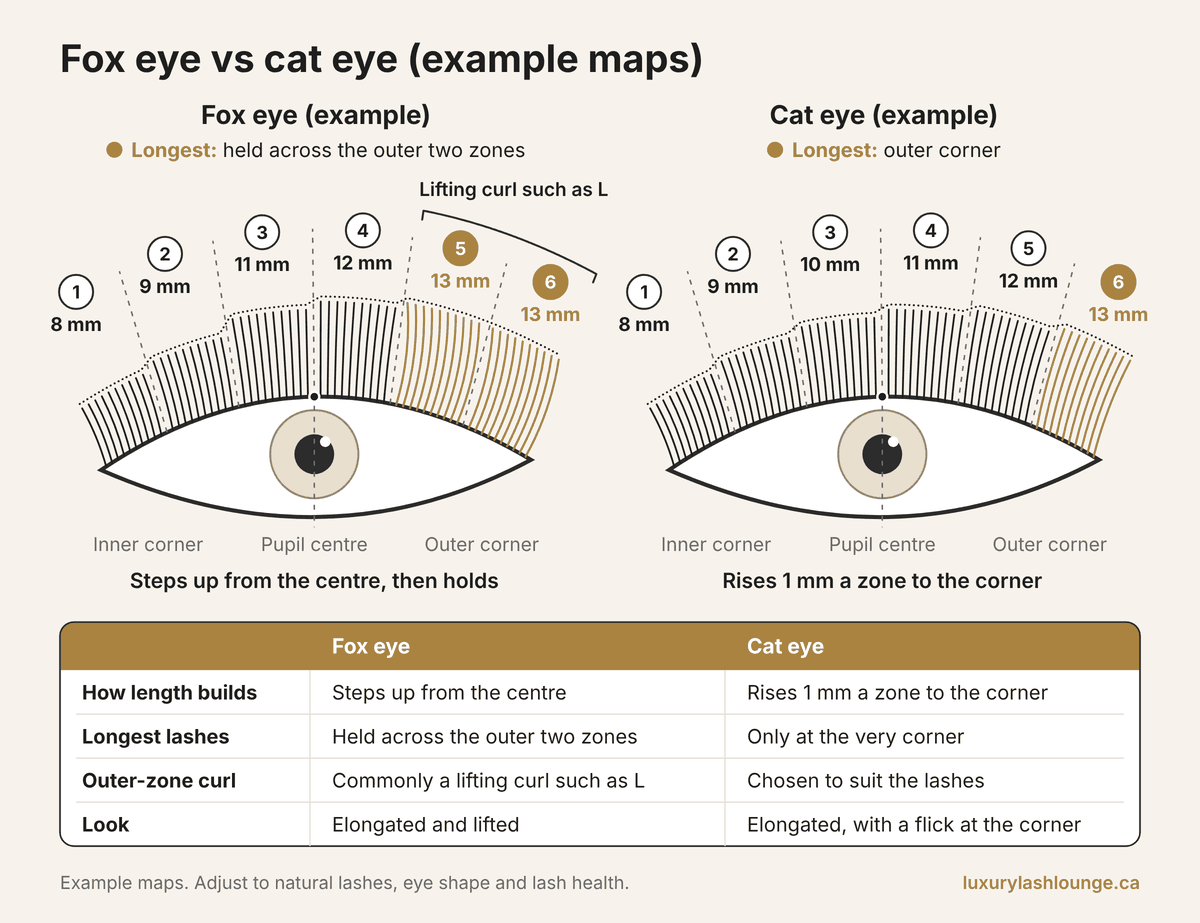
Both styles put length at the outer corner, but they build it differently. A cat eye rises gradually to its longest lash at the very corner. A fox eye steps up from the centre, holds its longest length across the outer zones and leans on a lifting curl.
Our two examples share the same short inner corner and the same 13 mm outer corner. From zone 3 to zone 5, the fox eye runs 1 mm longer in every zone. It reaches 13 mm one zone sooner and holds it to the corner.
| Fox eye (example) | Cat eye (example) | |
|---|---|---|
| Map, inner to outer (mm) | 8, 9, 11, 12, 13, 13 | 8, 9, 10, 11, 12, 13 |
| How length builds | Steps up from the centre | Rises 1 mm a zone to the corner |
| Longest lashes | Held across the outer two zones | Only at the very corner |
| Outer-zone curl | Commonly a lifting curl such as L | Chosen to suit the lashes |
| Look | Elongated and lifted | Elongated, with a flick at the corner |
| Commonly suits | Almond, round and close-set eyes | Round, almond and close-set eyes |
| Use with care | Hooded, downturned and wide-set eyes | Hooded, downturned and wide-set eyes |
Is fox eye the same as cat eye?
No, but they're close relatives, and some lash techs use the names loosely. Ask for a fox eye for a lifted, swept-up outer third, or a cat eye for a gradual build to a flick at the very corner. Our guide to cat eye lash extensions covers that style in full.
Fox eye vs squirrel and doll eye
A squirrel map also peaks in the outer third, about three-quarters across, then drops shorter at the very corner. It lifts without the long corner, so it's a common alternative when a fox eye's corner would be too long or too heavy.
A doll eye does the opposite of a fox eye. It puts the longest lashes in the centre, above the pupil, to make eyes look rounder and more open. See our guide to doll eye lash extensions.
Why curl matters for a fox eye
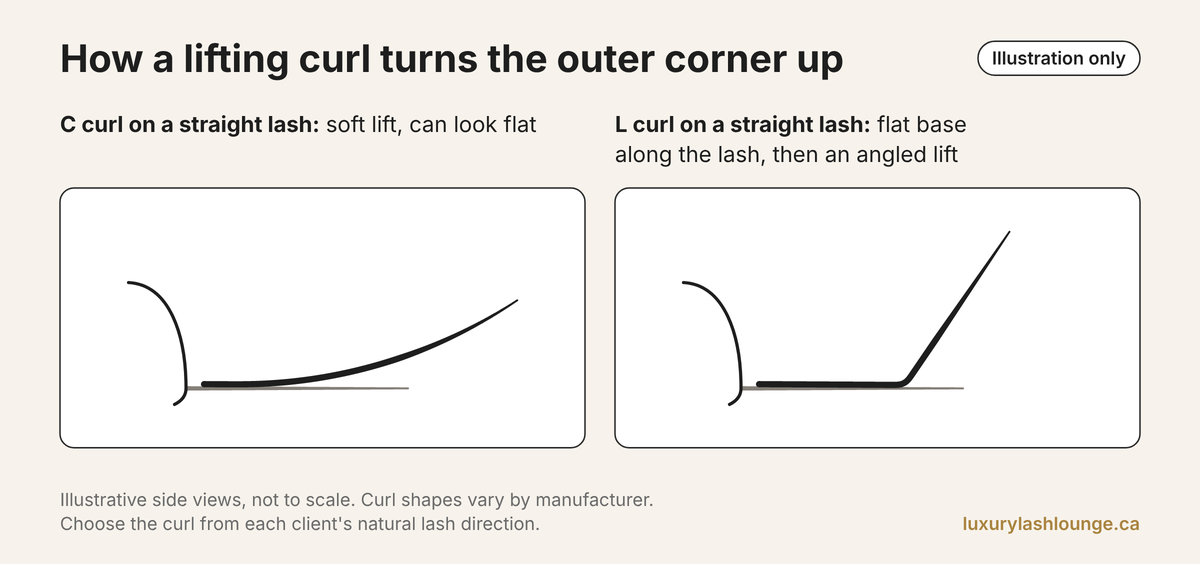
The map sets the length, but the curl creates the lift. A lifting curl such as L in the outer zones turns the longest lashes up. That lift is what separates a fox eye from a plain long outer corner.
How an L curl lifts the outer corner
L curls typically have a flat, straight base and then an angled lift. The base sits along a straight or downward natural lash, and the angle turns the extension up. L+ curls, in brands that make them, commonly add extra curl after the bend.
That matters because natural lashes don't all point the same way. A 2018 review in the Journal of Optometry notes that lash curvature can vary among individuals. It also cites a small 2006 study of 30 women that measured more pronounced lift-up and curl-up angles in the Caucasian women's lashes than in the Asian women's.
Group averages don't describe your lashes, so a lash tech checks the direction in every zone.
Choosing the curl for each zone
Our lash curl chart explains every curl. Here's how many lash techs apply it to a fox eye's outer zones.
| Natural lashes in the outer zones | Curls many lash techs reach for | Why |
|---|---|---|
| Point down or grow straight out | L or L+, or a strong curl such as D if the lash can take it | The flat L base follows a straight lash, then lifts it |
| Lift slightly | D for a lifted look, or CC for a softer lift | The lash already heads up |
| Already curly | A softer curl, such as C | A strong curl can over-curl and turn toward the lid |
For the inner and centre zones, the curl can follow the look you want. Alessia calls D curl the most popular curl with lash techs, a universal curl that looks good on everyone. She says C curl gives a more natural look.
Blending curls across the set
Many lash techs use one curl throughout a set, but a fox eye commonly switches to a lifting curl in the outer two zones. Keep the change gradual so the set looks even, and use one brand within a set, because curl shapes vary by manufacturer.
In our range, L curl comes on mixed length trays in 0.05 mm, with 8 to 15 mm on one tray.
What eye shape suits fox lashes?
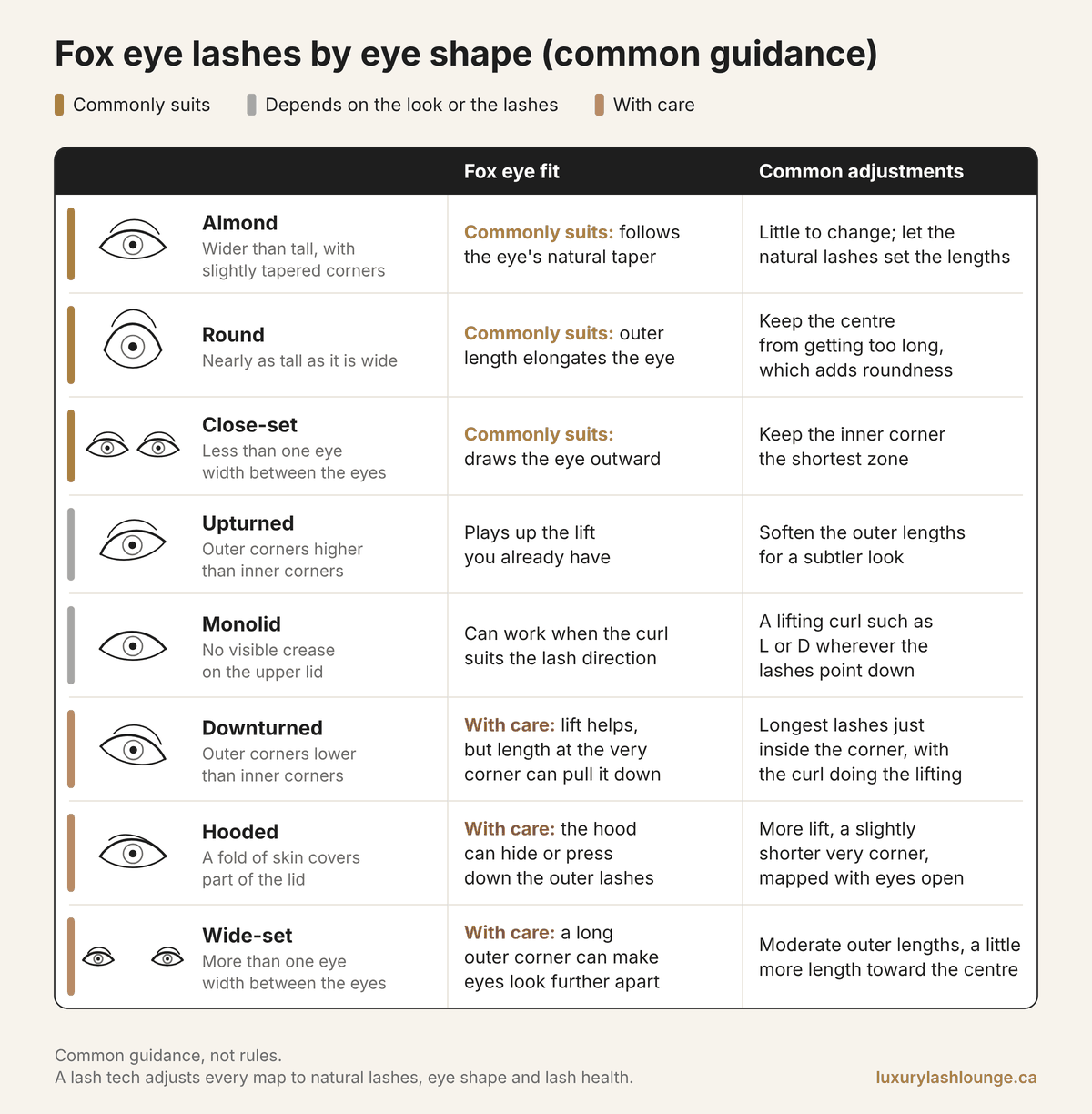
Fox eye lashes commonly suit almond, round and close-set eyes, where length at the outer corner elongates the eye. Hooded, downturned and wide-set eyes can wear a fox eye with adjustments, such as more lift or a shorter very corner.
This is common guidance, not a rule: your natural lashes have the final say. Many people also have more than one feature, such as hooded and downturned eyes.
| Eye shape | How to recognize it | Fox eye fit | Common adjustments |
|---|---|---|---|
| Almond | Wider than tall, with slightly tapered corners | Commonly suits: follows the eye's natural taper | Little to change; let the natural lashes set the lengths |
| Round | Nearly as tall as it is wide | Commonly suits: outer length elongates the eye | Keep the centre from getting too long, which adds roundness |
| Close-set | Less than one eye width between the eyes | Commonly suits: draws the eye outward | Keep the inner corner the shortest zone |
| Upturned | Outer corners higher than inner corners | Plays up the lift you already have | Soften the outer lengths for a subtler look |
| Monolid | No visible crease on the upper lid | Can work when the curl suits the lash direction | A lifting curl such as L or D wherever the lashes point down |
| Downturned | Outer corners lower than inner corners | With care: lift helps, but length at the very corner can pull it down | Longest lashes just inside the corner, with the curl doing the lifting |
| Hooded | A fold of skin covers part of the lid | With care: the hood can hide or press down the outer lashes | More lift, a slightly shorter very corner, mapped with eyes open |
| Wide-set | More than one eye width between the eyes | With care: a long outer corner can make eyes look further apart | Moderate outer lengths, a little more length toward the centre |
Fox eye lash extensions for hooded eyes
Fox eye lash extensions can suit hooded eyes, with adjustments. The fold can hide the outer lashes or press them down. The aim is to put lift where it shows and keep the very corner in proportion.
Steps many lash techs follow for hooded eyes:
- Map with the client sitting up and eyes open, noting how much of each outer zone the hood covers.
- Add lift before length: L curl where the lashes grow straight or point down, D where they lift slightly.
- Keep the very corner a little shorter, or move the longest lashes slightly inward, so the hood can't push them down.
- Check the shape again with the eyes open at the end.
If those changes take away too much of the fox eye, a squirrel or doll eye shape may suit better. Our lash map guide shows both for hooded eyes.
One cause of hooding is dermatochalasis, which EyeWiki, from the American Academy of Ophthalmology, describes as loose and redundant eyelid skin. It notes that drooping tissue, known as lateral hooding, can decrease side vision. If a hood affects your sight, see an eye doctor.
Fox eye in hybrid, volume and wispy versions
The fox eye is a shape, so a lash tech can build it as any set type. Hybrid gives a softer, textured fox eye, volume a denser one and mega volume the most dramatic; a wispy fox eye adds longer spikes.
Fox eye hybrid
A hybrid set mixes classic singles with light fans, for a fuller look than your natural lashes without the bold, dark look of volume. In a fox eye, some lash techs put more fans in the outer zones so the corner looks fullest.
Fox eye volume and mega volume
Volume places a fan of several fine extensions on each natural lash, for a denser, fluffier lash line. A fox eye in volume makes the lifted outer corner look fuller and darker.
Mega volume uses bigger fans of ultra-fine extensions for a very dramatic set. In our studio, 0.03 mm lashes are used to make big fans for mega volume sets.
Because a fox eye's longest lashes sit at the outer corner, the natural lashes there must carry that length and fan size, whatever the type. Your lash tech checks them before suggesting a type.
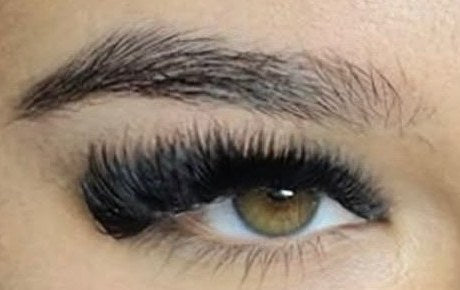
Wispy fox eye
A wispy fox eye adds longer spikes over a fox eye base, for a textured, fluttery outer corner. Many lash techs make the spikes from closed, tightly wrapped fans or single classic extensions so they stand out.
Spikes over a hybrid base tend to look light and airy, and spikes over a volume base look fuller. Our guide to wispy lash extensions explains how spikes are placed.
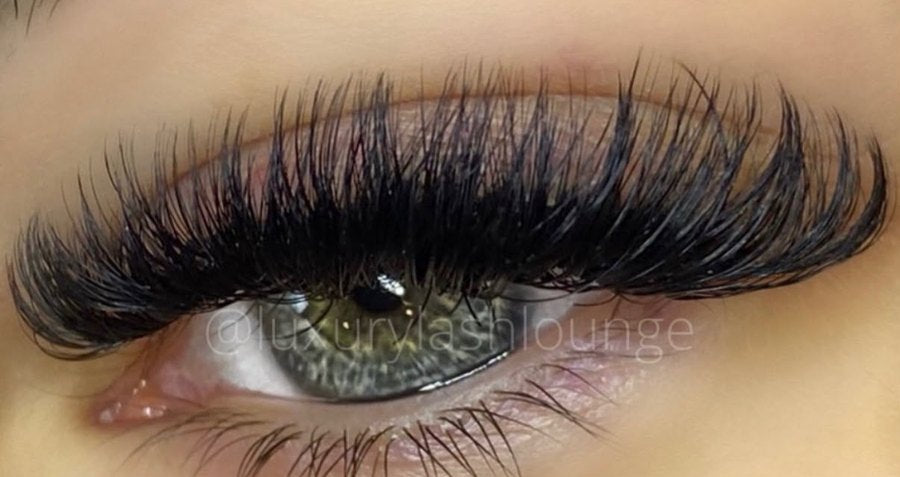
Keeping fox eye lashes healthy at the outer corner
A fox eye puts its longest extensions on the outer corner, so the natural lashes there carry the most length. The right fox eye is one your outer lashes can support, which means sizing each extension to its natural lash, not to the map.
Why outer-corner length needs care
Natural lashes rarely grow longer than 12 mm, according to the Journal of Optometry review. The example's 13 mm outer zones are longer than that, so they're only for strong, mature lashes. On short or fine outer lashes, a lash tech shortens those zones or uses lighter fans.
Weight adds up quickly. As a rough estimate for round fibres of the same material and length, weight follows cross-section, so a 0.15 mm extension carries about nine times the fibre of a 0.05 mm one.
Longer fibres carry more material too and, as a general rule, pull with more leverage on the natural lash. Real extensions taper and glue adds weight, so treat these figures as estimates, not measured weights.
EyeWiki lists traction alopecia, natural lashes lost to the traction of synthetic lashes, among the complications of extensions. The authors of a small 2024 study suggest that the added weight of extensions is "probably the most rational explanation" for the lash loss (milphosis) they noted. That was their explanation, not something the study measured.
The American Academy of Ophthalmology (AAO) adds that rubbing, tugging or pulling can fracture natural lashes and even permanently damage the follicle. It lists temporary or permanent lash loss among the risks of extensions.
How to protect the outer corner
- Size each extension to its lash. Go shorter or finer where the outer lashes are short or fine.
- One extension or fan per natural lash. Lashes glued together can't grow and shed on their own schedules.
- Hands off. Don't pick, pull or rub the outer corner, even when a lash feels loose.
- Wash daily. Alessia recommends washing your lashes ideally every day with an oil-free cleanser, such as our Lash Cleanser Kit, which doesn't break down the adhesive bond.
- Speak up. If the outer lashes droop, twist or feel heavy, tell your lash tech.
If your eyes itch, sting, swell or hurt, or your vision changes, don't remove the extensions yourself. For allergic reactions, the AAO warns that removing them yourself could damage your eyes, and advises seeing an ophthalmologist immediately. A doctor, optometrist or pharmacist can also advise you.
For more on lash damage and regrowth, see our guide to whether lash extensions ruin your lashes.
Upkeep and refills
A fox eye needs the same upkeep as any set. The AAO says extensions typically last three to four weeks, falling off as your natural lashes shed.
In the 2024 study above, 28 of the 31 women, all with dry eye complaints, had their extensions maintained every 2 to 3 weeks. Our guide to how long lash extensions last explains the lash cycle and refill timing.
At each refill, ask your lash tech to check the outer zones, since that's where a fox eye's length and lift sit. Grown-out extensions can twist or point the wrong way, and lash techs commonly replace them at a refill.
At our studio, at least 40% of your extensions must remain for the visit to count as a refill; less is charged as a full set. We don't refill another lash technician's work, so if you're wearing someone else's lashes, book a removal ($20) with your full set.
Prices are listed by set type, in Canadian dollars (CAD) before HST:
| Set type | Full set | Refill |
|---|---|---|
| Hybrid | $120 | $65 |
| Volume | $135 | $70 |
| Mega volume | $150 | $80 |
See our lash extension services in Woodbridge for details. Between visits, our lash extension aftercare guide covers washing, sleeping and showering.
How to ask for fox eye lashes
Tell your lash tech you want a fox eye: a lifted, elongated outer corner. Bring a photo or two, then let them check your natural lashes and eye shape before you agree on the map, curl and set type.
Before your appointment
- Choose a set type. At our studio: hybrid lash extensions for a fuller look without the bold, dark look of volume; volume lash extensions for a denser, fluffier lash line; mega volume for a very dramatic set.
- Collect photos. Remember that a photo shows someone else's natural lashes and eye shape.
- Decide how strong you want the corner. A subtle lift and a long, dramatic sweep use different lengths.
- Book a patch test if you've reacted before. Ours costs $20 and takes about 15 minutes.
- Mention any eye conditions. EyeWiki advises that people with existing eye disease or a history of allergy should avoid extensions, so check with your eye doctor first.
Our patch test places 5 to 10 short, natural extensions on each eye with our glue, plus the hydrogel eye pad we use in all our lash treatments. Itching, stinging, burning or swelling within 24 hours may mean a sensitivity or allergy.
At the consultation
Questions worth asking:
- Does a fox eye suit my eye shape, or would a squirrel or doll eye suit better?
- Can my outer lashes carry the lengths you're planning?
- Which curl will you use in the outer zones, and why?
- Will you record my map so my refills match?
The AAO suggests asking about your lash tech's training, certification and experience, and asking for the glue's ingredient list. Health Canada advises making sure the person applying your extensions is a trained professional.
If you wear glasses, wear them to the consultation. Your lash tech can then check that the outer lengths clear your lenses.
Booking with us
At our studio, appointments take around 1 hour, and 1.5 hours at most. To book a fox eye set with Alessia, text or call 647-533-7202, send a DM to @luxurylashlounge on Instagram, or contact us to book. We need 24 hours' notice to cancel.
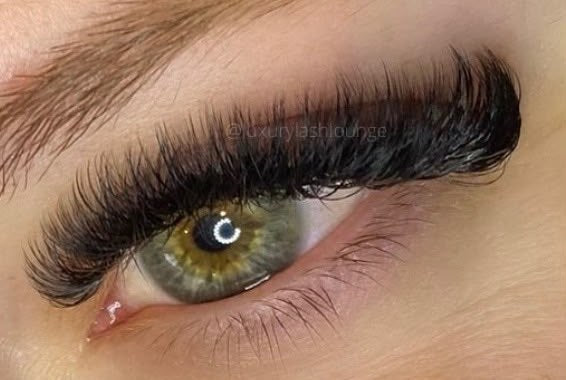
For lash techs: building lift at the outer corner
Build a fox eye from the natural lashes outward: check direction and strength in the outer zones, then choose the lifting curl and lengths they can carry. These steps are general practice, not a fixed method.
A step-by-step approach
- Map sitting up. Mark the pupil, the outer corner and any hood with the client's eyes open.
- Assess zones 4 to 6 from the side. Note lash direction, length, strength and new growth.
- Set the curl per zone. Use L where outer lashes grow straight or point down, and D where they lift slightly. In the inner and centre zones, choose a curl that suits the look.
- Set lengths each lash can carry. The example's 13 mm is a length to earn, not a default.
- Blend the transition. Keep length steps at 0 to 2 mm, and make curl changes gradual around zones 4 and 5.
- Guide the outer direction. Many lash techs direct the outer-zone extensions slightly up and out, toward the tail of the brow. Keep each base flush along its own isolated natural lash, with no adhesive on the skin.
- Check and record. Brush through with a lash spoolie, check the front with a lash mirror while the eyes stay closed, then record the map, curls and fan sizes.
Trays and tools from our range
| Need | In our range | Notes |
|---|---|---|
| Lifting curl for zones 5 and 6 | L curl mixed length trays, 0.05 mm, 8 to 15 mm | $17; 2 rows of each length on a 16-row tray |
| Inner and centre zones | D curl single length trays, 0.05 mm, 9 to 19 mm; mixed C, CC or D trays | $15; 8 mm in D curl comes only on the mixed tray |
| Hybrid classics | D curl mixed length trays, 0.15 mm | Our 0.15 mm comes in D curl only, so the L curl goes on the 0.05 mm fans |
| Mega volume fans | D curl mixed length trays, 0.03 mm | $17; our finest fibre, for big fans |
Compare every curl, thickness and length in our lash extension trays collection, including our single length volume trays. All product sales are final, so check the curl, thickness and length before you order.
Our lash tweezers include 45 degree isolation and 90 degree volume tweezers in Japanese steel, each hand tested for pick-up and fanning before it ships. Everything we sell is used on our own clients.
Safety and training
Health Canada's Cosmetic Ingredient Hotlist says cyanoacrylate eyelash extension adhesives must be sold for professional use only. Their labels must say "For application by trained professionals only" and "Ensure the eye is protected and immobilized during application."
Lash styling and mapping, fan making, isolation and placement are all part of our 1-on-1 Eyelash Extension Masterclass ($1,200) in Woodbridge. Certified lash techs can focus on styling and mapping in our customized Lash Refresher ($550).
FAQ
What are fox eye lashes?
Fox eye lashes are a lash extension style that lengthens and lifts the outer corner of the eye. The longest extensions sit across the outer zones, commonly in a lifting curl such as L. A trained lash tech applies them and adjusts the map to your natural lashes and eye shape.
What is a fox eye lash map?
A fox eye lash map is the zone-by-zone plan of lengths for a fox eye set. Our example runs 8, 9, 11, 12, 13 and 13 mm from the inner to the outer corner.
The outer two zones commonly use a lifting curl such as L. Lash techs adjust every map to the client's natural lashes, eye shape and lash health.
Is fox eye the same as cat eye?
No. Both lengthen the outer corner, but a cat eye builds gradually to its longest lash at the very corner. A fox eye steps up from the centre, holds its longest length across the outer zones and adds lift with a curl such as L.
Style names vary between studios, so bring a photo to your appointment.
What eye shape suits fox lashes?
Fox eye lashes commonly suit almond, round and close-set eyes, where outer-corner length elongates the eye, and they play up the lift of upturned eyes. Hooded, downturned and wide-set eyes can wear a fox eye with adjustments, such as more curl, a shorter very corner or moderate outer lengths. Your lash tech confirms the fit with your eyes open.
Do fox eye lashes suit hooded eyes?
They can, with adjustments. A hood can hide the outer lashes or press them down. Many lash techs add lift with an L or D curl and keep the very corner a little shorter.
They map with your eyes open to see where the fold falls. If that takes away too much of the look, a squirrel or doll eye shape may suit better.
What curl is best for fox eye lashes?
There's no single best curl, but the outer zones commonly use a lifting curl such as L. Its flat base sits along a straight or downward natural lash, and its angle turns the extension up.
Outer lashes that lift slightly may suit D, and the inner zones can follow the look you want. Curl shapes vary by manufacturer.
Can I get fox eye lashes as a hybrid or volume set?
Yes. The fox eye is a shape, so a lash tech can build it as a hybrid, volume or mega volume set. A wispy version adds longer spikes.
Hybrid looks softer and more textured, volume denser and fluffier, and mega volume the most dramatic. At our studio, prices are listed by set type.
Are fox eye lashes heavy?
Not by definition: weight depends on each extension's thickness, fan size and length, not on the style's name. A fox eye does put its longest lashes on the outer corner, though, so those natural lashes must be strong enough to carry them. A good lash tech shortens or lightens the outer zones on fine lashes.
How long can fake eyelashes stay on your eyes?
Professional lash extensions stay on until the natural lashes they're glued to shed, and the American Academy of Ophthalmology says they typically last three to four weeks. To keep a fox eye full, refills every 2 to 3 weeks are common; see our guide to how long lash extensions last.
How much do fox eye lash extensions cost?
At our studio, prices are listed by set type. Hybrid full sets are $120, volume $135 and mega volume $150, with refills at $65, $70 and $80, before HST.
A patch test or a removal is $20. See our lash extension services page for details and booking.
Can I do fox eye lashes at home?
Not as lash extensions. Health Canada says cyanoacrylate eyelash extension adhesives must be sold for professional use only, and labelled for application by trained professionals only. Never try a DIY set with professional glue.
Strip lashes and at-home clusters are different products, and this guide doesn't cover them.
About the author
Alessia Simonetta is the owner, master lash artist and certified lash trainer at Luxury Lash Lounge in Woodbridge (Vaughan), Ontario. She has been lashing since 2018 and holds 5 certifications: Classic Lash Artist, Hybrid Lash Artist, Volume Lash Artist, Mega Volume Artist and Certified Lash Trainer.
She has worked with thousands of lash clients and trained hundreds of students. Learn with her in our 1-on-1 lash training, or book lash extensions at our Woodbridge studio.
Sources
- American Academy of Ophthalmology. "Eyelash Extension Facts and Safety." Reena Mukamal; reviewed by Rebecca J. Taylor, MD. 23 February 2018. https://www.aao.org/eye-health/tips-prevention/eyelash-extension-facts-safety
- American Academy of Ophthalmology, EyeWiki. "Eyelash Extensions." Reviewed 10 May 2026; last edited 21 July 2026. https://eyewiki.aao.org/Eyelash_Extensions
- American Academy of Ophthalmology, EyeWiki. "Dermatochalasis." Reviewed 9 July 2026; last edited 1 November 2026. https://eyewiki.aao.org/Dermatochalasis
- Aumond S, Bitton E. "The eyelash follicle features and anomalies: A review." Journal of Optometry. 2018;11(4):211-222. doi:10.1016/j.optom.2018.05.003. https://pmc.ncbi.nlm.nih.gov/articles/PMC6147748/
- Na JI, Kwon OS, Kim BJ, Park WS, Oh JK, Kim KH, Cho KH, Eun HC. "Ethnic characteristics of eyelashes: a comparative analysis in Asian and Caucasian females." British Journal of Dermatology. 2006;155(6):1170-1176 (journal abstract page; 20 Asian and 10 Caucasian women aged 20 to 29). https://academic.oup.com/bjd/article-abstract/155/6/1170/6637367
- Grupcheva CN, Grupchev DI, Usheva N, Grupcheva LO. "Beauty versus Health: How Eyelash Extensions May Affect Dry Eye Disease?" Journal of Clinical Medicine. 2024;13(11):3101. doi:10.3390/jcm13113101. https://www.mdpi.com/2077-0383/13/11/3101
- Health Canada. "Cosmetic Ingredient Hotlist" (entry for cyanoacrylate-based adhesives). Modified 13 August 2025. https://www.canada.ca/en/health-canada/services/consumer-product-safety/cosmetics/cosmetic-ingredient-hotlist-prohibited-restricted-ingredients/hotlist.html
- Health Canada. "Eye cosmetics." Modified 5 December 2016. https://www.canada.ca/en/health-canada/services/cosmetics/eye-cosmetics.html