
Quick answer
Doll eye lash extensions are a professional lash extension style that puts the longest lashes in the centre of the eye, above the pupil, with shorter lashes toward both corners. The aim is a rounder, more open, wide-awake look, which is why many lash techs also call doll eye lashes "open eye" lashes.
The style commonly flatters almond, hooded and monolid eyes, while round eyes may suit a cat eye better. Many lash techs pair it with a lifting curl such as D and adjust every map to your natural lashes.
About this guide: it covers semi-permanent eyelash extensions applied by a trained lash tech, not eyelashes for toy dolls or strip lashes you glue on at home. Alessia Simonetta, our owner and master lash artist, does doll eye (open eye) sets at our private studio in Woodbridge, Vaughan, and lash techs have their own section near the end.
What are doll eye lash extensions?
Doll eye lash extensions are a lash style defined by where the longest extensions sit: in the middle of the lash line, over the pupil. Length steps down toward the inner and outer corners, so the eye looks taller in the centre and rounder overall.
The name describes the look the style aims for: wide, round, open eyes, like a doll's. It's a shape, not a product, so the same doll eye can be soft and natural or bold and full.
Every set combines a few separate choices:
| Choice | What it decides | Examples |
|---|---|---|
| Lash style | The shape, set by where the longest lashes sit | Doll eye (open eye), cat eye, fox eye, natural, wispy, wet look |
| Lash type | The fullness, set by how many extensions go on each natural lash | Classic, hybrid, volume, mega volume |
| Curl | How lifted the lashes look | C for a softer look, D for more lift |
| Thickness | How fine each extension is, and how much it weighs | 0.15 mm classics; 0.05 mm or 0.03 mm fans |
So a doll eye can be a hybrid set or a volume set: the same shape with a different fullness. Our guide to types of lash extensions and lash styles compares every type and style side by side.
Not the same as doll eyelashes or strip lashes
If you searched for "doll eye lashes", you may also have seen eyelashes made for toy dolls, or strip lashes and clusters sold for home use. Those are different products.
Professional lash extensions are attached to your natural lashes, one extension or one fan per natural lash, by a trained lash tech. Our guide to what lash extensions are explains how they're applied and what to expect at your first appointment.
The adhesive matters too. Health Canada warns that eyelash extension glue "may bond your eyelids instantly" and advises making sure the person applying your extensions is a trained professional. Its Cosmetic Ingredient Hotlist says cyanoacrylate eyelash extension adhesives "must be sold for professional use only", so a doll eye set is never a DIY project.
Doll eye vs open eye: are they the same?
Usually, yes. Many lash techs use "doll eye" and "open eye" for the same style, with the longest lashes over the centre of the eye.
There's no official naming standard, though, so the words can mean slightly different things from one lash tech to the next:
| Name you hear | What it commonly means | Worth asking |
|---|---|---|
| Doll eye | Longest lashes in the centre, for a round, wide-eyed look | How long and how curled the centre will be |
| Open eye | Usually the same style; some lash techs use it for a softer version | Whether they mean the same shape as a doll eye |
| Natural | Follows your own lash line, softly longer toward the outer third | Whether the centre will stand out at all |
At our studio, open eye and doll eye are one style on Alessia's list, so this guide uses the two names interchangeably. Wherever you book, describe the shape rather than the label: "longest over my pupils" is clearer than any style name. Ask your lash tech to describe the lengths they plan before you close your eyes.
How a doll eye set is built
A doll eye set comes from three choices: a map that peaks over the pupil, a curl that lifts the centre, and a thickness your lashes can carry.
Where the length goes
Here is our example, with lengths in mm across 6 zones, from the inner corner (zone 1) to the outer corner (zone 6). It's an example, not a prescription: a lash tech adjusts every map to your natural lashes, eye shape and lash health.
| Zone | 1 (inner) | 2 | 3 | 4 | 5 | 6 (outer) |
|---|---|---|---|---|---|---|
| Length (mm) | 9 | 10 | 12 | 12 | 11 | 10 |
Three features make it a doll eye:
- The peak sits in the centre. Zones 3 and 4, on either side of the pupil, carry the longest lashes: 12 mm in this example.
- Both corners are shorter. The inner corner is the shortest zone (9 mm), and the outer corner (10 mm) stays below the peak. That shorter outer corner is what separates a doll eye from a cat eye.
- The steps are small. Neighbouring zones change by 2 mm or less, so the lash line blends instead of looking stepped.
For scale, natural lashes rarely grow longer than 12 mm, according to a 2018 review in the Journal of Optometry. Our example's 12 mm centre already reaches that length, so going longer depends on natural lashes strong enough to carry it. Our lash map guide shows how lash techs mark the zones and plan each length.
Curl: what opens the centre
Curl decides how much of each lash points up rather than forward, so it shapes how open the centre looks from the front. Curl names and exact shapes vary by manufacturer, so treat the letters as a rough guide. Our lash curl chart compares every curl in detail.
- C curl lifts the lash in a softer arc and keeps more of its length pointing forward. Alessia's view: C curl gives a more natural look.
- D curl bends more of the lash upward, for a lifted, open look. In Alessia's words, D is the most popular curl with lash techs, a universal curl that looks good on everyone.
- L curl has a flat base and an angled lift. Lash techs commonly use it when natural lashes grow straight out or point down.
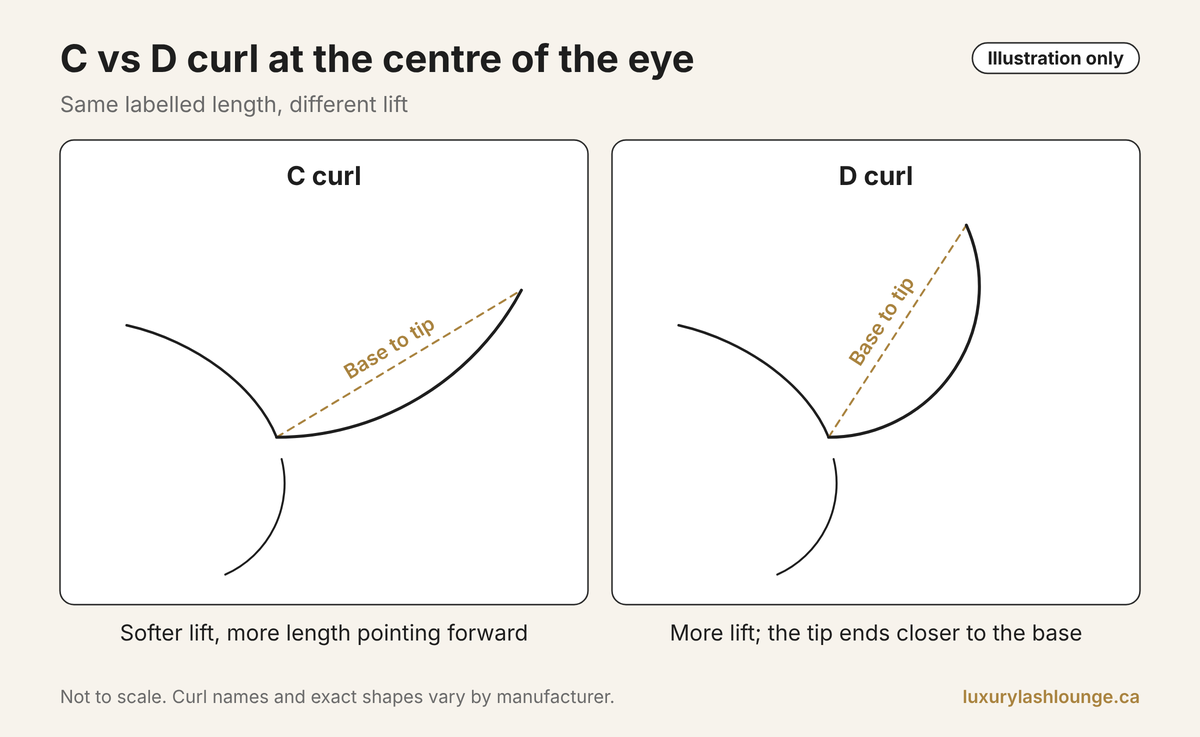
A curlier extension's tip typically ends closer to its base than a straighter extension of the same labelled length. So a 12 mm D and a 12 mm C can look different on the eye. Many lash techs check the centre from the front when they change curl.
Thickness and fullness
Thickness follows the type of set, from hybrid to mega volume, as the versions section below explains. In a doll eye, the centre lashes carry the longest extensions. A good set matches length and thickness to those natural lashes, not just to your photo.
Do doll eye lashes make your eyes look bigger?
Making your eyes look bigger and more open is the aim of the doll eye style, not a guaranteed result. Length and lift over the pupil add height to the centre of the eye, which is meant to make the eye look rounder and larger.
How much difference you'll see depends on four things:
- Your eye shape. A centre peak is commonly used to open almond and hooded eyes, but it can make round eyes look rounder still.
- Your natural lashes. They set the lengths your lash tech can safely use.
- Curl. Lashes that point down or hide under a hood add little openness until a curl lifts them into view.
- Fullness. A volume or mega volume set makes the lash line denser and darker than a hybrid set.
What the research says
We aren't aware of any study that has measured how much bigger doll eye lash extensions make eyes look. The closest evidence comes from makeup.
A 2015 perception study in the Journal of Cosmetic Science found that eyeliner and mascara can make eyes appear up to 6% larger (13% in area) than they really are. The effects didn't add up: eyeliner made no extra difference once mascara was on.
That study tested makeup, not lash extensions, so treat it as a clue rather than proof. It does suggest that a darker, more defined lash line can change how big eyes look to other people.
Who doll eye lashes suit
Doll eye lashes commonly flatter almond, hooded, monolid, downturned and deep-set eyes, because they put length where it opens the eye. Round and prominent eyes are where many lash techs use the style with care.
The table sums up that common guidance. It varies between lash techs, and your natural lashes decide what's possible.
| Eye shape | How to spot it | Doll eye fit | Common tweaks |
|---|---|---|---|
| Almond | Wider than tall, with slightly tapered corners | Often suits | Few changes; keep the inner corner short |
| Hooded | A fold of skin covers part of the lid when the eye is open | Often suits | A lifting curl (D, or L for downward lashes); outer corner shorter than the peak |
| Monolid | No visible crease on the upper lid | Often suits | A lifting curl such as L or D |
| Downturned | Outer corners sit lower than inner corners | Often suits | Keep the longest lashes inside the outer corner |
| Deep-set | Eyes sit further back under the brow bone | Often suits | Enough curl (D or L) to bring the lashes forward |
| Upturned | Outer corners sit higher than inner corners | Often suits | Balances the lift; keep outer corners moderate |
| Wide-set | More than one eye width between the eyes | Often suits | A little more length toward the inner centre |
| Close-set | Less than one eye width between the eyes | Can work | Short inner corners; a cat eye is a common alternative |
| Round | Nearly as tall as it is wide | Use with care | Can look rounder still; a cat eye often suits better |
| Prominent | Eyes sit forward, with more lid visible | Use with care | Moderate centre lengths in C or CC curl |
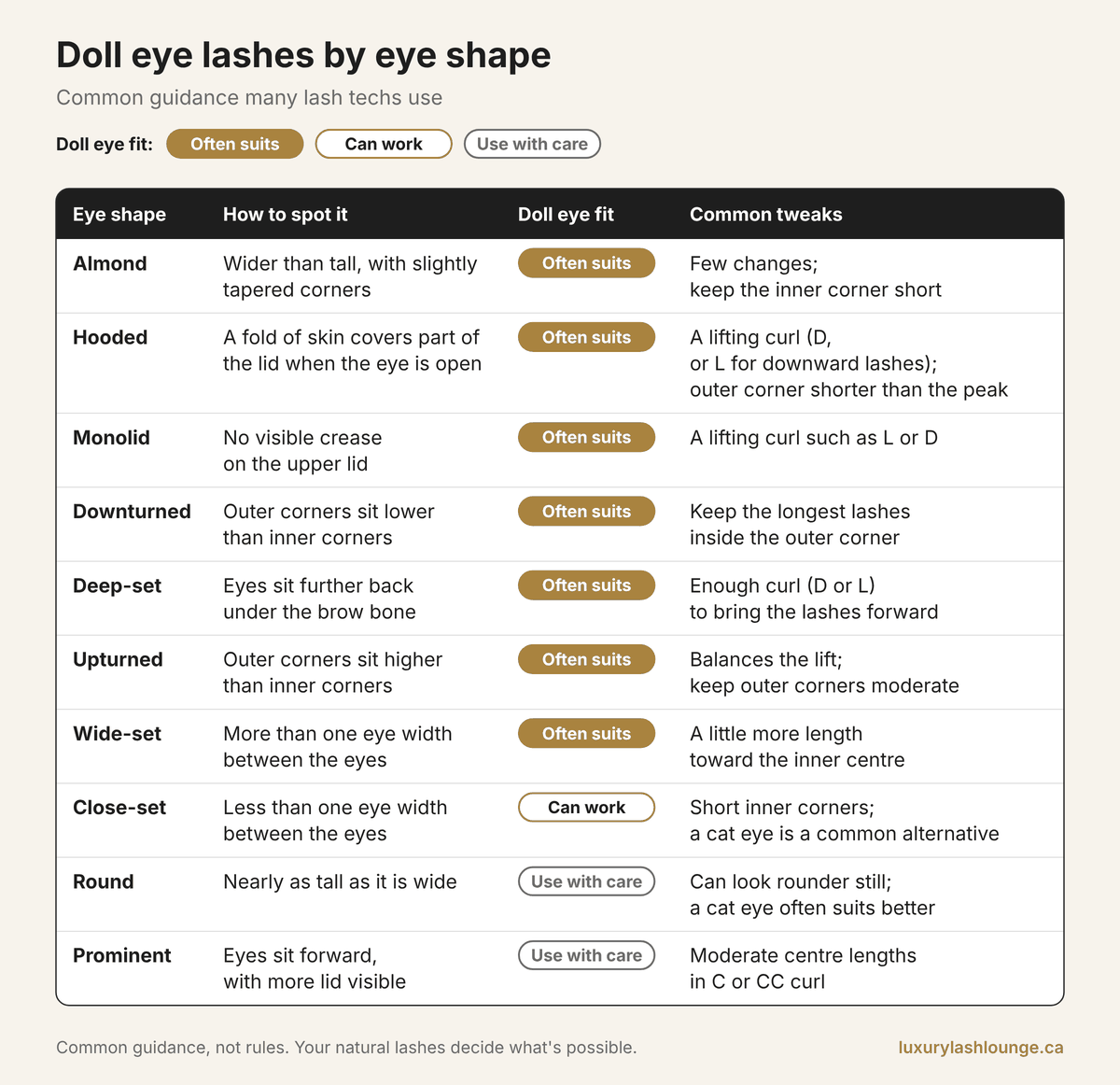
Many people have more than one feature, such as hooded and downturned eyes. Many lash techs start with the feature that changes the lash line most, often the hood.
Doll eye lashes for hooded eyes
A doll eye is one of the styles many lash techs suggest for hooded eyes. Length in the centre often shows below the fold, while long outer corners can hide under it or look droopy.
Common adjustments:
- Map with your eyes open. Your lash tech checks how much of each zone the hood covers while you sit up and look ahead.
- Add curl before length. A lifting curl such as D, or L if your lashes point down, helps the centre lashes clear the fold; a soft curl can disappear under it.
- Keep the outer corner shorter than the peak, so the hood doesn't press it down.
- Check the result with your eyes open before you leave the chair.
EyeWiki, from the American Academy of Ophthalmology, describes dermatochalasis, loose and redundant eyelid skin, as a common sign of aging around the eyes. It notes that this drooping tissue, classically called lateral hooding, can reduce side vision. If your hood affects your sight, see an eye doctor, because lash extensions won't change it.
Doll eye lashes for monolids
EyeWiki describes one eyelid type as "a single eyelid with no visible lid crease", often called a monolid. It also notes that an epicanthal fold, a crescent of skin at the inner part of the upper lid, "encourages downturning of the eyelashes".
Downward lashes hide length, so lash techs commonly pair a doll eye with an L or D curl on monolids. Your lash tech should check the lash direction in every zone before choosing.
Round eyes, and when another style suits better
A doll eye adds roundness, so on eyes that already look round it can make them look rounder still. Many lash techs suggest a style that lengthens the eye instead, such as a cat eye.
If you love the doll eye look anyway, ask about a softer version, with a gentler centre peak and moderate lengths. Prominent eyes call for similar care, and many lash techs avoid very long, tightly curled centre lashes there.
Doll eye vs cat eye: which is better for you?
Neither is better; they create different shapes. A doll eye puts the longest lashes in the centre for a rounder, more open look. A cat eye builds length toward the outer corner to lift and elongate the eye.
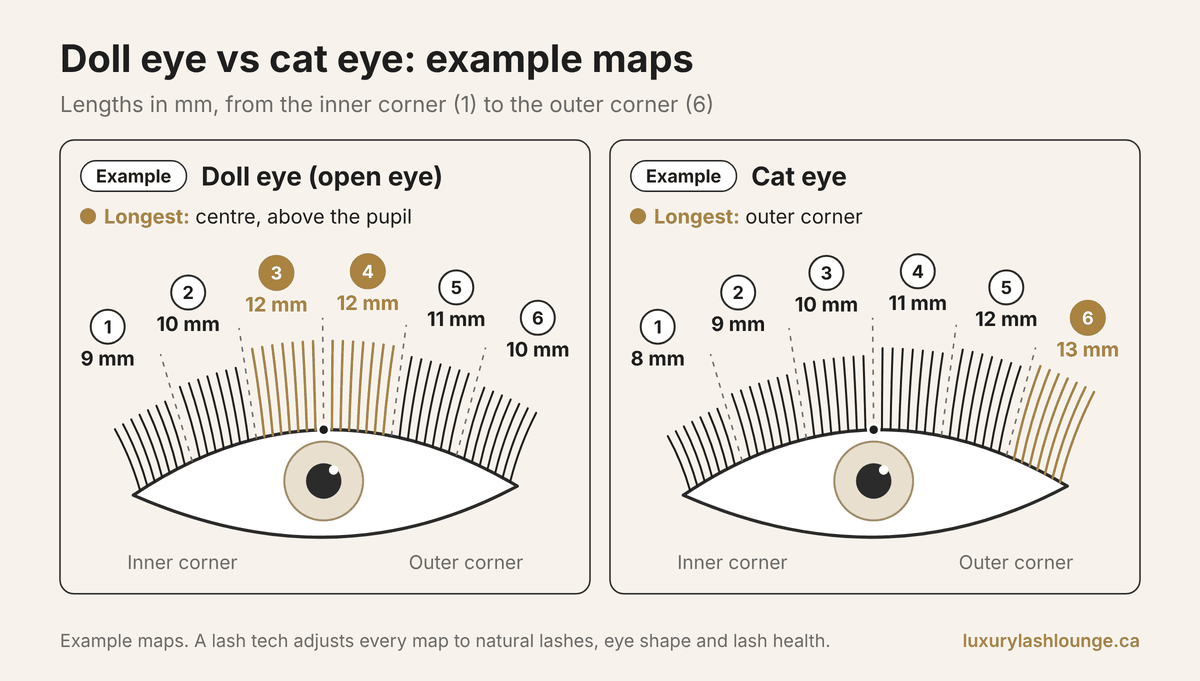
| Doll eye (open eye) | Cat eye | |
|---|---|---|
| Where the longest lashes sit | Centre of the eye, above the pupil | Outer corner |
| Peak in our examples | 12 mm, in zones 3 and 4 | 13 mm, in zone 6 |
| Outer corner | Shorter than the centre | The longest zone |
| Effect | Rounder, more open, wide-awake | Lifted, elongated |
| Often flatters | Almond, hooded, monolid, downturned, deep-set | Round, almond, close-set |
| Use with care on | Round and prominent eyes | Hooded, downturned and wide-set eyes |
| Natural lashes doing the most work | Centre lashes, over the pupil | Outer-corner lashes |
How to choose
- Choose a doll eye if you want rounder, more open eyes, or your eyes are hooded, downturned, monolid or deep-set.
- Choose a cat eye if you want a lifted, elongated look, or your eyes are round or close-set.
- Torn between them? A natural style follows your own lash line and typically suits almost every eye shape.
Our guide to cat eye lash extensions covers how that style is built and who it suits.
Where fox eye fits in
A fox eye is another outer-corner style: its lengths commonly step up from the centre and hold the longest length across the outer zones. Those outer zones commonly use a lifting curl such as L, for an elongated, lifted corner. Our guide to fox eye lash extensions compares fox eye and cat eye.
Alessia does doll eye, cat eye and fox eye sets at our Woodbridge studio, so you can talk through all three at your consultation.
Natural doll eye vs dramatic doll eye
A natural doll eye and a dramatic doll eye share one shape. What changes is how far each choice goes: length, curl and fullness.
| Natural doll eye | Dramatic doll eye | |
|---|---|---|
| Centre length | Shorter, closer to your own lashes | Longer, only where your natural lashes can carry it |
| Drop toward the corners | Gentle | More pronounced, for a rounder centre |
| Curl | Softer, such as C | More lift, such as D |
| Set type that fits at our studio | Hybrid | Volume or mega volume |
| Overall look | Your own lashes, opened up | Bold, dark and wide-eyed |
| Commonly chosen for | First sets and everyday wear | Events, photos or a bolder everyday look |
Many sets sit between the two. If you're unsure, start softer: adding length or curl at a refill is easier than waiting for long extensions to shed.
A dramatic doll eye puts its longest, heaviest extensions on the centre lashes, so it needs natural lashes strong enough to carry them. Our guide to whether lash extensions ruin your lashes explains how weight and wear affect natural lashes.
Doll eye in hybrid, volume and wet versions
Doll eye is a shape, so it works with any set type. Hybrid gives soft fullness, volume and mega volume give a denser, darker lash line, and a wet look uses closed, spiky fans.
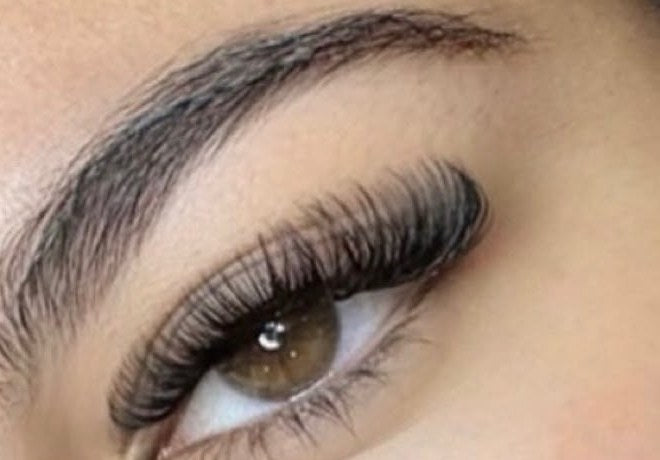
Doll eye hybrid
A doll eye hybrid places a mix of single classic extensions and light fans along the doll eye shape. At our studio, hybrid lash extensions suit you if you want a fuller look than your natural lashes without the bold, dark look of volume.
Doll eye volume and mega volume
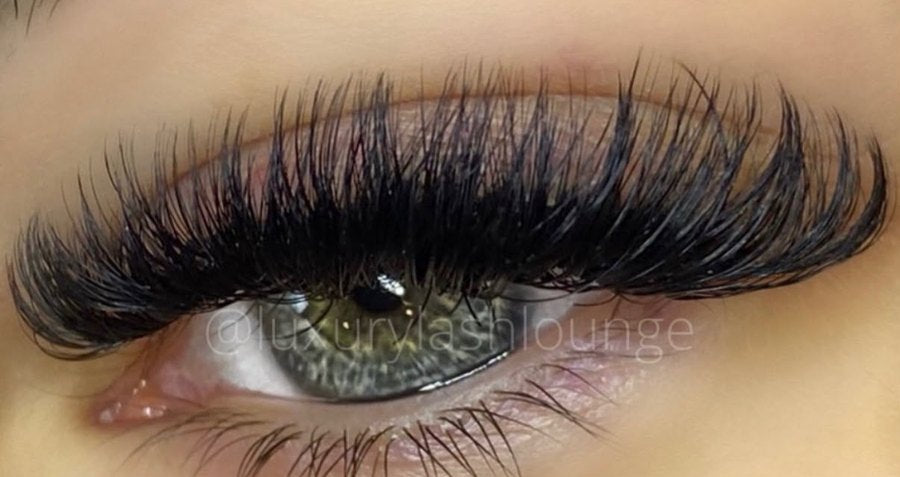
A doll eye volume set uses fans of several fine extensions for a denser, fluffier lash line, with the longest fans over the centre. Mega volume lash extensions use bigger fans for a very dramatic, voluminous set; in our studio, 0.03 mm lashes are used to make those big fans.
A wet look on a doll eye base
A wet set has nothing to do with water: it's a look made with closed, spiky fans that resemble wet lashes. There's no single wet set map, and wet sets are commonly built on another map, often natural or doll eye. Alessia does wet look sets too, and our guide to wet set lashes explains how they're made.
Upkeep and refills
Doll eye lash extensions need the same upkeep as any other style. The American Academy of Ophthalmology says extensions typically last three to four weeks, falling off as your natural lashes shed, so refills keep the shape full. Our guide to how long lash extensions last explains refill timing and our 40% refill rule.
- Keep the peak in place. Ask your lash tech to record your map, so each refill keeps the longest lashes over your pupils.
- Wash your lashes. Alessia recommends washing them ideally every day with an oil-free cleanser. Our Lash Cleanser Kit pairs a 60 ml oil-free foam with a brush and removes dirt and makeup without breaking down the adhesive bond.
Our prices are listed by set type: hybrid is $120 for a full set and $65 for a refill, volume $135 and $70, and mega volume $150 and $80. Prices are in Canadian dollars (CAD), before HST; see our page on lash extensions in Woodbridge for details.
How to ask for a doll eye set
To ask for doll eye lash extensions, describe where you want the length and show a photo. Then let your lash tech check your natural lashes and eye shape first. At our Woodbridge studio, Alessia does doll eye (open eye) sets, and appointments take around 1 hour, 1.5 hours at most.
- Describe the shape. Ask for the longest lashes over your pupils, rather than relying on the name alone.
- Bring a photo or two. A photo shows someone else's lashes and eye shape, so treat it as a guide to the look, not to the lengths.
- Choose your fullness. Pick hybrid, volume or mega volume, using the comparison above.
- Talk about curl. C gives a softer look and D more lift, and your lash tech matches the curl to the direction your lashes grow.
- Wear your glasses to the consultation. The longest doll eye lashes sit in the centre, so your lash tech can check that they clear your lenses.
- Mention your eye health. EyeWiki says people with existing eye disease or a history of allergy should avoid eyelash extensions. If that's you, check with your eye doctor first.
- Ask about training and glue. The AAO suggests asking about your lash tech's training and asking for the glue's ingredient list to check for allergens.
- Patch test if you've reacted before. We recommend a patch test after any past reaction or sensitivity to lash extensions.
Our patch test costs $20 and takes about 15 minutes. We place 5 to 10 short, natural extensions on each eye, using our glue and the hydrogel eye pad from all our lash treatments. Itching, stinging, burning or swelling within 24 hours may mean a sensitivity or allergy.
To book, text or call 647-533-7202, send an Instagram DM or an email, or use the form on our contact page. We need 24 hours' notice to cancel, and if you're wearing another lash tech's extensions, book a $20 removal with your full set.
If your eyes react: with pain, redness, itching, swelling, discharge, light sensitivity or blurred vision after a set, don't remove the extensions yourself. The AAO advises seeing an ophthalmologist immediately after a reaction, and your optometrist or pharmacist can also advise you. Never try to recreate a doll eye set at home with professional lash glue.
For lash techs: mapping the centre without weighing down the lash
Put the peak over the pupil with the client's eyes open, step down gently to both corners, and let curl rather than extra length open the eye. Then check that every centre lash can carry its extension.
- Assess the centre zones first. Check the length, strength and direction of the natural lashes over the pupil, where a doll eye puts its longest extensions. Base the centre lengths on the healthy, full-length lashes there; short, new lashes commonly get shorter, lighter extensions, or none until they grow.
- Mark the pupil with the eyes open. Line the peak up with that mark, not with the middle of the pad. Place lash mapping stickers over gel eye pads or tape, never on their own to secure the lower lashes.
- Step down gently. In our example, neighbouring zones differ by 2 mm or less. Keep the inner corner shortest and the outer corner below the peak, or the shape drifts toward a cat eye.
- Add curl before length. On straight or downward centre lashes, extra length adds weight but still points down, while a D or L curl lifts the lash into view.
- Watch the weight. As a rough rule for round fibres, a 12 mm extension holds about 20% more fibre than a 10 mm one of the same thickness. Thickness matters even more: by the same rough rule, a 0.15 mm classic holds about nine times the fibre of a same-length 0.05 mm lash, before taper and glue.
- Test the first few. After a few extensions in the centre, check that the natural lashes still sit at their usual angle. If they droop or twist, go shorter or finer.
- Check from the front, then with the eyes open. Brush through with a spoolie, and use a lash mirror to spot gaps and crisscrossing while the client's eyes stay closed. At the end, sit the client up and check that both peaks line up with the pupils.
- Record the map (style, lengths, curl, thickness and fan size), so refills keep the peak in place.
EyeWiki lists traction alopecia, "the condition where natural lashes are lost due to the traction of synthetic lashes", among the complications of eyelash extensions. The AAO lists temporary or permanent lash loss as a risk. It warns that rubbing, tugging or pulling can break natural lashes and in some cases permanently damage the follicle.
Trays and tools for a doll eye
- Lengths. Our example uses 9 to 12 mm. Our single length volume trays cover each of those lengths in 0.05 mm, in C curl (8 to 12 mm) or D curl (9 to 19 mm).
- Mixed trays. Our mixed length trays put 8 to 15 mm on one 16-row tray, with 2 rows of each length. D curl comes in 0.03, 0.05 or 0.15 mm, and C, CC and L curl in 0.05 mm.
- Hybrid sets. Keep both 0.15 mm and 0.05 mm trays on hand. Compare every option in our lash extension trays collection.
- Tweezers. Isolate with a 45 degree isolation tweezer and fan with our 90 degree volume pick-up and fanning tweezer. Both are Japanese steel and hand tested for pick-up and fanning before they ship; see all our lash tweezers.
Practise the shape before you take clients
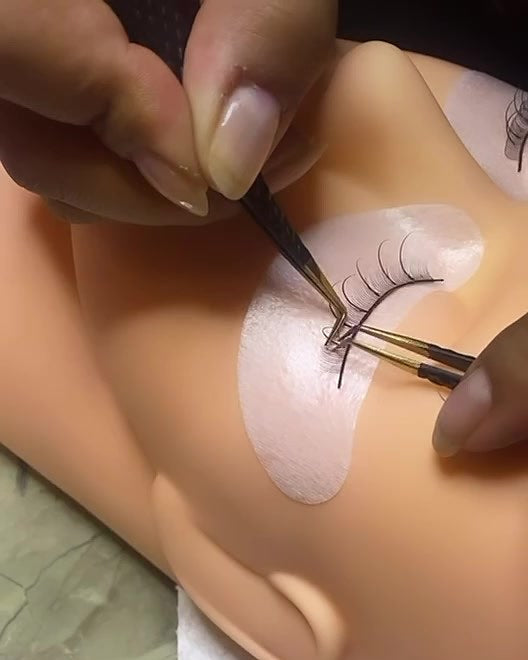
Lash styling and lash mapping are part of our 1-on-1 Eyelash Extension Masterclass ($1,200), along with mannequin practice and live model application. Certified lash techs can focus on styling and mapping in the customized Lash Refresher ($550).
Frequently asked questions
What are doll eye lashes?
Doll eye lashes are a lash extension style that puts the longest extensions in the centre of the eye, above the pupil, and shorter ones toward both corners. The aim is a rounder, more open look, which is why the style is also called open eye. The same phrase is sometimes used for eyelashes sold for toy dolls, which are a different product.
Is a doll eye or cat eye better?
Neither is better; they suit different goals and eye shapes. A doll eye peaks in the centre for a rounder, more open look and commonly flatters almond, hooded, monolid and downturned eyes.
A cat eye builds to the outer corner for a lifted, elongated look and commonly flatters round and close-set eyes. Your lash tech can help you choose after checking your eye shape with your eyes open.
What is the difference between open eye lashes and doll eye lashes?
Often there is none: many lash techs use both names for the style with the longest lashes over the centre of the eye. Some use "open eye" for a softer, more natural version and keep "doll eye" for a rounder, more dramatic one. Because naming varies, tell your lash tech where you want the longest lashes and bring a photo.
Will doll eye lashes make my eyes look bigger?
That's the aim of the style, not a guarantee. Length and lift over the pupil add height to the centre of the eye, which is meant to make the eye look rounder and more open.
The effect depends on your eye shape, natural lashes and curl. We know of no study that has measured this for lash extensions. A 2015 study of eyeliner and mascara, which tested makeup rather than extensions, found they can make eyes look up to 6% larger.
Are doll eye lashes good for hooded eyes?
Often, yes. Many lash techs suggest a doll eye for hooded eyes, because length in the centre often shows below the fold. Long outer corners, by contrast, can hide under it or look droopy.
A lifting curl such as D, or L for downward lashes, helps the lashes clear the hood. Ask your lash tech to check the shape with your eyes open.
What curl is best for doll eye lash extensions?
There's no single best curl; it depends on your natural lashes and the look you want. Alessia describes C curl as giving a more natural look, and D curl as the most popular curl with lash techs, a universal curl that looks good on everyone. L curl is commonly used when natural lashes grow straight or point down.
Can doll eye lash extensions look natural?
Yes. A natural doll eye keeps the centre lengths closer to your own lashes and uses a softer curl, such as C. At our studio, hybrid gives the softest look.
The centre still opens the eye, but the result looks like your own lashes, enhanced. A dramatic doll eye adds length, curl and fullness.
Can I get a doll eye hybrid or volume set?
Yes. Doll eye is a shape, so it works with hybrid, volume and mega volume sets, and a wet look can be built on a doll eye base too.
At our Woodbridge studio, full sets are $120 for hybrid, $135 for volume and $150 for mega volume, before HST. Prices are listed by set type on our services page.
Can I wear glasses with doll eye lashes?
Yes, but mention it when you book and bring your glasses to the consultation. In a doll eye set the longest lashes sit in the centre, so your lash tech can check that they clear your lenses. If they would touch, common fixes are a shorter centre length or a curl that lifts more steeply, such as D instead of C.
About the author
Alessia Simonetta is the owner, master lash artist and certified lash trainer at Luxury Lash Lounge in Woodbridge (Vaughan), Ontario. She has been lashing since 2018 and holds 5 certifications: Classic Lash Artist, Hybrid Lash Artist, Volume Lash Artist, Mega Volume Artist and Certified Lash Trainer. She has worked with thousands of lash clients and trained hundreds of students.
Learn lash styling and mapping with her in our 1-on-1 lash training, or book lash extensions at our Woodbridge studio.
Sources
- Health Canada. "Eye cosmetics." https://www.canada.ca/en/health-canada/services/cosmetics/eye-cosmetics.html
- Health Canada. "Cosmetic Ingredient Hotlist: Prohibited and restricted ingredients" (entry for cyanoacrylate-based adhesives, eyelash extension adhesives; page modified 2025-08-13). https://www.canada.ca/en/health-canada/services/consumer-product-safety/cosmetics/cosmetic-ingredient-hotlist-prohibited-restricted-ingredients/hotlist.html
- American Academy of Ophthalmology. "Eyelash Extension Facts and Safety." By Reena Mukamal; reviewed by Rebecca J Taylor, MD; published 23 February 2018. https://www.aao.org/eye-health/tips-prevention/eyelash-extension-facts-safety
- EyeWiki, American Academy of Ophthalmology. "Eyelash Extensions." https://eyewiki.aao.org/Eyelash_Extensions
- Aumond S, Bitton E. "The eyelash follicle features and anomalies: A review." Journal of Optometry. 2018;11(4):211-222. https://pmc.ncbi.nlm.nih.gov/articles/PMC6147748/
- Matsushita S, Morikawa K, Yamanami H. "Measurement of eye size illusion caused by eyeliner, mascara, and eye shadow." Journal of Cosmetic Science. 2015;66(3):161-174 (journal page with the article's first page and synopsis). https://library.scconline.org/v066n03/17
- EyeWiki, American Academy of Ophthalmology. "Dermatochalasis." https://eyewiki.aao.org/Dermatochalasis
- EyeWiki, American Academy of Ophthalmology. "Asian Blepharoplasty (Double Eyelid Procedure)." https://eyewiki.aao.org/Asian_Blepharoplasty_%28Double_Eyelid_Procedure%29