
Quick answer
Wet set lashes, also called wet lash extensions, are lash extensions styled to look dark, spiky and defined, like lashes fresh out of the water. Lash techs commonly create the look with closed fans: a few fine extensions held together, so each fan reads as one spike.
It's a style, not a set type, so it can be built on a hybrid or volume base and on different lash maps. The name describes the look, not water. At our studio, wet sets fall into the volume category, so they're priced as a volume set.
Who this guide is for: clients first, with a labelled section for lash techs near the end. Alessia Simonetta, our owner and master lash artist, does wet sets at our private studio in Woodbridge, Vaughan.
What are wet set lashes?
Wet set lashes are lash extensions grouped into crisp, separate spikes, the way real lashes clump into fine points when they're wet. The finish is often described as glossy and defined, and compared to a fresh coat of mascara.
Wet is a texture style: it describes how the extensions are grouped. Shape styles such as doll eye and cat eye describe where the length goes. The set type is a third choice, as our guide to the types of lash extensions explains.
Wet look lashes, wet lash extensions and other names
Studios and lash techs use several names for the same look:
- wet set lashes, or wet set lash extensions
- wet look lashes, or wet look lash extensions
- wet lash extensions
- wet mascara lashes, because the finish looks like fresh mascara
Names vary by studio, so a photo says more than the name. "Wet look" strip lashes and clusters sold for home use are different products.
Lash extensions themselves are a job for a trained lash tech. Health Canada's Cosmetic Ingredient Hotlist says cyanoacrylate adhesives for eyelash extensions must be sold for professional use only, not directly to consumers.
A look, not water
"Wet set" is about how the lashes look, not about water. Your lash tech doesn't wet your lashes to create the style; natural lashes are cleaned and fully dried before a set goes on.
Like any other set, a wet set needs to stay dry at first, then be washed regularly. Our lash extension aftercare guide covers the first 48 hours, showering and swimming.
How wet lash extensions are made
Wet lash extensions are commonly made with closed fans: a few fine extensions kept tight and attached to one natural lash as a single spike. Many lash techs mix in open fans or classic singles to control how full the set looks.
Open fans vs closed fans
Every handmade fan starts the same way: a few fine extensions gathered at a narrow base, which is attached to one natural lash. What changes is the shape above the base.
- Open fan: the extensions spread apart toward the tips, like a small hand fan. Rows of open fans give the soft, fluffy texture of a typical volume set.
- Closed fan: the extensions stay together along their length, so the fan looks like one thicker, pointed lash. Rows of closed fans give the spiky wet look.
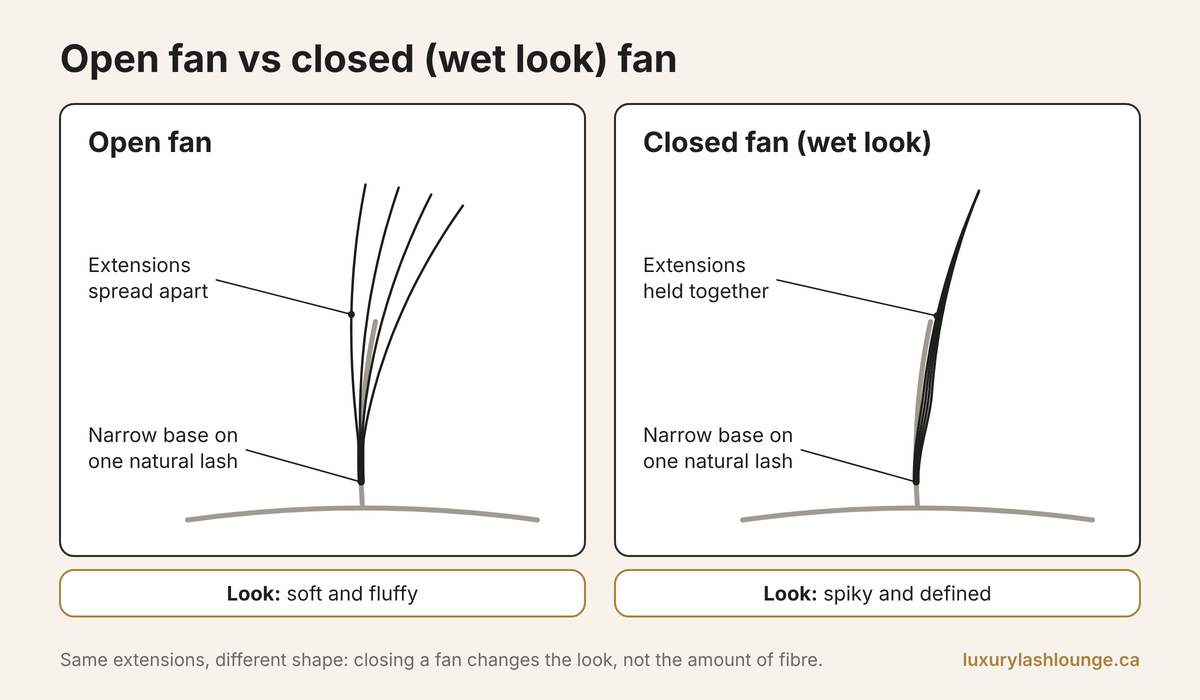
Closing a fan changes its shape, not how much fibre it holds. A closed fan carries the same amount of fibre as an open fan made from the same extensions.
How the fibres are grouped
You'll hear "spikes" for both wet and wispy sets. In a wet set, the spikes are usually the closed fans themselves, and they make up most of the lash line. In a wispy set, spikes are longer extensions placed every few millimetres above a softer base.
Methods vary by lash tech. Many make each closed fan by hand during the appointment, and some suppliers sell pre-made closed fans. Either way, each closed fan attaches to one isolated natural lash: the grouping happens inside the fan, and your natural lashes stay separate.
Mixing in open fans fills the lash line between spikes, so the set looks fuller. More open fans soften the effect; more closed fans make it crisper.
Thickness and curl in a wet set
Closed fans are commonly made from fine volume fibres, which typically run from 0.03 to 0.07 mm thick. Classic singles are thicker, and thicker fibres look bolder but weigh more. Sizes vary by manufacturer, so treat these as common ranges.
Curl decides how lifted the spikes look:
- C curl: Alessia describes it as giving a more natural look.
- D curl: in Alessia's words, the most popular curl with lash techs, a universal curl that looks good on everyone.
- A lifting curl such as L: commonly used to turn straight lashes upward, or to keep spikes visible on hooded eyes.
Our lash curl chart compares every common curl, thickness and length.
Lengths: which map a wet set sits on
There's no single wet set map. Wet sets are commonly built on another map, often natural or doll eye, using closed, spiky fans in place of open ones.
| Base map (example) | Lengths, inner to outer corner (mm) | Where the longest lashes sit | Wet set effect |
|---|---|---|---|
| Natural | 8, 9, 10, 11, 11, 10 | Follows your lash line, softly longer toward the outer third | Subtle, like your own lashes with fresh mascara |
| Doll eye (open eye) | 9, 10, 12, 12, 11, 10 | Centre of the eye, above the pupil | Rounder, more open eyes |
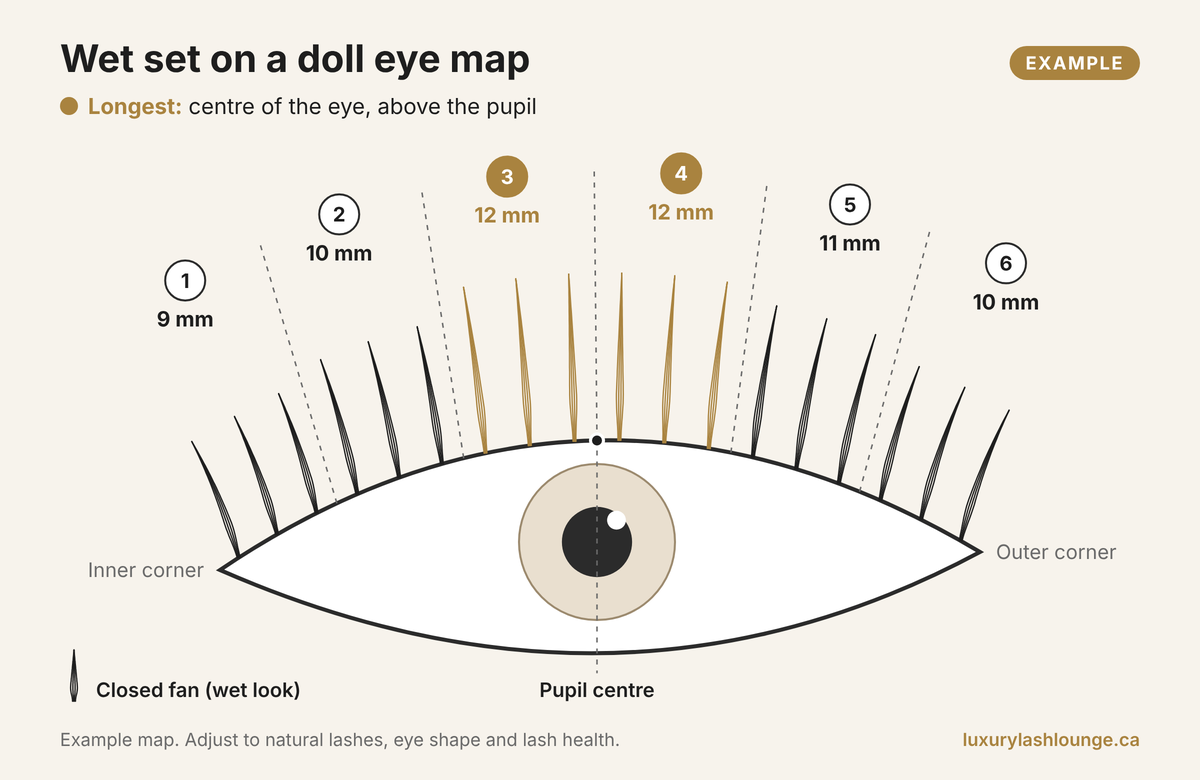
These maps are examples only. A lash tech adjusts every map to your natural lashes, eye shape and lash health, and the wet look can sit on other shapes too. Our lash map guide explains how lash techs plan zones and lengths.
Wet set vs wispy vs hybrid
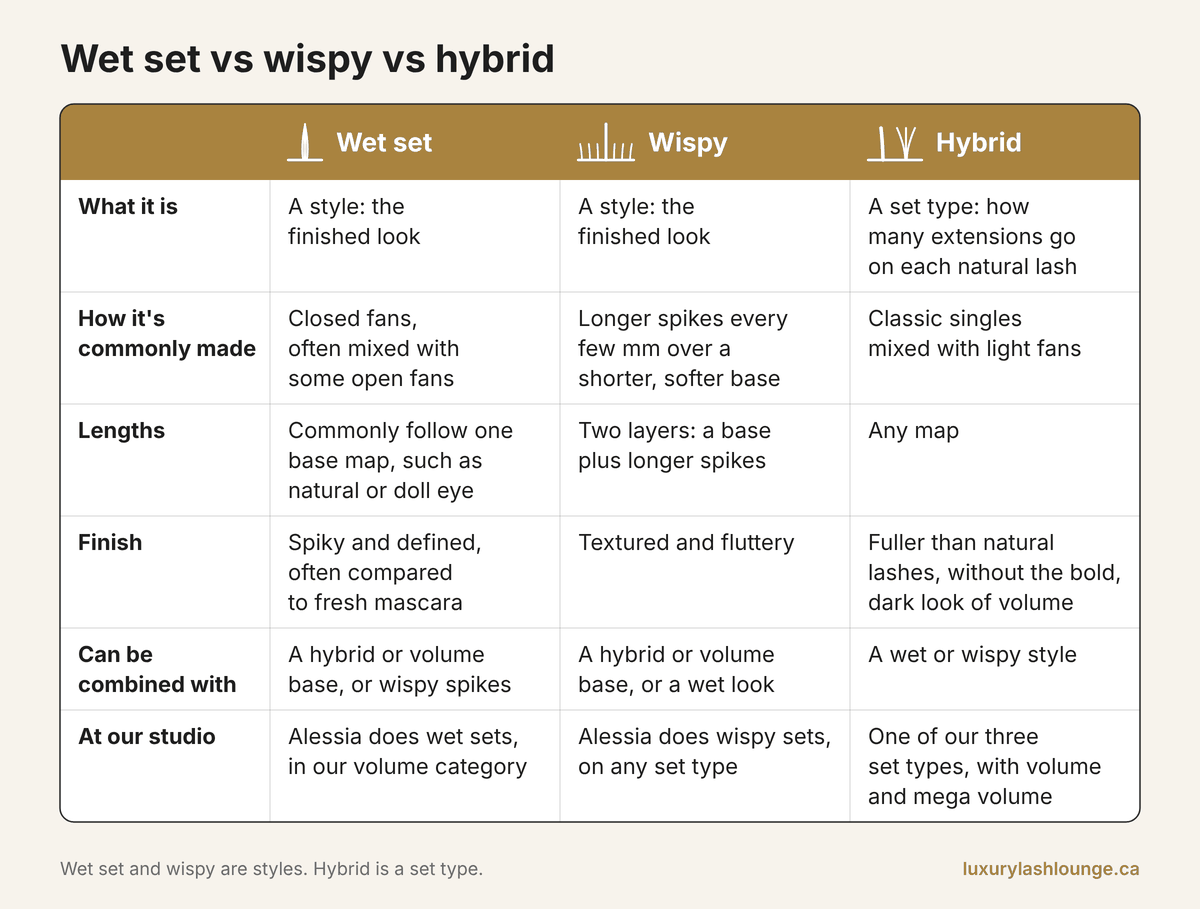
Wet and wispy are both styles, while hybrid is a set type, so the three aren't strict alternatives. A wet set looks spiky and defined, a wispy set looks textured and fluttery, and a hybrid set can carry either look.
| Wet set | Wispy | Hybrid | |
|---|---|---|---|
| What it is | A style: the finished look | A style: the finished look | A set type: how many extensions go on each natural lash |
| How it's commonly made | Closed fans, often mixed with some open fans | Longer spikes every few mm over a shorter, softer base | Classic singles mixed with light fans |
| Lengths | Commonly follow one base map, such as natural or doll eye | Two layers: a base plus longer spikes | Any map |
| Finish | Spiky and defined, often compared to fresh mascara | Textured and fluttery | Fuller than natural lashes, without the bold, dark look of volume |
| Can be combined with | A hybrid or volume base, or wispy spikes | A hybrid or volume base, or a wet look | A wet or wispy style |
| At our studio | Alessia does wet sets, in our volume category | Alessia does wispy sets, on any set type | One of our three set types, with volume and mega volume |
Wet set vs wispy
Wispy gets its texture from length; a wet set gets its texture from shape. That's the quickest way to tell them apart.
In a wispy set, longer spikes stand out every few millimetres above a shorter, softer base, so the line looks uneven on purpose. In a wet set, closed fans make up most of the line, and their lengths commonly follow the base map. The result looks grouped and defined rather than feathery.
The two can be combined: some lash techs add longer, wispy-style spikes to a wet set, a mix sometimes called a wet wispy set. For bases, spike placement and maps, read our guide to wispy lash extensions.
- Choose a wet set for defined, mascara-like lashes.
- Choose wispy for a soft, feathery line with visible spikes.
- Ask about a mix if you like both.
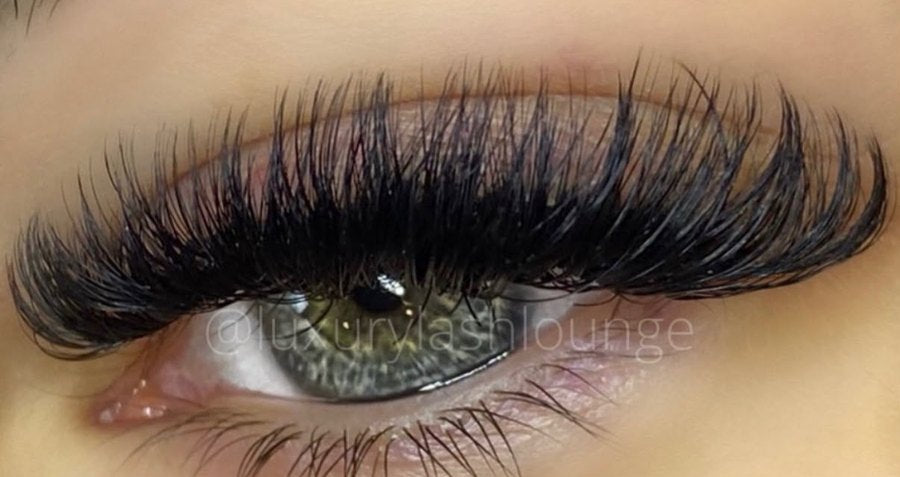
For contrast with the crisp, closed-fan look, the photo below shows soft, textured volume fans.
Wet set vs hybrid
This isn't a true either-or: hybrid describes how a set is built, mixing classic singles with light fans, while wet describes the finish. Many lash techs make a wet look on either base, but at our studio wet sets fall into the volume lash extensions category. If you like a hybrid but want more definition, ask about a wet set.
A hybrid wet set or a volume wet set?
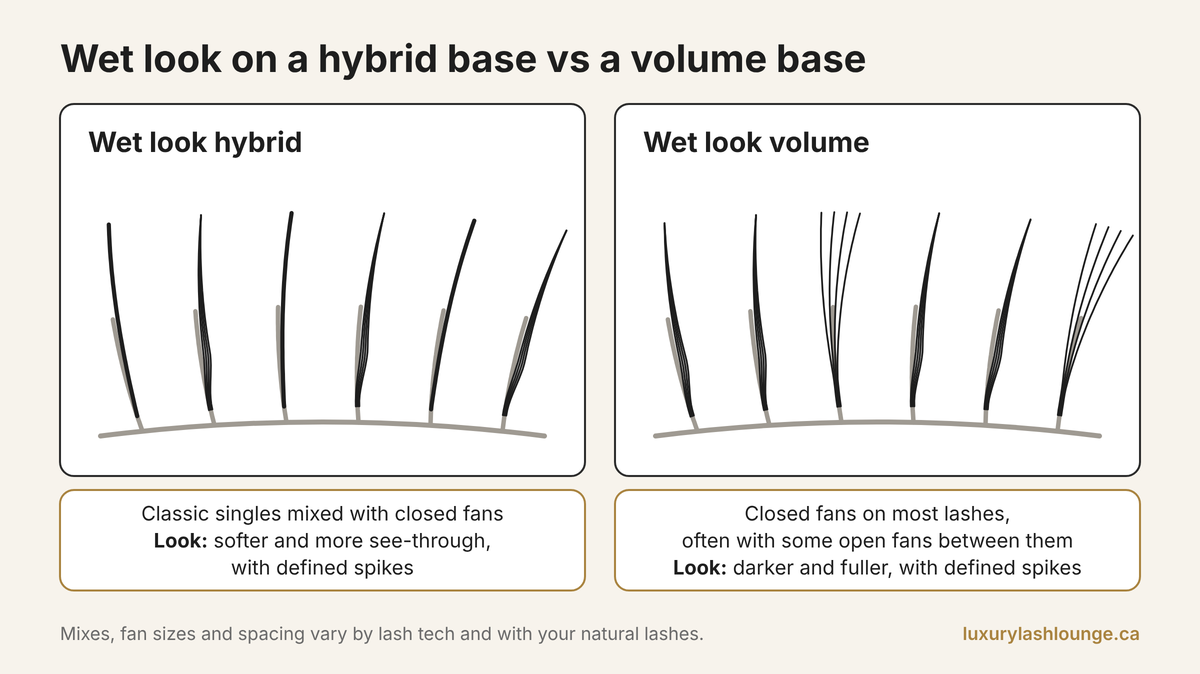
A wet set can sit on a hybrid base for a softer, more see-through result, or on a volume base for a darker, fuller one. So is a wet set hybrid or volume? In general it can be either, and the base decides how dramatic it looks; at our studio, wet sets fall into the volume category.
A hybrid wet set
A wet look hybrid commonly mixes classic singles with closed fans instead of open ones. The singles keep the line soft and see-through, and the closed fans add spiky definition.
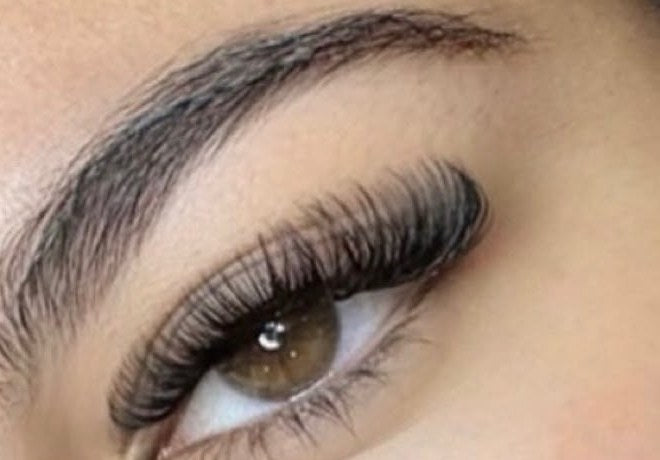
Below is a hybrid set by Alessia. A wet look hybrid commonly closes its light fans into spikes.
A volume wet set
A wet look volume set commonly puts closed fans on most natural lashes, often with some open fans between them for density. The result is a darker, fuller line with defined spikes: the bolder version of the wet look.
Closing the fans trades some of volume's fluff for definition: the more fans are closed, the spikier the set looks.
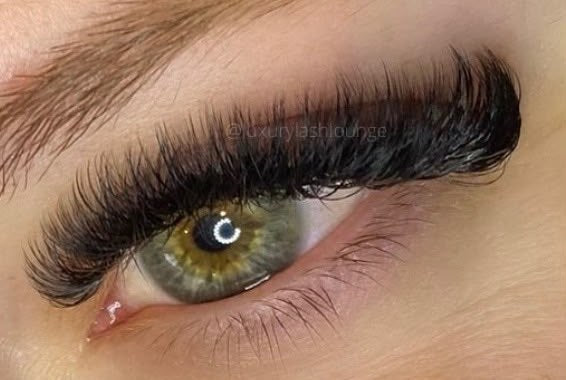
In a wet look volume set, most of those fans would be closed into spikes.
Who wet set lashes suit
Wet set lashes can suit most eye shapes, because the base map underneath can be adapted. What matters more is your natural lashes, and whether you like a defined, mascara-like finish.
Eye shape
Many lash techs use these starting points, though they vary by lash tech and with your natural lashes:
| Eye shape | Base map that often flatters a wet set | Use with care |
|---|---|---|
| Almond | Natural or doll eye | Few limits; let your natural lashes set the length |
| Round | Cat eye, to lengthen the eye | A doll eye base, which can make round eyes look rounder |
| Hooded | Doll eye, with a lifted curl such as D or L | Long outer corners that hide under the lid |
| Monolid | Doll eye, with a curl that lifts | Soft curls that point straight out and disappear |
| Downturned | Doll eye, or a map that peaks just inside the outer corner | Long, heavy outer corners that pull the eye down |
| Upturned | Natural or doll eye | A strong cat eye, which exaggerates the lift |
A doll eye base puts the longest lashes above the pupil to open the eye; our guide to doll eye lash extensions goes deeper. A cat eye base builds length toward the outer corner; see cat eye lash extensions.
Natural lash strength
Your natural lashes decide how much the set can carry:
- Strong, full lashes: most bases and lengths are possible.
- Fine or short lashes: closed fans of fewer, finer fibres and modest lengths keep the load down.
- Sparse or gappy lashes: spaced spikes can show the gaps, so many lash techs add open fans between the closed ones.
- Straight or downward-pointing lashes: a more lifted curl, such as D or L, helps turn the spikes into view.
Lifestyle
A wet set may suit you if you:
- like the look of mascara but would rather not apply and remove it every day
- prefer a defined, separated look to a soft, fluffy one
- are happy to wash and brush your lashes as part of your routine
If you want the softest, most blended finish, a fluffier style will probably suit you better.
When to skip extensions
EyeWiki, the American Academy of Ophthalmology's online eye encyclopedia, says people with existing eye disease or a history of allergy should avoid eyelash extensions. It suggests mascara, used properly, as a safer alternative. If that may be you, talk to your eye doctor before you book.
How long does a wet set last? Refills and upkeep
Like any set, a wet set's extensions stay on until their natural lashes shed, and the American Academy of Ophthalmology (AAO) says extensions typically last three to four weeks. Many lash techs suggest a refill every 2 to 3 weeks, and our guide to how long lash extensions last explains the growth cycle, refill timing and retention.
At our studio, at least 40% of your extensions must remain for a refill; less is charged as a full set. We don't refill another lash technician's work.
At our studio, wet sets fall into the volume category, so a wet set is priced as a volume set: $135 for a full set and $70 for a refill, in Canadian dollars (CAD), before HST. All our prices are on the lash extension services page.
Removals and patch tests are $20 each.
Aftercare for a wet set
Care for a wet set like any other set: keep it dry at first, wash it regularly and never rub or pull it. Here's the short version.
- First 24 to 48 hours: most lash techs ask you to keep your lashes dry and away from steam. EyeWiki advises against washing your face in the first few hours after application.
- Every day: Alessia recommends washing your lashes, ideally every day, with an oil-free cleanser. Our Lash Cleanser Kit is an oil-free foam made not to break down the adhesive bond.
- Brushing: once your lashes are fully dry, brush them into place with a clean lash spoolie.
- Hands off: the AAO warns that rubbing, tugging or pulling can fracture your natural lashes and even permanently damage the eyelash follicle.
- Mascara: Alessia tells clients they're free to wear mascara or eyeliner, since extensions are semi-permanent, but she highly recommends against it. In her experience, these products contain oils that break down the adhesive bond and will most likely make extensions shed prematurely.
Because the wet look already gives a mascara-like finish, you may not miss mascara at all. Our guide to mascara on lash extensions explains what to do if you still want it. For showers, swimming, saunas and sleep, see our full aftercare guide.
If your eyes react: don't remove the extensions yourself if you notice pain, redness, itching, swelling, discharge, light sensitivity or blurred vision. See an eye doctor promptly. For allergic reactions, the AAO says not to remove extensions or treat the reaction on your own, and to see an ophthalmologist immediately.
How to ask for a wet set at your consultation
To ask for wet set lashes, say "wet set" or "wet look", then show your lash tech two or three photos of the result you want.
What to bring and what to say
- Photos of wet sets you like, and one of a look you don't
- Whether you'd like a softer hybrid base or a fuller volume base
- How bold you want it: subtle for every day, or more dramatic
- Your routine: makeup habits, workouts and how you sleep
- Any past reaction or sensitivity to lash extensions, plus eye conditions or allergies
Questions to ask
- Which base map, curl and lengths would suit my eyes and natural lashes?
- Will you mix open fans with the closed ones?
- What training do you have in lash extensions, and can I see the glue's ingredient list?
- When should I book my first refill?
The AAO suggests asking about your lash tech's training, certification and experience, and checking the glue's ingredient list for allergens. Health Canada's eye cosmetics advice also says to make sure the person applying your extensions is a trained professional.
Before your appointment
- If you've reacted before: book a patch test first. At our studio it costs $20 and takes about 15 minutes. We place 5 to 10 short, natural lash extensions on each eye using our glue, plus the same hydrogel eye pad we use in all our lash treatments. Itching, stinging, burning or swelling within 24 hours may mean a sensitivity or allergy, so let us know.
- Timing: Alessia says appointments take around 1 hour, 1.5 hours at most, for full sets and refills.
- Preparation: lash techs commonly ask you to come without eye makeup, so your natural lashes can be cleaned and fully dried before the set.
- Another tech's lashes: outside removals are welcome. If you book a full set while wearing another technician's lashes, you must book a removal with it.
How to book
Text or call 647-533-7202, send a DM to @luxurylashlounge on Instagram, email luxurylashloungevaughan@gmail.com, or use the form on our contact page. We're a private, appointment-only studio at 118 Pioneer Ln, Woodbridge, and we need at least 24 hours' notice to cancel.
For lash techs: building a wet set
A wet set follows the same rules as any volume work: clean prep, one fan per isolated natural lash, and a weight that lash can carry. Only the fan's shape changes. This section describes common practice in general terms; the technique itself is learned hands-on.
What you need
| You need | Its job in a wet set | From our shop |
|---|---|---|
| Fine volume fibres | Closed fans | Single length volume trays: 0.05 mm, C curl 8 to 12 mm, D curl 9 to 19 mm |
| A spread of lengths | Mapping and practice | Mixed length trays: 8 to 15 mm; 0.05 mm in C, CC, D and L curl; D curl also in 0.03 and 0.15 mm |
| Classic fibres | The singles in a wet look hybrid | 0.15 mm D curl mixed length trays |
| Fanning tweezer | Picks up fibres and forms narrow fans | Volume pick up and fanning tweezer: 90 degree tip for wide and narrow fans |
| Isolation tweezer | Separates one natural lash | Isolation tweezer: 45 degree tip |
| Adhesive | Bonds the base of each fan | EXTREME BOND: 5 ml, 0.5 to 1 second dry time |
| Spoolies and cleanser | Checking the set and prepping lashes | Lash spoolies (50 per pack) and the Lash Cleanser Kit |
Our trays are Korean PBT fibre, 16 rows each, and everything we sell is used on our own clients. For hybrid work, keep both 0.15 mm and 0.05 mm trays on hand. Compare every thickness and curl in our lash extension trays, and every grip and tip in our lash tweezers.
Cyanoacrylate glues cure on contact with surface moisture, as a 2018 review in Molecules explains. So room humidity can change how fast your glue sets, and EXTREME BOND works best at 50 to 70% humidity. It's for trained lash professionals only, as Health Canada requires for cyanoacrylate eyelash extension adhesives.
Building a wet set, step by step
- Consult and map. Choose a base map, often natural or doll eye, and plan where closed fans, open fans or singles go. Plan lengths with lash mapping stickers placed over gel eye pads or tape; never use stickers alone to hold down the lower lashes.
- Prep the natural lashes. Wash them with an oil-free foam cleanser and let them dry fully before you start, to help adhesive retention.
- Protect the eyes. Health Canada warns that lash extension glue may bond the eyelids instantly, and says the eyes must be protected and immobilized during application. Cover the lower lashes with gel eye pads.
- Make each closed fan. Pick up a few fine fibres with your fanning tweezer and keep them together instead of spreading them, with a narrow, neat base.
- Dip only the base. Work from a fresh drop of adhesive and dip only the base of the fan, as our EXTREME BOND instructions say. Keep adhesive off the skin.
- Isolate and attach. Isolate one natural lash with your isolation tweezer, then attach the closed fan to that lash alone.
- Build the pattern. Follow your map, adding open fans or singles where planned, and compare both eyes as you go.
- Check with a spoolie. Brush through to make sure no lashes are stuck together and every fan points the right way.
- Clear the fumes. In our studio, we use the Pink USB Lash Fan at the end of an appointment to clear glue fumes before the client opens their eyes.
Keeping closed fans light
Closing a fan doesn't make it lighter. Its weight depends on how many fibres it holds, how thick and long they are, and any adhesive it carries.
- Thickness adds up fast. As a rough calculation for round fibres of the same length and material, fibre grows with the square of the diameter. So a 0.07 mm fibre carries about twice the fibre of a 0.05 mm one.
- Length adds leverage. Natural eyelashes usually don't grow beyond 12 mm before falling out, according to StatPearls. The further an extension reaches past its natural lash, the more leverage it has on that lash.
- Overload has a cost. EyeWiki lists traction alopecia, where natural lashes are lost to the traction of synthetic lashes, among the complications of extensions. It notes this may further damage the follicles, resulting in stunted growth.
Common wet set problems and fixes
| Problem | Common cause | Fix |
|---|---|---|
| Spikes look clumpy, not crisp | Too many fibres in each fan, or too much adhesive | Use fewer fibres and a smaller drop, and dip only the base |
| Two natural lashes stuck together | Incomplete isolation | Re-isolate, then brush through to check each lash moves on its own |
| The set looks sparse or gappy | Too few fans between the spikes | Add open fans or classic singles between the closed fans |
| A choppy, uneven line | Inconsistent spacing or big jumps in length | Map spacing and lengths first, and compare both eyes |
| Spikes crossing or pointing different ways | Inconsistent placement angle | Check direction with a spoolie as you work |
| Natural lashes drooping under the set | Fans too heavy or too long | Go lighter, finer and shorter |
Hygiene between clients
Use a fresh spoolie and a fresh pair of gel eye pads for each client. York Region Public Health lists tweezers used to apply false eyelashes among the reusable instruments that are to be cleaned and disinfected after each use. Clean our tweezers, then disinfect them, and don't put them in an autoclave.
Practise before you work on clients
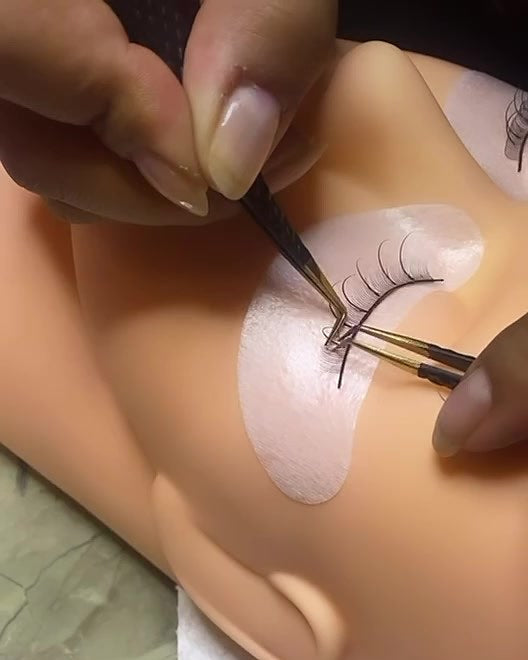
Practise closed fans on a mannequin head with practice strip lashes, which suit classic lashes, premade fans and volume fans. Fan making techniques, isolation, lash wrapping and placement, plus lash styling and mapping, are all part of our 1-on-1 Eyelash Extension Masterclass ($1,200).
Certified lash techs can focus on fan making or lash styling in the customized Lash Refresher ($550). Both are taught in person at our Woodbridge studio; see 1-on-1 lash training.
Frequently asked questions
What are wet set lashes?
Wet set lashes are lash extensions styled to look wet: dark, spiky and defined, like fresh mascara. Lash techs commonly create the look with closed fans, where a few fine extensions stay together so each fan reads as one spike. Wet is a style, not a set type, so it works on a hybrid or volume base. At our studio, wet sets fall into the volume category.
Is a wet set hybrid or volume?
In general it can be either: hybrid and volume are set types, while wet is a style that describes the finish. A wet look hybrid commonly mixes classic singles with closed fans for a softer, more see-through result, and a wet look volume set puts closed fans on most lashes for a darker, fuller line. At our studio, wet sets fall into the volume category.
Do wet sets look natural?
They can. A wet set on a natural map, with a C curl and modest lengths, can look like your own lashes with a coat of mascara. Longer lengths, a more lifted curl and a volume base look bolder, and the spiky finish looks more defined than a soft, fluffy set.
How long does a wet set lash last?
As long as any other set: each extension stays on until its natural lash sheds, and the American Academy of Ophthalmology says extensions typically last three to four weeks. Many lash techs suggest refills every 2 to 3 weeks, as our guide to how long lash extensions last explains. At our studio, at least 40% of your extensions must remain to count as a refill.
Can you get your lashes wet with a wet set?
Yes: "wet set" describes the look, not water, and washing is part of normal aftercare once the first 24 to 48 hours have passed. Alessia recommends washing your lashes ideally every day with an oil-free cleanser, and our lash extension aftercare guide covers showers, swimming and saunas.
How do you stop lashes getting wet in the shower?
For the first 24 to 48 hours, keep your face out of the spray, skip long, steamy showers and wash your hair with your head tilted back. After that you can shower as usual, then pat your lashes dry and brush them once they're dry, as our aftercare guide explains.
What happens if you use mascara on eyelash extensions?
Alessia tells clients they're free to wear mascara, since extensions are semi-permanent, but she highly recommends against it. In her experience, mascara contains oils that break down the adhesive bond and will most likely make extensions shed prematurely. A wet set already looks like fresh mascara, and our guide to mascara on lash extensions covers the rest.
What's the difference between wet set and wispy lashes?
A wispy set gets its texture from length: longer spikes sit every few millimetres above a shorter, softer base. A wet set gets its texture from shape: closed fans make the lashes look grouped and spiky, while their lengths commonly follow one map. The two can be combined, with longer, wispy-style spikes added to a wet set.
Which eye shapes suit a wet set?
Most eye shapes can wear one, because the base map does the shaping. Many lash techs choose a doll eye map to open up almond, hooded or monolid eyes, and a cat eye map to lengthen round eyes. Hooded eyes often need a lifted curl, such as D or L, so the spikes show above the fold.
Are wet sets heavier than other lash sets?
Not by default: a closed fan carries the same fibre as an open fan made from the same extensions. Weight comes from more fibres per fan, thicker fibres, longer lengths and extra adhesive. A trained lash tech matches each fan to what your natural lash can carry.
Can I get the wet look at home?
Not with lash extensions. Health Canada says cyanoacrylate adhesives for eyelash extensions must be sold for professional use only, and warns that lash extension glue may bond your eyelids instantly. "Wet look" strip lashes and clusters sold for home use are different products, so for a true wet set, book a trained lash tech.
About the author
Alessia Simonetta is the owner, master lash artist and certified lash trainer at Luxury Lash Lounge in Woodbridge (Vaughan), Ontario. She has been lashing since 2018 and holds 5 certifications: Classic Lash Artist, Hybrid Lash Artist, Volume Lash Artist, Mega Volume Artist and Certified Lash Trainer. She has worked with thousands of lash clients and trained hundreds of students.
Book a wet set with her through our lash extension services, or learn fan making and lash styling in 1-on-1 lash training.
Sources
- Health Canada. "Cosmetic Ingredient Hotlist: Prohibited and Restricted Ingredients" (cyanoacrylate-based adhesives entry: eyelash extension adhesives "must be sold for professional use only"). Date modified 2025-08-13. https://www.canada.ca/en/health-canada/services/consumer-product-safety/cosmetics/cosmetic-ingredient-hotlist-prohibited-restricted-ingredients/hotlist.html
- American Academy of Ophthalmology, EyeWiki. "Eyelash Extensions." Reviewed 10 May 2026 (Sweeney AR, MD); last edited 21 July 2026. https://eyewiki.aao.org/Eyelash_Extensions
- American Academy of Ophthalmology. Mukamal R, reviewed by Taylor RJ, MD. "Eyelash Extension Facts and Safety." 23 February 2018. https://www.aao.org/eye-health/tips-prevention/eyelash-extension-facts-safety
- Health Canada. "Eye cosmetics." Date modified 2016-12-05. https://www.canada.ca/en/health-canada/services/cosmetics/eye-cosmetics.html
- Duffy C, Zetterlund PB, Aldabbagh F. "Radical Polymerization of Alkyl 2-Cyanoacrylates." Molecules. 2018;23(2):465. https://www.mdpi.com/1420-3049/23/2/465
- Patel BC, Lopez MJ, Joos ZP. "Anatomy, Head and Neck: Eyelash." StatPearls (NCBI Bookshelf), updated 24 July 2023. https://www.ncbi.nlm.nih.gov/books/NBK537278/
- York Region Public Health. "Makeup Application, Eyelashes, and Eyebrows" (personal service settings fact sheet, undated). https://www.york.ca/resource/makeup-application